


How U.S. Companies Can Stay Compliant When Shipping Lithium Batteries in 2026
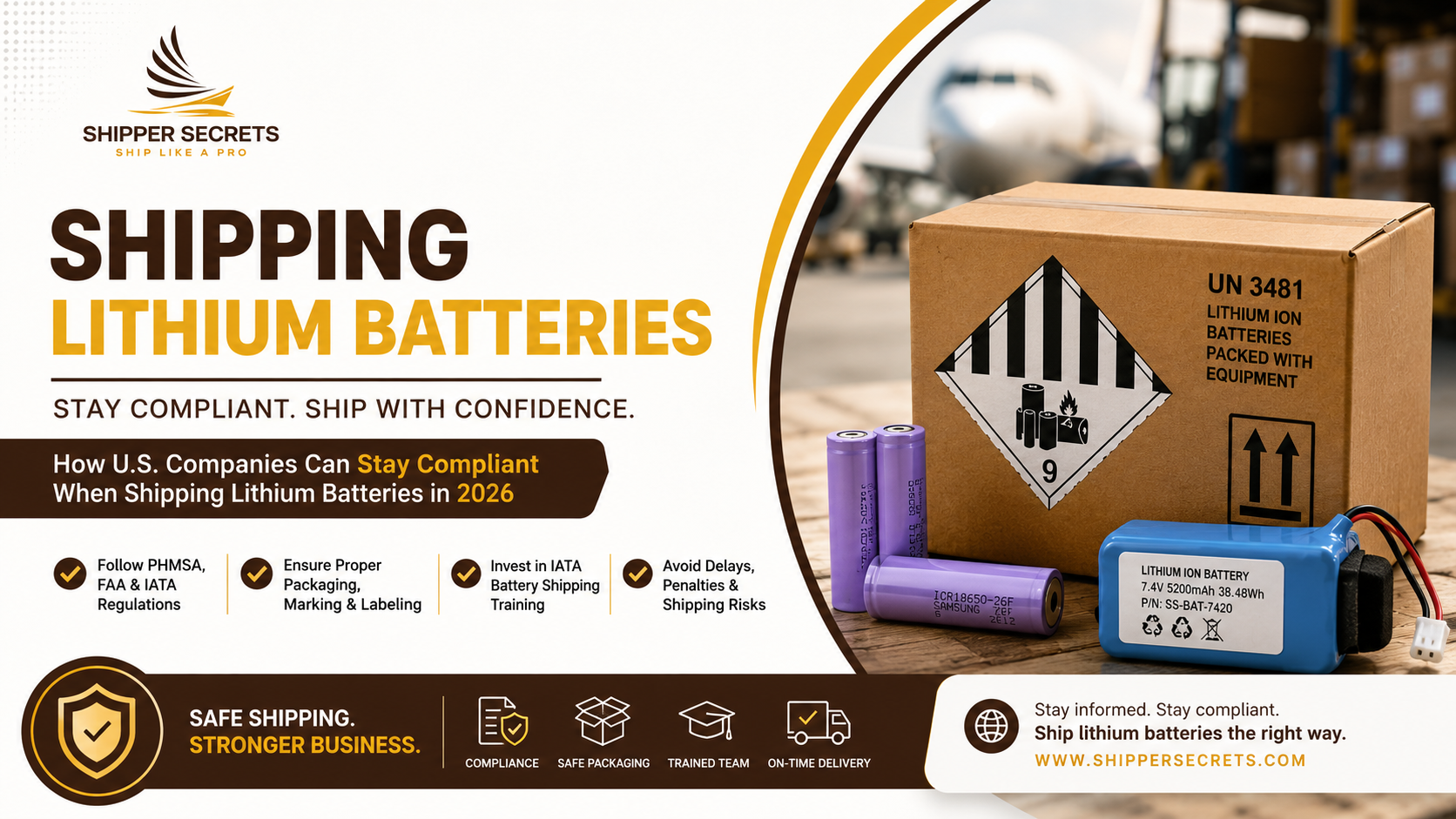
Shipping lithium batteries in 2026 requires careful attention to U.S. government rules, air transport guidance, and trained shipping teams. For companies that move electronics, devices, tools, or spare batteries, compliance is not optional; it is part of keeping products moving safely and avoiding shipment delays.
If your team needs practical support, Shipper Secrets provides training to help businesses understand lithium battery shipping requirements and apply them correctly in day-to-day operations.
Why lithium battery shipping is tightly regulated
Lithium batteries are treated as dangerous goods because damaged, improperly packed, or short-circuited batteries can overheat and create fire risks. The FAA explains that lithium batteries have a real safety impact on aircraft operations, and the agency maintains lithium battery resources to help reduce incidents.
PHMSA, the U.S. agency responsible for hazardous materials transportation, provides a Lithium Battery Guide for Shippers that breaks the rules down by battery type, size, and configuration. That guide is one of the most useful starting points for anyone handling shipping lithium batteries in the United States
Step 1: Classify your batteries correctly
Before any shipment moves, you must know exactly what you are shipping. PHMSA’s Lithium Battery Guide organizes requirements by battery chemistry, size, and configuration so shippers can quickly find what applies to them.
Key factors include:
-
Chemistry: Lithium ion (rechargeable) vs lithium metal (non‑rechargeable)
-
Capacity: Watt‑hour (Wh) rating for lithium ion, lithium content for lithium metal
-
Configuration: Batteries shipped alone, packed with equipment, or contained in equipment
Using PHMSA’s official shipping lithium batteries guide helps ensure you assign the correct UN number and apply the right packing instructions from the start
Step 2: Follow U.S. PHMSA packaging, marking, and labeling rules
Once your batteries are classified, PHMSA’s guide points to specific packaging, marking, and labeling requirements, which may vary depending on whether the shipment qualifies for exceptions or must fully comply with all hazmat provisions.
Typical compliance actions include:
-
Using tested packaging that protects against short circuit, movement, and damage in transit
-
Applying the lithium battery mark and appropriate hazard labels, including the correct UN number (for example, UN 3480 or UN 3481)
-
Ensuring packaging instructions and quantities per package match the applicable section of the HMR and, for air shipments, the IATA DGR
This packaging work forms the foundation of safe, compliant shipping lithium batteries in any mode.
Step 3: Align air shipments with FAA expectations
For air transport, the FAA provides a consolidated Lithium Battery Resources page, and an interactive guide to shipping lithium batteries, to support compliance with ICAO and IATA rules. These resources help shippers understand how U.S. enforcement aligns with international standards.
Key expectations for air shipments include:
-
Respecting SoC limits for lithium ion batteries, especially when packed with or contained in equipment.
-
Following IATA’s packing instructions for batteries alone, with equipment, or contained in equipment
-
Applying IATA’s operator variations where an airline imposes stricter conditions than the baseline DGR
Consulting the FAA’s interactive guide to shipping lithium batteries by air can support your internal procedures and training for air shipments.
Step 4: Invest in IATA battery shipping training
By 2026, IATA expects shippers, freight forwarders, and ground handlers to understand not just the DGR, but also specialized guidance for batteries. This makes IATA battery shipping training increasingly important for U.S. companies that routinely ship lithium batteries by air.
Effective IATA battery shipping training typically covers:
-
Battery-specific classification and identification
-
Application of IATA lithium battery shipping guidelines and packing instructions
-
Operator variations and airline-specific restrictions
-
Documentation, marks, and labels required by the IATA DGR
When paired with DOT-mandated hazmat training, this helps ensure your team can interpret and apply both U.S. and international requirements consistently.
Step 5: Build a 2026-ready lithium battery compliance checklist
To keep shipments moving smoothly, many U.S. companies formalize a lithium battery compliance checklist based on PHMSA, FAA, and IATA guidance.
A 2026-ready checklist might include:
-
Verify battery type, capacity, and configuration against PHMSA’s Lithium Battery Guide.
-
Confirm packaging meets both HMR and the applicable IATA DGR packing instructions for air shipments.
-
Ensure marks and labels (including UN numbers) are correctly applied and legible.
-
Check that SoC limits for lithium ion batteries are observed when required.
-
Confirm that hazmat employees have current DOT and IATA battery shipping training and that training records are maintained.
This approach turns complex regulations into a repeatable process for shipping lithium batteries safely and legally.
Practical compliance checklist
Before offering a lithium battery shipment, your team should confirm:
-
Is the battery lithium ion or lithium metal?
-
Is it shipped alone, with equipment, or contained in equipment?
-
Does the packaging match the applicable PHMSA requirements?
-
Are the correct marks, labels, and UN numbers on the package?
-
If the shipment is going by air, does it follow the latest IATA rules?
-
Has the team been trained on the current battery shipping process?
If the answer to any of these questions is unclear, the shipment should be reviewed before it leaves the facility.
How Shipper Secrets helps
Many businesses know the regulations exist, but they still struggle with the day-to-day execution. That is where Shipper Secrets provides training that can help your team understand shipping lithium batteries more clearly, reduce avoidable mistakes, and improve shipment readiness.
For companies that want a practical way to handle lithium battery compliance in the USA, training can be just as important as the regulation itself. With the right support, your team can ship faster, with fewer errors, and with more confidence.
Frequently Asked Questions
1. What are the key lithium battery shipping requirements in 2026?
In 2026, businesses shipping lithium batteries must comply with U.S. DOT (PHMSA) regulations and, for air transport, applicable IATA Dangerous Goods Regulations (DGR). Requirements may include proper classification, approved packaging, correct marking and labeling, documentation, and applicable state of charge (SoC) limits for certain air shipments.
2. Is training required to ship lithium batteries in the United States?
Yes. Under U.S. DOT hazardous materials regulations, employees who classify, package, mark, label, document, or prepare lithium battery shipments must receive appropriate hazmat training. For air shipments, IATA battery shipping training is also recommended to ensure compliance with international air transport requirements.
3. Can lithium batteries be shipped by air, ground, or sea?
Yes. Lithium batteries can be transported by air, highway, rail, and sea when they are packaged and prepared in accordance with the applicable regulations. The shipping requirements vary depending on the battery type, size, and whether the batteries are shipped alone, packed with equipment, or contained in equipment.
4. Which lithium batteries are prohibited from shipping?
Damaged, defective, or recalled lithium batteries are generally prohibited from normal transportation because they present a higher fire risk. Certain high-capacity batteries and specific battery configurations may also be subject to additional restrictions, particularly for air transport.
5. How can businesses ensure lithium battery shipping compliance?
Businesses can improve compliance by correctly identifying the battery type, using approved packaging, applying the required marks and labels, following PHMSA and IATA guidelines, and ensuring employees complete regular DOT and IATA lithium battery shipping training. Regular compliance reviews also help reduce shipping delays and regulatory violations.
Final Thoughts
Shipping lithium batteries in 2026 requires more than simply following a checklist; it demands a clear understanding of U.S. hazardous materials regulations, air transport requirements, and proper employee training. By classifying batteries correctly, using compliant packaging and labeling, following PHMSA, FAA, and IATA guidance, and keeping your team up to date with current training, businesses can reduce shipping delays, avoid costly penalties, and improve transportation safety.
At Shipper Secrets, we help businesses simplify lithium battery compliance through practical, industry-focused training designed for real-world shipping operations. Whether you're shipping occasionally or managing high-volume battery shipments, investing in the right knowledge today will help your organization remain compliant, efficient, and prepared for the evolving regulations of 2026 and beyond.
🚚 Stay Compliant. Ship with Confidence.
Don't let lithium battery shipping regulations slow down your business. Equip your team with the knowledge they need to meet DOT, PHMSA and FAA requirements while reducing costly shipping errors and delays.
Shipper Secrets offers practical, industry-focused lithium battery shipping training designed to help U.S. businesses stay compliant and keep shipments moving safely.
📞 Call Us: 708.275.8418
📍 Visit Us: 868 Cardiff Road, Naperville, IL 60565
Get started today and build a safer, more compliant shipping operation for 2026 and beyond.

 English
 Arabic
 French
 Spanish
 Deutsch
 Turkish
 Dutch
Dutch
 Italiano
 Russian
 Romaian
 Portuguese (Brazil)
 Greek
Greek