


10 Common Academic Writing Mistakes Students Should Avoid
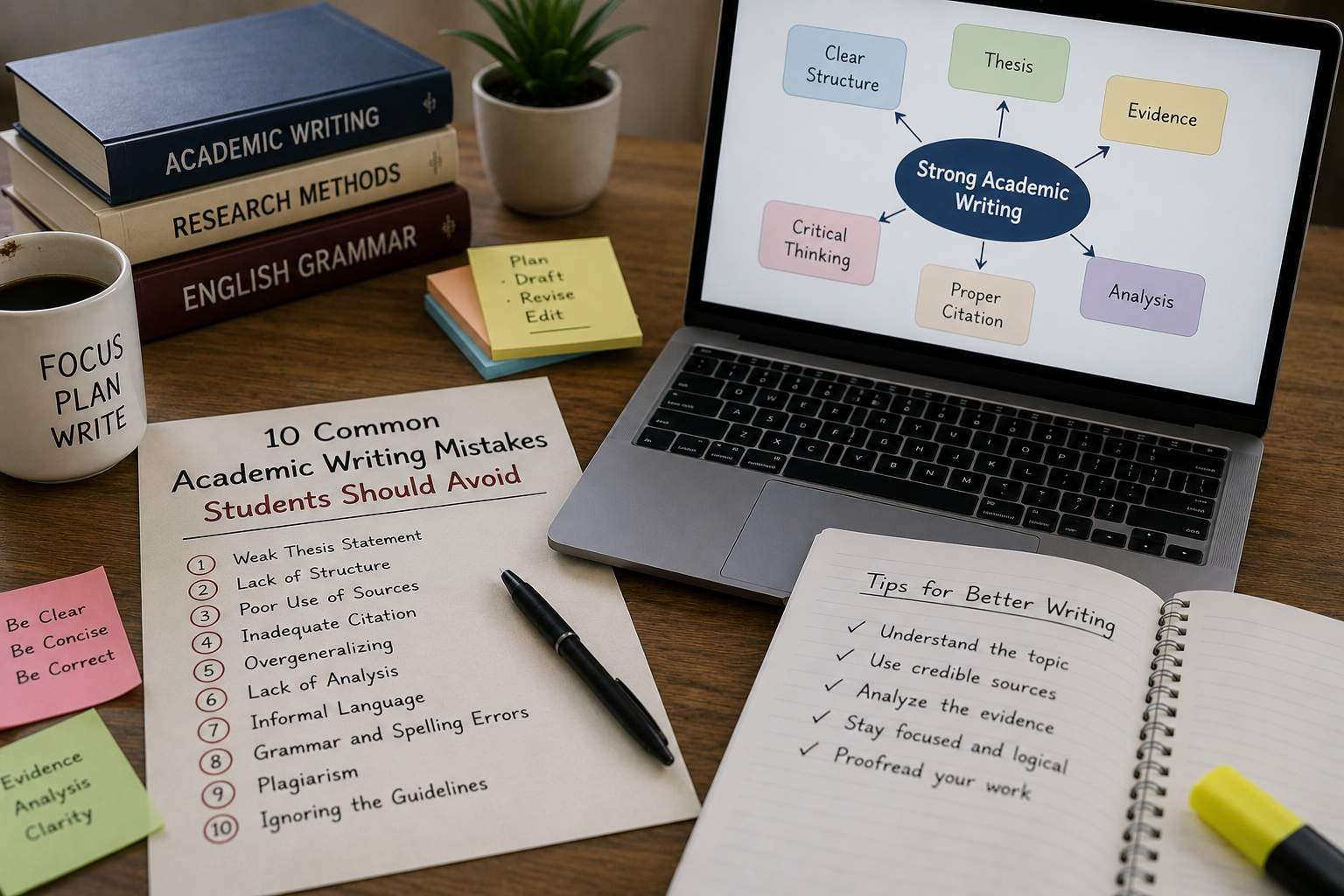
A brilliant argument can still earn a mediocre grade. It happens more often than students expect, and it rarely comes down to a lack of knowledge. Instead, it's usually a handful of recurring, avoidable mistakes that quietly chip away at an otherwise solid paper. Academic writing rewards precision, and even small missteps in structure, sourcing, or citation can undercut work that took hours to research.
The good news is that these mistakes follow predictable patterns. Once a student learns to recognize them, they become far easier to catch — often before an instructor ever sees the draft. This guide breaks down ten of the most common academic writing mistakes, why they happen, and exactly how to fix them.
What You'll Learn
-
The most frequent structural and research mistakes in student writing
-
Why these mistakes happen, even among strong students
-
Practical fixes you can apply during your next revision
-
Warning signs that a paper needs deeper editing, not just a proofread
1. Starting With a Vague or Unfocused Thesis Statement
A thesis statement that's too broad gives an entire paper nowhere solid to stand. Statements like "This paper will discuss climate change" describe a topic, not an argument. University instructors generally expect a thesis to state a specific, debatable position that the rest of the paper is built to defend.
Fix it: Narrow your thesis until it makes a claim someone could reasonably disagree with. Instead of announcing a topic, take a position on it.
2. Treating the Introduction as an Afterthought
Many students draft the introduction first and never revisit it, even after the argument evolves during writing. This often leaves a mismatch between what the introduction promises and what the paper actually delivers.
Fix it: Write or revise your introduction after finishing the first full draft, once you know exactly what your paper argues.
Actionable Takeaway
Compare your final conclusion to your introduction. If the ideas don't align closely, your introduction needs revising to match the argument you actually made.
3. Relying on Weak or Unreliable Sources
Not all sources carry the same academic weight, and this is one of the most common academic mistakes among first- and second-year students. Random blog posts, unverified websites, or outdated articles can weaken an otherwise strong argument, even if the writing itself is polished.
Academic best practices recommend prioritizing peer-reviewed journals, institutional publications, and material found through Google Scholar or your university's library database over general web searches.
Academic Sources vs Non-Academic Sources
|
Feature |
Academic Sources |
Non-Academic Sources |
|
Review Process |
Peer-reviewed by subject experts |
Rarely reviewed or fact-checked |
|
Authorship |
Identifiable, credentialed authors |
Often anonymous or unclear |
|
Evidence |
Backed by data and methodology |
Frequently opinion-based |
|
Longevity |
Stable, citable publication |
Can be edited or removed anytime |
|
Best Use |
Research papers, essays, dissertations |
General background reading only |
4. Overusing Direct Quotations Instead of Paraphrasing
Papers packed with long quotations can feel like a collection of other people's ideas rather than an original argument. While quotations have their place, especially for precise or primary-source material, over-reliance on them can suggest limited critical engagement with the research.
Fix it: Paraphrase most evidence in your own words, and reserve direct quotes for language that's genuinely difficult to rephrase without losing meaning.
5. Forgetting to Explain Why Evidence Matters
Dropping a statistic or quotation into a paragraph without explanation leaves the reader to make the connection themselves. Well-structured research improves an argument only when each piece of evidence is followed by analysis that ties it back to the thesis.
Fix it: After every citation, add at least one sentence explaining its relevance to your specific claim.
6. Inconsistent or Incomplete Citations
Missing citations, inconsistent formatting, or mismatched in-text and reference list entries are among the most common technical mistakes in student writing. Whether the required style is APA, MLA, Chicago, or Harvard referencing, consistency matters as much as accuracy.
This mistake carries real consequences. Incomplete citations can trigger plagiarism concerns through tools like Turnitin, even when the omission was accidental rather than intentional.
Actionable Takeaway
Build your reference list as you research, not after writing. Add each source the moment you use it, rather than trying to reconstruct citations from memory later.
7. Writing in an Overly Complicated Style
Some students assume that longer sentences and rarer vocabulary make writing sound more academic. In practice, this often does the opposite — it obscures the argument and makes the paper harder to follow. Clear, direct sentences that convey a strong idea are almost always more effective than dense ones that hide a weak one.
Fix it: Read your paragraphs aloud. If a sentence is hard to say clearly, it's likely hard to read clearly too.
8. Ignoring Counterarguments
Many student essays present only one side of an argument, which can make the paper feel incomplete or one-dimensional. Addressing a counterargument — and explaining why your position still holds — demonstrates critical thinking and strengthens rather than weakens your case.
Fix it: Include at least one paragraph that acknowledges an opposing view and responds to it directly, rather than ignoring it entirely.
9. Skipping Proper Proofreading and Editing
Editing and proofreading are often treated as the same step, but they serve different purposes. Editing addresses structure, clarity, and argument strength. Proofreading catches grammar, spelling, and formatting errors. Rushing through both in a single pass, especially close to a deadline, is one of the most common reasons strong research still results in a paper full of avoidable errors.
Fix it: Separate these into two distinct passes, ideally with time between them so you can review your work with fresh eyes.
10. Overdependence on AI Tools Without Critical Review
AI writing tools can genuinely help with brainstorming, outlining, or clarifying difficult concepts. The mistake happens when students use AI-generated text or explanations without verifying accuracy or applying their own critical thinking. Responsible AI usage means treating these tools as support for your process, not a replacement for your own analysis and understanding.
Most universities' academic integrity policies expect submitted work to reflect the student's own reasoning, so it's worth checking your specific institution's guidelines on AI use before relying on these tools heavily.
A Realistic Student Example
Consider a first-year international student writing an argumentative essay for the first time in a new academic system. Early drafts included a broad thesis, several unexplained statistics, and inconsistent citations, all common mistakes for someone adjusting to new academic expectations. After narrowing the thesis, adding analysis after each piece of evidence, and organizing references properly, the paper became noticeably more focused and easier to follow. None of these fixes required new research — just a more deliberate revision process.
Warning Signs Your Paper Needs Deeper Revision
Watch for these signals during your own review:
-
A thesis statement that could apply to almost any paper on the topic
-
Paragraphs where evidence outnumbers your own analysis
-
Sources you can't clearly explain the credibility of
-
Citations that don't match between the in-text reference and the bibliography
-
A paper that reads noticeably differently in tone from paragraph to paragraph, often a sign of unreviewed AI-assisted sections
-
No dedicated proofreading pass before submission
Left unaddressed, these issues can lead to lower grades, requests for revision, or in cases involving citation problems, academic integrity reviews.
Expert Tips to Avoid These Mistakes Going Forward
-
Outline before drafting so your structure is intentional, not improvised.
-
Track sources from the start of your research process, not the end.
-
Read sources critically, noting not just supporting evidence but also limitations or counterpoints.
-
Build in separate time for editing and proofreading rather than combining them.
-
Set a personal deadline a day or two before the actual due date, leaving room for a final review.
-
Use AI tools to support, not replace, your own critical analysis and writing process.
Frequently Asked Questions
1. What is the most common mistake students make in academic writing?
Weak thesis statements and unexplained evidence are among the most frequent issues, since they undermine the paper's argument even when the research itself is solid.
2. How can I fix a weak thesis statement?
Narrow it to a specific, debatable claim rather than a general topic description. A strong thesis should state a clear position the rest of the paper defends.
3. Why do citation mistakes matter if they're accidental?
Even unintentional citation errors can trigger plagiarism detection tools like Turnitin and raise academic integrity concerns, so accuracy and consistency matter regardless of intent.
4. Is it a mistake to use AI tools for academic writing?
Not inherently. AI tools can support brainstorming and editing, but relying on them without critical review or verification is considered a mistake and may conflict with academic integrity policies.
5. How much time should I spend on editing versus proofreading?
Both deserve dedicated time, but editing for structure and argument strength should generally happen before proofreading for grammar and formatting, since content changes can affect wording throughout the paper.
Final Thoughts
Most academic writing mistakes aren't caused by a lack of knowledge or effort — they come from rushed drafting, inconsistent habits, and skipped revision steps. Recognizing these ten patterns is the first step toward avoiding them. With a more deliberate research, drafting, and editing process, students can turn papers that are technically complete into ones that are genuinely persuasive and well-supported.

 English
 Arabic
 French
 Spanish
 Portuguese
 Deutsch
 Turkish
 Italiano
 Russian
 Romaian
 Portuguese (Brazil)
 Greek
Greek