


North America Hospital Logistics & Delivery Robots Market: Adoption Trends & Growth Outlook
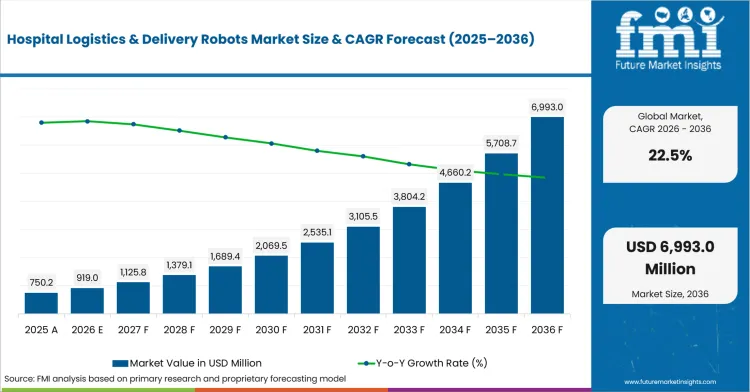
The global Hospital Logistics & Delivery Robots Market is expanding rapidly as hospitals increasingly deploy autonomous systems to transport medications, supplies, materials, and other items across complex healthcare facilities. According to Future Market Insights (FMI), the market is projected to grow from USD 919.0 million in 2026 to USD 6,993.0 million by 2036, registering a 22.5% CAGR during the forecast period.
👉 Get Detailed Market Forecasts, Competitive Benchmarking, and Pricing Trends: https://www.futuremarketinsights.com/reports/sample/rep-gb-34081
Market growth is being driven by hospital labor pressures, increasing demand for efficient internal transportation, the need to protect clinical staff time, and growing adoption of autonomous material movement. Hospitals are evaluating logistics robots as operational tools capable of handling predictable transport routes while allowing nurses and other clinical personnel to focus on patient-facing responsibilities.
The market is expected to create an absolute dollar opportunity of approximately USD 6.1 billion between 2026 and 2036. Adoption will increasingly depend on route density, hospital infrastructure, fleet management, elevator integration, access controls, security requirements, interoperability, and long-term deployment economics.
Key Hospital Logistics & Delivery Robots Market Highlights at a Glance
- Market Size (2026): USD 919.0 Million
- Forecast Market Size (2036): USD 6,993.0 Million
- Forecast Period: 2026–2036
- CAGR (2026–2036): 22.5%
- Absolute Dollar Opportunity: Approximately USD 6.1 Billion
- Leading Component: Hardware (56.0% Market Share in 2026)
- Leading Robot Type: Autonomous Tugs and Carts (44.0% Market Share in 2026)
- Leading Application: Medication Delivery (30.0% Market Share in 2026)
- Key Growth Areas: United States, China, South Korea, Japan, and Germany
- Key Companies: ST Engineering Aethon, Diligent Robotics, Swisslog Healthcare, Relay Robotics, and Panasonic
Analyst Viewpoint
"Hospital logistics robotics is increasingly being evaluated around defined transport workflows where predictable routes and repeatable demand can generate measurable operational value. The strongest opportunities arise when robots reduce routine walking and material-transfer workloads without disrupting clinical operations. As hospitals move toward autonomous internal logistics, vendors that combine dependable navigation, secure delivery, fleet management, infrastructure integration, and long-term operational support are expected to strengthen their position."
Why Is the Hospital Logistics & Delivery Robots Market Growing?
The growing need to improve hospital transportation efficiency is creating new opportunities for autonomous logistics and delivery robots.
Hospital staff can spend substantial amounts of time transporting medications, supplies, specimens, meals, and other materials between departments. Automating these repetitive routes can help reduce non-clinical workloads and preserve staff capacity for patient care.
Labor costs are strengthening the business case for automation. The American Hospital Association reported that United States hospital labor costs reached approximately USD 890 billion in 2024, representing 56% of total expenses. Rising workforce expenditure is encouraging hospitals to examine robotics for routine transport activities.
The American Hospital Association also reported that United States hospitals spent USD 51.1 billion on contract staff during 2023, further highlighting the importance of workforce optimization.
Key Growth Drivers
- Rising hospital labor costs.
- Increasing pressure on clinical staff capacity.
- Growing demand for efficient internal transportation.
- Increasing medication delivery requirements.
- Expansion of multi-campus hospital systems.
- Rising adoption of autonomous mobile robots.
- Increasing focus on secure and trackable material movement.
- Growing need to optimize hospital workflows.
Autonomous logistics robots can operate along established routes, communicate with elevators and access systems, and provide delivery records that improve visibility across internal hospital transportation.
👉 Access the Complete Report in PDF Format: https://www.futuremarketinsights.com/reports/brochure/rep-gb-34081
Which Component Leads the Hospital Logistics & Delivery Robots Market?
Hardware is projected to account for 56.0% of component demand in 2026, making it the leading component segment.
Sensors, batteries, navigation equipment, robotic drive systems, safety components, and secure transport compartments form the physical foundation of autonomous hospital logistics.
Hardware performance is particularly important in hospitals because robots must operate safely around patients, clinicians, visitors, beds, carts, and other equipment while maintaining reliable performance over extended operating hours.
Fleet software is also gaining importance as hospitals deploy multiple robots that must coordinate routes, elevators, priorities, charging schedules, and delivery tasks.
Why Do Autonomous Tugs and Carts Lead Robot Type Demand?
Autonomous tugs and carts are estimated to account for 44.0% of robot-type demand in 2026.
These systems are suited to repetitive transportation of heavier loads across established hospital corridors. They can connect loading areas, supply rooms, central services, and nursing units across multiple floors.
Their ability to move carts and materials without continuous human intervention makes them particularly relevant for hospitals seeking to automate predictable logistics routes.
Why Does Medication Delivery Dominate Application Demand?
Medication delivery is projected to hold 30.0% of application demand in 2026.
Medication transportation requires secure, trackable movement between pharmacies and patient-care areas. Autonomous delivery robots can support controlled routes while reducing routine transportation responsibilities for pharmacy and clinical staff.
Locked compartments, electronic access controls, and digital delivery records can further improve accountability and reduce uncertainty during medication handoffs.
How Are Logistics Robots Improving Hospital Operations?
Hospital robotics is increasingly shifting from individual delivery tasks toward integrated internal logistics management.
Robots can be deployed for medication delivery, supply transportation, specimen movement, and other repetitive workflows. When multiple robots operate simultaneously, fleet-management software can coordinate routes, elevator access, charging, and delivery priorities.
The value of automation therefore depends not only on robot performance but also on infrastructure readiness and workflow planning.
Hospitals must evaluate corridor layouts, elevator systems, security controls, charging locations, route volume, and integration requirements before large-scale deployment.
What Are the Latest Technology and Innovation Trends?
Innovation is reshaping the hospital logistics and delivery robotics industry.
Major trends include:
- Expansion of autonomous mobile robots.
- Increasing use of autonomous tugs and carts.
- Secure robotic medication delivery.
- Integration with hospital elevators and access controls.
- Growth of fleet-management software.
- Electronic delivery verification.
- Increasing use across multi-building hospital campuses.
- Integration of logistics and material-handling automation.
- Greater emphasis on infrastructure-compatible robotics.
Vendors are increasingly combining autonomous transportation with software and hospital workflow integration to support broader logistics automation rather than isolated robotic deliveries.
👉 Explore the Latest Healthcare Industry Analysis Now:
https://www.futuremarketinsights.com/industry-analysis/healthcare
What Are the Key Market Challenges and Restraints?
High deployment costs remain a major constraint for hospital logistics and delivery robotics.
Hospitals may need to invest in robots, fleet-management software, charging infrastructure, elevator integration, access-control systems, facility modifications, training, maintenance, and technical support.
Existing hospitals can present additional challenges because established buildings may have constrained renovation windows and complex corridor layouts.
Procurement teams must therefore evaluate route volume and infrastructure requirements alongside the purchase price of individual robots.
What Is the Regional Outlook?
The United States represents an important growth market because large health systems can distribute fleet software, integration, and service costs across multiple campuses.
China is expected to contribute to market development as newly constructed and modernized healthcare facilities increasingly incorporate digital infrastructure and automation.
South Korea is also developing opportunities for hospital robotics through advanced digital healthcare environments and technology adoption.
Japan has experience with controlled indoor transportation and places importance on compact robotic systems capable of operating within established hospital environments.
Germany represents another important market supported by established healthcare infrastructure and growing demand for labor-efficient hospital operations.
What Is the Competitive Landscape?
Competition is increasingly centered on autonomous navigation, payload capacity, secure delivery, fleet coordination, hospital-system integration, infrastructure compatibility, and long-term service support.
Leading companies are strengthening their market positions through autonomous transport platforms, medication delivery systems, mobile manipulation, fleet-management software, and integrated hospital automation contracts.
Key Companies
- ST Engineering Aethon
- Diligent Robotics
- Swisslog Healthcare
- Relay Robotics
- Panasonic
These companies are competing through autonomous transport, secure medication delivery, mobile manipulation, material handling, fleet software, and integrated hospital logistics solutions.
👉 Read Full Report: https://www.futuremarketinsights.com/reports/hospital-logistics-and-delivery-robots-market
Frequently Asked Questions
1. What is the projected size of the Hospital Logistics & Delivery Robots Market by 2036? The global market is projected to reach USD 6,993.0 million by 2036, increasing from USD 919.0 million in 2026.
2. What is the expected CAGR of the Hospital Logistics & Delivery Robots Market? The market is forecast to expand at a 22.5% CAGR between 2026 and 2036.
3. Which component leads the market? Hardware is projected to lead the component segment with 56.0% market share in 2026.
4. Which robot type dominates the market? Autonomous tugs and carts are estimated to hold 44.0% of robot-type demand in 2026.
5. Which application segment leads the market? Medication delivery is projected to account for 30.0% of application demand in 2026.
6. What factors are driving hospital logistics robotics adoption? Rising labor costs, clinical workforce pressure, demand for efficient internal transportation, medication delivery requirements, and growing hospital automation are key market drivers.
7. What is the major restraint affecting the market? High deployment costs, infrastructure integration requirements, facility constraints, maintenance expenses, and workflow implementation challenges remain important barriers to adoption.
Related Reports:
https://plaza.rakuten.co.jp/nk99fmi/diary/202608120002/
https://plaza.rakuten.co.jp/nk99fmi/diary/202608120003/
https://plaza.rakuten.co.jp/nk99fmi/diary/202608120004/
https://plaza.rakuten.co.jp/nk99fmi/diary/202608120005/
https://plaza.rakuten.co.jp/nk99fmi/diary/202608120006/
About Future Market Insights (FMI)
Future Market Insights (FMI) is a global market intelligence and consulting firm providing comprehensive market research, competitive intelligence, and strategic business insights across industries. The firm delivers detailed forecasts, technology analysis, and data-driven recommendations that support informed decision-making for manufacturers, investors, distributors, and policymakers worldwide.
For Press & Corporate Inquiries
Rahul Singh
AVP – Marketing and Growth Strategy
Future Market Insights, Inc.
+91 8600020075
For Sales – sales@futuremarketinsights.com
For Media – Rahul.singh@futuremarketinsights.com
For Web – https://www.futuremarketinsights.com

 English
 Arabic
 French
 Spanish
 Portuguese
 Deutsch
 Turkish
 Dutch
Dutch
 Italiano
 Russian
 Portuguese (Brazil)
 Greek
Greek