


The Art of Growth: A Deep Dive into the Minimalist World of Agar.io
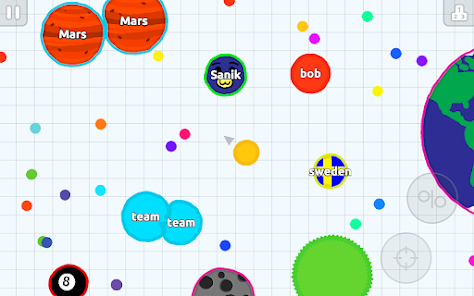
In the vast landscape of online gaming, where high-definition graphics and complex narratives often reign supreme, there is a subgenre that thrives on absolute simplicity. At the forefront of this movement is Agar.io, a browser-based phenomenon that turned the biological concept of cell growth into one of the most addictive competitive experiences of the last decade. Whether you play it during a quick work break or dedicate hours to climbing the leaderboard, Agario offers a unique psychological thrill that few other games can replicate.
Introduction: The Beauty of the Circle
When you first load into Agar.io, you are greeted by a grid-lined background reminiscent of a biology student’s graph paper. You are a small, colored circle—a cell. There is no tutorial, no complex backstory, and no elaborate control scheme. You move your mouse, and your cell follows.
The core premise is deceptively simple: eat or be eaten. By consuming small, stationary pellets scattered across the map, you grow in size. Once you are large enough, you can consume other players who are smaller than you. However, as you grow, you become slower, turning the game into a constant balancing act between power and mobility. It is this fundamental tension that makes Agar.io a masterclass in minimalist game design.
The Gameplay Experience: From Prey to Predator
The "life cycle" of a typical session in Agar.io is a journey through different tactical phases.
The Microscopic Phase
As a newcomer to the map, you are essentially at the bottom of the food chain. Your primary goal is survival. At this stage, the game feels like a fast-paced "bullet hell" or avoidance game. You weave between massive giants that could swallow you without a second thought. Because you are small, you are incredibly agile, allowing you to duck behind "viruses"—green, spiked circles that provide a safe haven for small cells but cause large cells to explode into fragments.
The Mid-Tier Struggle
Once you have consumed enough pellets to reach a respectable size, the game shifts. You are no longer just avoiding others; you are hunting. This is where the mechanics of "splitting" and "ejecting mass" come into play. By pressing the spacebar, your cell splits into two equal halves, launching one forward at high speed. This is the primary way to capture smaller, faster players. However, splitting is a risk; it leaves you vulnerable to even larger predators who can now swallow your smaller fragments.
The Titan Phase
If you manage to break into the top ten leaderboard, Agar.io becomes a game of zone control and psychology. As a massive cell, you move with the weight of a planet. You can no longer chase small players effectively. Instead, you must corner them or use the "W" key to eject small amounts of mass, perhaps to bait a trap or to feed a virus to pop a rival giant. At this level, the screen is often filled with your own mass, and every movement is a calculated risk.
Essential Tips for Survival and Dominance
While the controls are simple, the strategy in Agar.io is deep. To move beyond being a mere snack for others, consider these tactical approaches:
-
Use the Edges and Corners: If you are being chased by a larger cell, head toward the corners of the map. While it might seem like you are trapping yourself, many large players are afraid to commit to a corner because it limits their movement. If they get too close, you can often use a well-timed split to jump past them.
-
The Virus Shield: Learn to love the green spiked circles. If you are small, you can hide inside them. If a giant cell is chasing you, you can "feed" the virus by pressing "W" toward it. After seven shots of mass, the virus will grow and launch a clone of itself at the enemy, potentially shattering their massive cell into dozens of tiny, edible pieces.
-
Don’t Be Afraid to Split: New players often try to stay as one large, "safe" circle. However, splitting is essential for speed. Being in two or four pieces allows you to cover more ground and collect pellets faster. Just ensure there isn't a predator nearby who is larger than your individual halves.
-
Observe the Momentum: In Agar.io, mass naturally decays over time. The larger you are, the faster you lose mass. This means you must stay active. If you see two giants fighting, stay close to the sidelines. When one inevitably splits or gets popped by a virus, there will be a "feeding frenzy" of ejected mass that can catapult a small player into the top ranks instantly.
The Social Phenomenon: Emergent Cooperation
One of the most fascinating aspects of Agar.io is the lack of a formal chat system. Players communicate through movement and the sharing of mass. You will often see "teaming" in Free-For-All modes, where two players feed each other to survive. While this is controversial among some purists, it adds a layer of social deduction to the game. Can you trust the cell that just gave you a bit of mass? Will they turn on you the moment you are vulnerable? These silent alliances make every round unpredictable.
The game also allows for personalization through "skins." By choosing specific usernames (like countries or popular memes), your cell takes on a unique appearance. This adds a layer of tribalism and personality to the grid, as "Earth" chases "Mars" or two rival countries battle for dominance in a digital petri dish.
Conclusion: Why We Keep Coming Back
Agar.io succeeds because it taps into a primal human instinct: the desire to grow and the fear of being consumed. It strips away the fluff of modern gaming and leaves us with a pure test of reflexes, spatial awareness, and risk assessment.
There is a certain Zen-like quality to the game. Even when you lose—even when a cell ten times your size engulfs you and sends you back to the beginning—the barrier to entry is so low that you immediately want to try again. You think to yourself, "Just one more try. This time, I’ll be the one on the leaderboard."
In a world of complex simulations, Agario reminds us that sometimes, all you need for a great game is a few circles, a grid, and the drive to be just a little bit bigger than everyone else. Whether you are a casual player looking to kill ten minutes or a competitive strategist aiming for the number one spot, the petri dish is waiting.

 English
 Arabic
 Spanish
 Portuguese
 Deutsch
 Turkish
 Dutch
Dutch
 Italiano
 Russian
 Romaian
 Portuguese (Brazil)
 Greek
Greek