


A Complete Guide to 1D and 2D Barcodes for Businesses
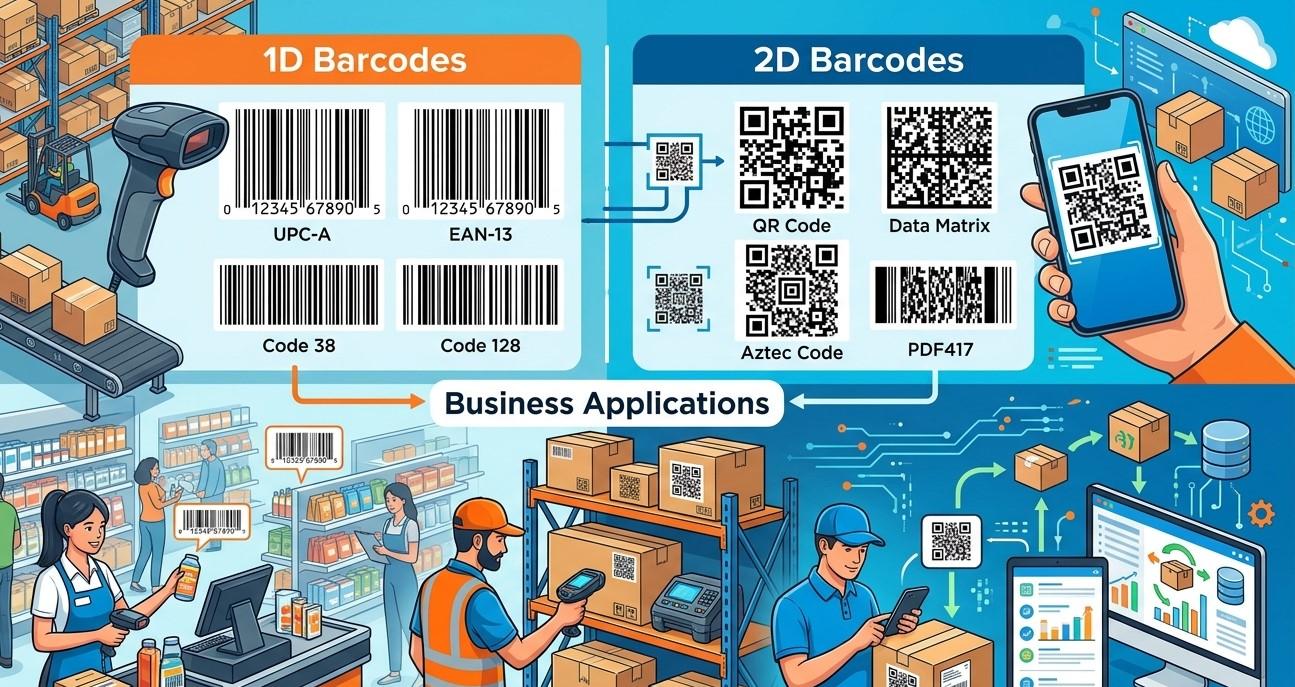
Barcodes have become an essential part of modern business operations. From retail checkout counters and warehouses to manufacturing facilities, healthcare organizations, logistics companies, and asset management systems, businesses use barcodes to identify products, track inventory, manage shipments, and improve operational accuracy.
As technology has evolved, businesses now have access to different types of barcode formats. The two broad categories are 1D barcodes and 2D barcodes. While both are designed to store and communicate information through machine-readable patterns, they differ significantly in how they store data, how much information they can contain, and where they are most useful.
Understanding these differences can help businesses select the right barcode technology for their specific requirements.
Pointus Solutions provides barcode and identification technologies for businesses across different industries. Organizations looking to Shop Barcode equipment can explore barcode scanners, printers, labels, and other Printing Products designed to support reliable product identification and data capture.
What Is a Barcode?
A barcode is a machine-readable representation of information. It uses a specific pattern that can be scanned by a compatible barcode reader or imaging device.
The information encoded in a barcode can include:
- Product numbers
- SKU numbers
- Serial numbers
- Inventory identifiers
- Shipment information
- Asset numbers
- URLs
- Batch information
- Other business data
When a barcode is scanned, the reader decodes the information and sends it to a connected computer, POS system, inventory platform, ERP system, or other business application.
Barcodes help businesses automate data capture and reduce the need for manual information entry.
What Are 1D Barcodes?
A 1D barcode, also known as a linear barcode, stores information using a series of parallel lines and spaces. Information is encoded horizontally across the barcode.
1D barcodes have been widely used for decades and remain extremely common in retail, warehousing, logistics, manufacturing, and inventory management.
Some of the most recognizable examples include UPC and EAN barcodes found on retail products.
Common Types of 1D Barcodes
Several 1D barcode formats are used for different applications.
UPC
Universal Product Code, or UPC, is widely used in retail environments. It is commonly associated with consumer products and point-of-sale systems.
EAN
European Article Number, commonly known as EAN, is another widely used retail barcode format. It is frequently found on products sold internationally.
Code 39
Code 39 can encode letters and numbers and is often used in manufacturing, industrial, and identification applications.
Code 128
Code 128 is a high-density barcode format capable of encoding a wide range of characters. It is commonly used in logistics, transportation, inventory management, and warehousing.
ITF-14
ITF-14 is commonly used for identifying shipping containers and cartons in supply chain environments.
Advantages of 1D Barcodes
1D barcodes continue to be popular because they offer several practical advantages.
Simple and Familiar
They are widely supported by existing barcode scanners, printers, and business software.
Cost-Effective
1D barcode systems can be economical for businesses that only need to encode basic identification information.
Easy to Print
They can be printed on many different label sizes and materials.
Suitable for Retail
UPC and EAN barcodes remain particularly useful for product identification and point-of-sale applications.
Reliable for Basic Identification
When a business only needs to identify an item using a product or SKU number, a 1D barcode can often provide everything required.
What Are 2D Barcodes?
A 2D barcode stores information in two dimensions rather than a single horizontal line. Instead of relying only on bars and spaces, 2D barcodes use patterns of squares, dots, or other geometric elements.
2D barcodes can store significantly more information than traditional 1D barcodes while often requiring less physical space.
Two widely known examples are QR Codes and Data Matrix codes.
Common Types of 2D Barcodes
QR Codes
QR codes are among the most recognizable 2D barcode formats. They can store information such as URLs, product details, contact information, identification data, and other digital content.
They are used in:
- Marketing
- Payments
- Product information
- Authentication
- Ticketing
- Customer engagement
- Inventory applications
Data Matrix
Data Matrix codes can store substantial amounts of information in a compact area. They are commonly used in manufacturing, electronics, healthcare, and other applications where space is limited.
PDF417
PDF417 is a stacked 2D barcode format that can store a large amount of data. It is used in applications such as transportation, identification documents, and logistics.
Advantages of 2D Barcodes
2D barcodes provide several benefits for businesses with more advanced data requirements.
Higher Data Capacity
A 2D barcode can store significantly more information than many traditional 1D barcodes.
Compact Design
Because information is encoded in two dimensions, a large amount of data can fit into a relatively small area.
Error Correction
Many 2D barcode formats include error-correction capabilities, allowing them to remain readable even when part of the code is damaged.
Digital Screen Scanning
Many modern 2D imagers can scan barcodes displayed on smartphones and tablets.
Versatile Applications
2D barcodes can support applications ranging from product identification and asset tracking to healthcare and manufacturing.
1D vs. 2D Barcodes: Key Differences
The main difference between the two is how information is stored.
| Feature | 1D Barcodes | 2D Barcodes |
|---|---|---|
| Data structure | Linear | Two-dimensional |
| Data capacity | Lower | Higher |
| Typical examples | UPC, EAN, Code 39, Code 128 | QR Code, Data Matrix, PDF417 |
| Space requirements | Usually wider | Can be more compact |
| Common applications | Retail, inventory, logistics | Manufacturing, healthcare, product information |
| Scanner requirement | 1D scanner or compatible imager | 2D imaging scanner |
| Error correction | Limited depending on format | Often available |
| Digital screen scanning | Limited | Commonly supported |
The best choice depends on the type and amount of information your business needs to encode.
When Should a Business Use 1D Barcodes?
A 1D barcode can be an excellent option when your business primarily needs simple product or item identification.
Consider 1D barcodes if:
- You only need to encode a product number or SKU.
- Your existing systems are based on UPC or EAN.
- You operate a traditional retail environment.
- Your labels have sufficient horizontal space.
- Your scanners already support 1D barcodes.
- Your information requirements are relatively simple.
For many retail and basic inventory applications, there may be no need to move to a more complex barcode format.
When Should a Business Use 2D Barcodes?
2D barcodes may be more appropriate when your business needs to store more information or use compact labels.
Consider 2D barcodes if:
- You need to store more information.
- Label space is limited.
- You need to encode serial or batch information.
- You need product traceability.
- You want to scan codes from mobile device screens.
- You need advanced identification capabilities.
- You expect your data requirements to increase.
Manufacturing, healthcare, electronics, logistics, and asset management operations can benefit from 2D barcode technology.
Barcode Scanners for 1D and 2D Barcodes
Choosing the correct barcode scanner is essential.
1D Scanners
Traditional laser scanners are generally designed for linear barcodes. They can be suitable for retail and other applications where 1D codes are the primary requirement.
2D Imagers
2D imaging scanners use camera-based technology to capture and decode both 1D and 2D barcodes.
They can also provide additional flexibility, such as reading barcodes from:
- Smartphones
- Tablets
- Computer screens
- Printed labels
- Different orientations
If a business expects to use both 1D and 2D barcodes, a 2D imaging scanner can provide greater flexibility.
Choosing the Right Barcode Printer
Barcode printing quality is critical regardless of whether you use 1D or 2D barcodes.
Businesses should consider:
- Print resolution
- Printing speed
- Label size
- Label material
- Printing volume
- Direct thermal or thermal transfer technology
- Connectivity
- Operating environment
For example, a warehouse printing thousands of durable inventory labels may require a different printer from a small retail store printing occasional product labels.
The Importance of Barcode Label Quality
A barcode is only useful if it can be scanned reliably.
Poor print quality can result from:
- Low print resolution
- Incorrect barcode dimensions
- Damaged labels
- Poor contrast
- Incorrect printer settings
- Unsuitable label material
- Improper label placement
Businesses should test barcode readability before deploying large quantities of labels.
Using compatible Printing Products, including appropriate labels and ribbons, can help maintain consistent print quality.
Applications of 1D and 2D Barcodes
Barcode technology can be applied across many industries.
Retail
1D barcodes such as UPC and EAN are widely used for product identification and point-of-sale transactions. 2D codes can also support product information, promotions, and digital customer experiences.
Warehousing
Both 1D and 2D barcodes can be used for products, storage locations, bins, cartons, pallets, and inventory management.
Manufacturing
Manufacturers can use barcodes to track raw materials, components, production batches, serial numbers, and finished products.
Healthcare
2D barcodes can be useful for medication identification, specimen tracking, patient information, and medical equipment management.
Logistics
Barcodes help identify packages, cartons, pallets, and shipments as they move through supply chains.
Asset Management
Businesses can use barcodes to identify computers, tools, equipment, machinery, and other assets.
How to Choose Between 1D and 2D Barcodes
A simple decision-making process can help.
Step 1: Determine the Information Required
If you only need a basic product identifier, 1D may be sufficient. If you need to encode more information, consider 2D.
Step 2: Evaluate Label Space
Limited space can make 2D barcodes more attractive because they can store more information in a compact area.
Step 3: Check Your Scanners
Make sure your existing scanners can read the barcode format you plan to use.
Step 4: Consider Future Requirements
Think about whether your business may need additional data or more advanced traceability in the future.
Step 5: Evaluate Your Software
The barcode format should be compatible with your inventory, ERP, POS, warehouse, or other business systems.
Common Mistakes Businesses Should Avoid
Businesses should avoid selecting barcode technology based only on popularity or price.
Common mistakes include:
- Choosing a barcode format without considering data requirements
- Using scanners that do not support the required barcode type
- Printing barcodes at inadequate resolution
- Ignoring label material
- Failing to test scanning performance
- Overlooking future business requirements
- Using inconsistent barcode identification standards
A complete barcode strategy should consider the barcode format, printer, scanner, software, labels, and business workflow together.
Final Thoughts
Both 1D and 2D barcodes provide valuable solutions for modern businesses. 1D barcodes remain an excellent choice for simple product and inventory identification, particularly in retail and traditional warehouse environments. 2D barcodes offer greater data capacity, compact formats, and additional flexibility for applications requiring more detailed information and traceability.
The right solution ultimately depends on your business requirements, label space, data needs, scanning equipment, software, and future plans.
If you are planning to Shop Barcode equipment, consider the complete barcode ecosystem rather than choosing a scanner or printer independently. The right combination of barcode technology, scanners, labels, printers, and other Printing Products can help improve accuracy, productivity, and operational visibility.
Pointus Solutions provides barcode and identification technologies for retail, warehousing, manufacturing, logistics, healthcare, and other industries. Whether your business needs traditional 1D barcodes or more advanced 2D solutions, selecting the appropriate technology can provide a strong foundation for efficient product identification, inventory management, and data capture.

 English
 Arabic
 French
 Spanish
 Portuguese
 Turkish
 Dutch
Dutch
 Italiano
 Russian
 Romaian
 Portuguese (Brazil)
 Greek
Greek