


The Strategic Role of SaaS in Insurance: From Legacy Systems to Intelligent Insurance Operations
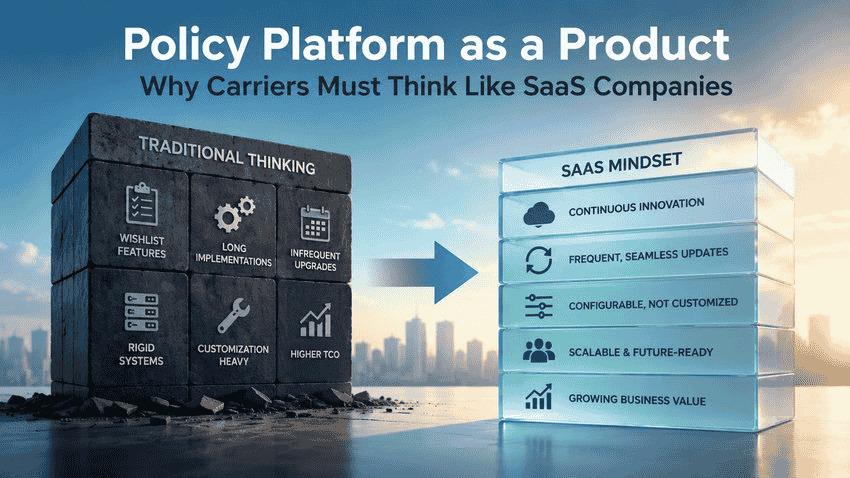
The insurance industry is entering an era where technology is becoming closely connected to underwriting performance, claims efficiency, customer experience, and risk management. For American insurers, SaaS in the insurance industry offers a practical path toward modernization without requiring every organization to replace its entire technology environment at once.
Software as a Service (SaaS) provides access to software through cloud infrastructure, with much of the application management handled by the technology provider. But the strategic value for insurers extends beyond hosting. Modern SaaS can connect applications, data, automation, analytics, and artificial intelligence (AI) into more flexible workflows.
The National Association of Insurance Commissioners (NAIC) recognizes technology and insurtech as forces affecting areas including risk assessment, product development, distribution, claims, and customer interaction.
Insurance Technology Is Moving Toward Modularity
Many established insurance companies operate complex technology stacks built over many years.
Core policy systems, claims applications, billing platforms, customer databases, and reporting tools may have been implemented at different times and for different business requirements.
This creates a common modernization challenge: replacing everything at once can be disruptive.
SaaS enables a different approach.
Insurers can introduce specialized cloud applications for selected functions and integrate them with existing technology. Over time, this can create a more modular architecture in which individual components can evolve without requiring the entire environment to be rebuilt.
This is an important strategic shift.
Modernization becomes a continuous process rather than a single massive technology project.
Underwriting Is Becoming More Data-Driven
Underwriting has always depended on data, but the volume and variety of available information continue to expand.
Depending on the insurance line, underwriters may evaluate applications, historical claims, property information, financial records, geographic characteristics, inspection reports, images, and third-party datasets.
A connected SaaS environment can make these sources easier to access within an underwriting workflow.
AI can add another layer of support by helping classify documents, summarize information, identify patterns, or prioritize cases for review.
The NAIC reports that insurers are using or exploring AI/ML applications across areas such as underwriting, pricing, claims, customer service, and fraud detection.
However, better technology does not eliminate the need for underwriting expertise. Instead, it can reduce administrative work and allow professionals to concentrate on complex risk decisions.
Claims Technology Can Move Beyond Basic Automation
Claims departments face a different but equally important challenge: managing large amounts of information quickly.
A claim may involve photographs, estimates, policy language, customer communications, repair records, adjuster notes, and other documentation.
SaaS platforms can help organize these elements within a unified workflow.
Automation can handle selected repetitive activities, while AI can assist with tasks such as document processing, image analysis, and fraud-related reviews.
The NAIC identifies claims as one of the insurance functions where AI applications are being developed and deployed.
This can help claims teams focus more attention on complicated cases and customer communication.
The objective should not be maximum automation. It should be better claims outcomes with appropriate human oversight.
SaaS Can Improve Collaboration Between Departments
Insurance organizations often struggle when important information remains trapped inside individual systems or departments.
Underwriting may have one view of a customer. Claims may have another. Customer service may rely on a separate application.
A modern SaaS ecosystem can help connect these workflows.
For example, information generated during a claim may become useful for future underwriting or risk analysis. Customer-service interactions may provide insights into recurring product or process problems.
When systems can share appropriate information, the organization can begin treating data as an enterprise asset instead of a collection of departmental records.
That creates an important opportunity for insurers seeking better operational visibility.
AI Makes Data Architecture Even More Important
AI adoption is accelerating, but AI quality depends heavily on data quality.
Deloitte's insurance technology research identifies data transformation, AI infrastructure, cloud modernization, and cybersecurity as important areas for insurers as they scale AI capabilities.
This creates a critical insight for SaaS buyers.
Before asking whether a platform includes AI, insurers should ask whether the platform can provide reliable access to governed data.
An AI-enabled application with incomplete, inconsistent, or poorly governed information may deliver limited value.
The strongest technology strategies therefore treat data architecture and AI strategy as connected priorities.
Customer Expectations Are Also Driving Change
Policyholders increasingly interact with financial and consumer services through digital channels.
They expect fast access to information, convenient communication, simple transactions, and visibility into ongoing processes.
SaaS platforms can support these expectations through customer portals, automated communications, digital workflows, and integrated service tools.
For insurers, the challenge is maintaining convenience without sacrificing security or regulatory compliance.
A smooth digital experience still needs strong identity management, data protection, and appropriate controls around sensitive information.
Third-Party Technology Creates New Risk
SaaS can simplify technology management, but it also creates dependencies on external providers.
An insurer may rely on a SaaS vendor for application availability, data storage, security controls, software updates, and technical support.
That makes vendor management an important component of technology strategy.
Insurance organizations should assess providers for:
- Cybersecurity practices
- Data protection
- Service availability
- Business continuity
- Disaster recovery
- Incident response
- Data portability
- Access controls
- Contractual responsibilities
- Regulatory requirements
This becomes particularly important when the SaaS provider supplies AI models or third-party data that could influence insurance processes.
Responsible AI Cannot Be Separated From SaaS
As SaaS platforms increasingly incorporate AI, insurers need governance processes that extend beyond traditional software procurement.
The NAIC's Model Bulletin on the Use of Artificial Intelligence Systems by Insurers emphasizes governance, risk management, accuracy, fairness, and compliance with applicable insurance laws.
For insurers, this means asking how automated outputs are produced, monitored, documented, and reviewed.
Human oversight remains especially important for decisions that can materially affect policyholders.
A responsible technology strategy should make it possible to understand where automation is being used and when human intervention is required.
Measuring the Business Value of SaaS
A common mistake is evaluating SaaS primarily through licensing costs.
Insurance executives should also measure operational outcomes.
Useful performance indicators can include:
- Time required to process an application
- Underwriter productivity
- Claims cycle time
- Customer response times
- Manual data-entry requirements
- System availability
- Integration performance
- Employee adoption
- Error rates
- Cost per transaction
These measures can help determine whether the platform is producing real business value.
A SaaS investment should ultimately answer a business question: What will the insurer be able to do better, faster, or more intelligently because of this technology?
The Future Is an Integrated Insurance Ecosystem
The future of SaaS in the insurance industry will likely involve increasingly connected technology rather than isolated cloud applications.
SaaS can provide flexible software delivery. APIs can connect systems. Data platforms can create broader visibility. AI can support analysis and automation. Human professionals can provide judgment and accountability.
Together, these capabilities can help insurers build more adaptable operating models.
For American insurance companies, the opportunity is not to eliminate legacy technology overnight. It is to create a measured modernization strategy that connects existing systems with new capabilities while maintaining security, governance, and regulatory discipline.
The insurers that gain the greatest advantage from SaaS may ultimately be those that treat cloud technology not as an IT upgrade, but as a foundation for faster decisions, stronger risk management, better customer experiences, and continuous innovation.

 Arabic
 French
 Spanish
 Portuguese
 Deutsch
 Turkish
 Dutch
Dutch
 Italiano
 Russian
 Romaian
 Portuguese (Brazil)
 Greek
Greek