


Bosch’s USD 225 Million CHIPS Award Signals Electronics Supply Investment as Automotive EMS Market Expands
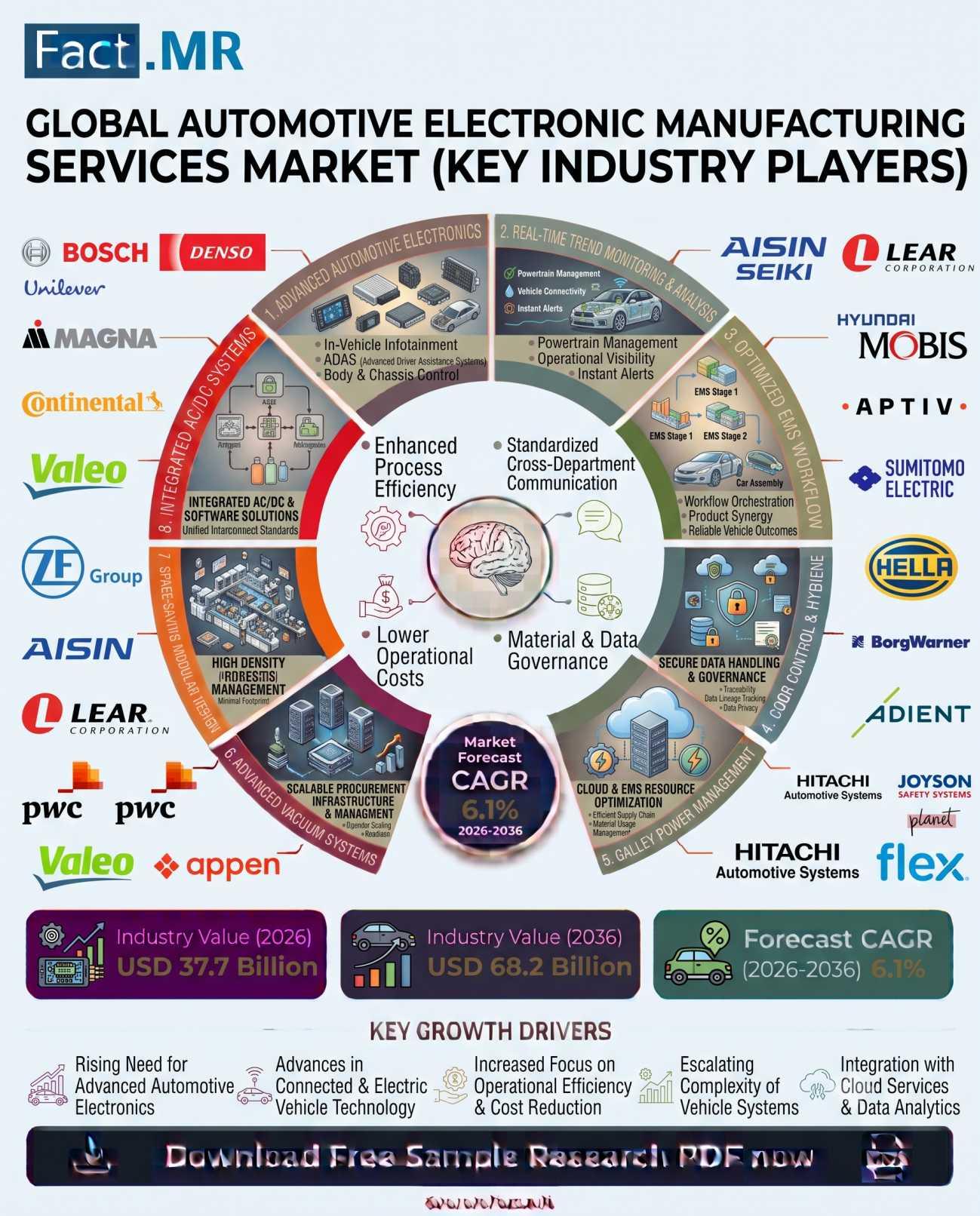
Bosch is set to receive up to USD 225 million in CHIPS incentives to support its planned USD 2.0 billion silicon carbide semiconductor facility in Roseville, California, strengthening the regional supply chain for automotive power electronics and related vehicle technologies.
The development comes as automakers increase electronics content across electric, hybrid, connected, and software-defined vehicle platforms. According to Fact.MR, the Automotive Electronic Manufacturing Services Market is projected to grow from USD 147.2 billion in 2026 to USD 410.5 billion by 2036, expanding at a 10.8% CAGR over the forecast period.
Get Detailed Market Forecasts, Competitive Benchmarking, and Pricing Trends: https://www.factmr.com/connectus/sample?flag=S&rep_id=4865
Automotive Electronics Moves Beyond Conventional Board Assembly
The shift toward electrified and software-managed vehicles is changing what automakers expect from electronics manufacturing partners. New vehicle programs increasingly combine electronic control units, sensors, displays, infotainment systems, safety modules, and power-control electronics within tighter development and production schedules.
The International Energy Agency reported that global electric car sales exceeded 17 million units in 2024, representing more than one-fifth of global car sales. As electric and hybrid platforms expand, EMS providers are increasingly involved in assembling and testing electronics used in battery systems, charging systems, powertrain controls, and connected cabin applications.
This creates a different competitive environment for EMS providers. Automotive customers need more than production capacity; they also require traceability, qualification records, testing capabilities, and the ability to manage engineering changes during vehicle launches.
The growing importance of silicon carbide supply also connects semiconductor localization with EMS demand. Greater regional availability of automotive-grade power components can help manufacturers build more resilient electronics supply chains, particularly for electrified platforms.
ECU Assemblies and Infotainment Lead Key Market Segments
Electronic Control Units are expected to remain the largest product category, accounting for 39.8% of the market in 2026. Powertrain, body, safety, and infotainment control units continue to require specialized assembly and testing as vehicle architectures become increasingly software-managed.
Audio and Infotainment is projected to represent 23.6% of application demand in 2026. Displays, connectivity systems, wireless modules, and processors are increasing the electronics workload inside vehicle cabins.
Original Equipment Manufacturers are expected to account for 68.2% of sales-channel demand in 2026, reflecting the importance of platform-level sourcing, validation, warranty requirements, and launch schedules.
The combination of higher electronic content and tighter qualification requirements means EMS providers are increasingly being evaluated on their ability to support an entire production-release process rather than simply assemble circuit boards.
Japan and the USA Show Strongest Country-Level Growth
Japan is projected to record the fastest growth among the profiled markets, with a 12.0% CAGR from 2026 to 2036. The country's automotive electronics ecosystem is supported by its semiconductor capabilities and growing focus on software-defined vehicle development.
The Mobility DX Strategy updated by Japan's Ministry of Economy, Trade and Industry and Ministry of Land, Infrastructure, Transport and Tourism in June 2025 maintained a target for Japanese software-defined vehicles to account for 30% of global SDV unit sales in both 2030 and 2035.
The USA follows with an estimated 11.3% CAGR through 2036. Electrified vehicle adoption and investment in domestic semiconductor capacity are expected to support demand for automotive electronics manufacturing services.
South Korea is forecast to grow at 9.6% CAGR, supported by its export-oriented automotive industry and increasing eco-friendly vehicle sales. The UK follows at 9.2% CAGR, while Germany is projected to advance at 8.5% CAGR.
Analyst Perspective
Shambhu Nath Jha, Principal Consultant at Fact.MR, said:
"Automotive EMS selection is shifting from board build price to release evidence. Suppliers are expected to win programs when they combine clean electronics assembly with traceable software, component and quality records. The next contest is expected to be fought around qualification speed and warranty protection."
The comment reflects a broader shift in automotive sourcing. As the number and complexity of electronic systems increase, manufacturing partners increasingly influence launch readiness, quality control, component traceability, and warranty exposure.
Market Snapshot
Market size in 2026: USD 147.2 billion
Projected market size by 2036: USD 410.5 billion
Forecast CAGR, 2026-2036: 10.8%
Electronic Control Unit share in 2026: 39.8%
Original Equipment Manufacturer share in 2026: 68.2%
Audio and Infotainment share in 2026: 23.6%
Absolute opportunity through 2036: USD 263.3 billion
Browse full Report: https://www.factmr.com/report/4865/automotive-electronic-manufacturing-services-market
The Automotive Electronic Manufacturing Services Market is expected to add USD 263.3 billion in market value between 2026 and 2036.
What's Driving Near-Term Demand?
Several developments are expected to shape EMS demand over the next few years.
Electrified vehicle platforms are increasing the number of power-control and charging-related electronics that require automotive-grade assembly and testing. Battery systems, charging systems, and electrified powertrain controls create additional opportunities for specialized manufacturing partners.
ECU consolidation is also changing the value of individual assemblies. Zonal and centralized architectures can reduce the number of separate modules while increasing the complexity and value of the remaining controllers. EMS providers that combine PCB assembly with firmware loading and end-of-line testing may be better positioned for these programs.
Infotainment and connectivity upgrades provide another source of demand. Displays, antennas, processors, and wireless modules require precise assembly and functional testing, particularly as automakers continue upgrading connected-cabin systems.
At the same time, automotive-grade qualification requirements remain a significant barrier. EMS providers must satisfy production approval, customer audits, testing requirements, and documentation standards before becoming part of a vehicle platform.
Recall exposure adds another layer of scrutiny. The National Highway Traffic Safety Administration reported that 997 safety recalls involving vehicles and vehicle equipment were issued in 2025, involving more than 29 million vehicles. For electronics suppliers, the ability to trace components and production records can therefore become an important part of customer selection.
Competitive Landscape
The competitive environment includes established electronics manufacturing companies with automotive production capabilities as well as broader automotive electronics ecosystem participants.
Jabil Inc., Flex Ltd., Sanmina Corporation, Kimball Electronics / Kimball Solutions, Zollner Elektronik AG, and Universal Scientific Industrial (USI) are among the key companies profiled in the market analysis.
Jabil and Flex have direct relevance to outsourced automotive electronics manufacturing, while Sanmina, Kimball Electronics, Zollner Elektronik, and USI contribute additional manufacturing, assembly, testing, and engineering capabilities.
The broader automotive electronics ecosystem also includes companies such as Bosch, Denso, Continental, ZF, Infineon, NXP, and Astemo. These companies should not all be treated as pure-play EMS competitors, as their roles extend across automotive systems, components, semiconductors, and vehicle technologies.
Automotive EMS Market: What the Report Covers
The Fact.MR analysis evaluates the market across Application, Product, Sales Channel, and Region.
By application, the report covers Audio and Infotainment, Powertrain, Safety Systems, Body and Comfort, Electric Vehicle and Hybrid Electric Vehicle, and Advanced Driver Assistance Systems.
By product, coverage includes Electronic Control Units, Sensors, Current Carrying Devices, and Displays and Human Machine Interface Components.
Sales-channel analysis covers Original Equipment Manufacturers, Tier 1 Suppliers, Direct Vehicle Manufacturers, and Aftermarket demand.
The regional assessment spans North America, Latin America, Europe, East Asia, South Asia and Pacific, and the Middle East and Africa, with detailed country analysis for the USA, UK, Germany, South Korea, and Japan.
Explore More Related Studies Published by Fact.MR Research:
https://www.openpr.com/news/4517185/hydrogen-fuel-cell-control-unit-platforms-for-vehicles-market
https://www.openpr.com/news/4517195/over-the-air-updatable-vehicle-control-unit-platforms-market
https://www.openpr.com/news/4573140/warehouse-digital-twin-orchestration-software-market
https://www.openpr.com/news/4573148/v2x-bidirectional-ev-chargers-is-estimated-to-reach-usd-1-03250
About the Report
The Automotive Electronic Manufacturing Services Market study evaluates outsourced and partner-supported manufacturing of vehicle electronic assemblies used across control, safety, comfort, connectivity, electrified powertrain, and cockpit systems.
The research incorporates more than 120 sources, 35 company portfolios, 25 countries, and 20 industry interviews. Primary research includes discussions with manufacturers, service providers, distributors, procurement teams, end users, and subject-matter experts. Desk research incorporates government statistics, regulatory publications, company filings, trade data, technical studies, industry associations, and public policy sources.
The report uses a hybrid top-down and bottom-up approach to estimate market size and forecast demand based on vehicle electronics content, ECU and sensor assembly demand, EV and hybrid platform growth, infotainment programs, safety electronics adoption, OEM sourcing behavior, aftermarket replacement requirements, and country-level adoption patterns.
Contact:
US Sales Office
11140 Rockville Pike
Suite 400
Rockville, MD 20852
United States
Tel: +1 (628) 251-1583, +353-1-4434-232
Email: sales@factmr.com
About Fact.MR
Fact.MR is a global market research and consulting firm, trusted by Fortune 500 companies and emerging businesses for reliable insights and strategic intelligence. With a presence across the U.S., UK, India, and Dubai, we deliver data-driven research and tailored consulting solutions across 30+ industries and 1,000+ markets. Backed by deep expertise and advanced analytics, Fact.MR helps organizations uncover opportunities, reduce risks, and make informed decisions for sustainable growth.

 English
 Arabic
 French
 Spanish
 Portuguese
 Deutsch
 Turkish
 Italiano
 Russian
 Romaian
 Portuguese (Brazil)
 Greek
Greek