


Malignant Ascites Market Forecast Highlights Innovation in Therapeutic Management
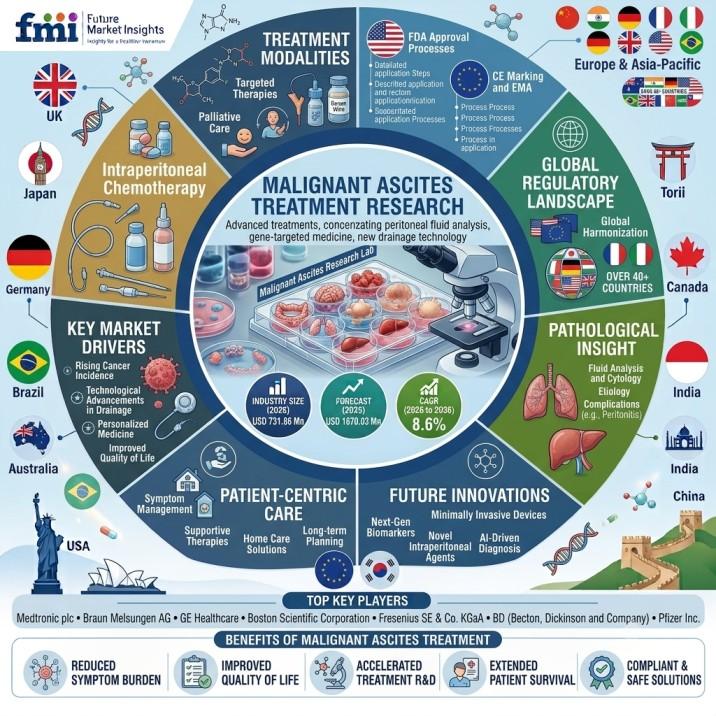
According to Future Market Insights (FMI), the global malignant ascites market is projected to grow from USD 731.86 million in 2026 to USD 1.67 billion by 2036, expanding at a 8.6% CAGR during the forecast period. The market was valued at USD 673.90 million in 2025, creating an incremental opportunity of approximately USD 938.17 million between 2026 and 2036.
The market is gaining momentum as longer survival among patients with metastatic cancers increases the cumulative need for ascites management. Paracentesis is expected to account for 32.6% of treatment type demand in 2026, while hospitals are projected to represent 29.6% of distribution channel demand.
👉 Get Detailed Market Forecasts, Competitive Benchmarking, and Pricing Trends:
https://www.futuremarketinsights.com/reports/sample/rep-gb-1658
Why Ascites Management Is Becoming More Important in Advanced Cancer Care
Malignant ascites develops when cancer affects the peritoneal cavity and causes fluid accumulation. As patients with advanced malignancies live longer, repeated fluid-management procedures can become an important component of supportive and palliative care.
Paracentesis remains a major treatment approach, particularly when rapid fluid removal is required. Its established clinical use and availability across hospital settings support its leading position in the treatment landscape.
At the same time, the use of indwelling tunneled peritoneal catheters is expanding the options available for patients who require recurrent drainage. These systems can support drainage outside conventional inpatient settings and align with the broader development of home-based palliative care pathways.
Growth in ambulatory surgical centers is also supporting the market. As catheter placement procedures increasingly move into outpatient environments, providers are evaluating ways to manage recurring malignant ascites while reducing dependence on repeated hospital visits.
"The primary commercial opportunity in malignant ascites is increasingly linked to the transition from episodic hospital paracentesis toward continuous home-based drainage through indwelling catheters," said Anurag Sharma, Principal Consultant at Future Market Insights. "As oncology and palliative care programs develop more standardized outpatient pathways, manufacturers with catheter-based drainage solutions can address changing requirements across cancer centers and home-care settings."
The shift toward ambulatory management is also creating opportunities for manufacturers to develop products that support easier placement, drainage, monitoring, and patient management.
Market Snapshot
· Global market size in 2025: USD 673.90 million.
· Global market size in 2026: USD 731.86 million.
· Global forecast for 2036: USD 1.67 billion.
· Global CAGR, 2026-2036: 8.6%.
· Incremental opportunity: USD 938.17 million.
· Paracentesis share in 2026: 32.6%.
· Hospitals share in 2026: 29.6%.
· China CAGR, 2026-2036: 11.6%.
· India CAGR, 2026-2036: 10.7%.
· Germany CAGR, 2026-2036: 9.9%.
· France CAGR, 2026-2036: 9.0%.
· UK CAGR, 2026-2036: 8.1%.
· USA CAGR, 2026-2036: 7.3%.
· Brazil CAGR, 2026-2036: 6.4%.
The malignant ascites market is forecast to increase from USD 731.86 million in 2026 to USD 1.67 billion by 2036, reflecting sustained demand for procedural and supportive management of cancer-associated fluid accumulation.
👉 Access the Complete Report in PDF Format:
https://www.futuremarketinsights.com/reports/brochure/rep-gb-1658
What's Driving Near-Term Demand?
The rising prevalence of cancer and the growing number of patients living with advanced-stage malignancies are supporting demand for malignant ascites management. Longer survival can increase the number of patients requiring repeated interventions during the course of their disease.
Home-based drainage is another important market development. Tunneled peritoneal catheters can provide an alternative to repeated large-volume paracentesis for selected patients requiring recurrent drainage. Their adoption is linked to the expansion of palliative care models that emphasize outpatient and home-based management.
The development of ambulatory surgical center capacity is also influencing treatment pathways. Catheter placement and related procedures can increasingly be incorporated into outpatient care models, potentially reducing reliance on inpatient resources.
Hospitals remain the largest distribution channel, accounting for 29.6% of market demand in 2026. Their role reflects the continued importance of hospital-based procedures, specialist oncology services, and multidisciplinary management of advanced cancer patients.
Where Are the Fastest-Growing Country Opportunities?
China is projected to record the highest CAGR among the countries assessed at 11.6% from 2026 to 2036, followed by India at 10.7%. Germany is expected to expand at 9.9%, while France is forecast to register a 9.0% CAGR.
The UK is projected to grow at 8.1%, followed by the USA at 7.3% and Brazil at 6.4%.
China and India represent important growth markets as oncology infrastructure expands and access to cancer treatment and supportive care improves. Mature markets such as the USA and Germany continue to provide demand through established cancer-care networks and procedural capacity.
The geographical outlook highlights the relationship between advanced cancer care, palliative treatment availability, and access to malignant ascites management procedures.
What Challenges Could Constrain Adoption?
Repeated procedures can place a significant burden on patients and healthcare providers. Frequent hospital visits for large-volume paracentesis can increase resource requirements, particularly for patients with recurrent fluid accumulation.
Product adoption can also be influenced by clinical pathway standardization. Hospitals and cancer centers need appropriate protocols for catheter placement, drainage management, infection prevention, and follow-up when introducing home-based drainage programs.
Reimbursement and access considerations may create additional differences between markets. The availability of specialist services, outpatient infrastructure, home-care support, and payment mechanisms can affect the pace at which newer drainage approaches are incorporated into routine care.
Manufacturers also face the requirement to demonstrate product reliability and usability across different clinical environments as healthcare providers evaluate alternatives to repeated hospital-based interventions.
Key Market Highlights at a Glance
· Paracentesis is projected to lead treatment types with a 32.6% share in 2026.
· Hospitals are expected to account for 29.6% of distribution channel demand.
· China is forecast to register an 11.6% CAGR through 2036.
· India is projected to expand at a 10.7% CAGR.
· Demand is supported by longer survival among patients with metastatic cancers.
· Tunneled peritoneal catheters are creating opportunities for home-based and ambulatory drainage.
· Growing ambulatory surgical center capacity is supporting outpatient catheter placement.
· Market development remains closely linked to palliative care pathways and procedural standardization.
Competitive Landscape
Competition in the malignant ascites market includes established medical device, healthcare technology, and pharmaceutical companies serving cancer-care and fluid-management requirements.
Key companies profiled in the Future Market Insights study include Medtronic plc, B. Braun Melsungen AG, GE HealthCare, Boston Scientific Corporation, Fresenius SE & Co. KGaA, BD (Becton, Dickinson and Company), and Pfizer Inc.
Market participants are focusing on product portfolios, procedural efficiency, catheter-based drainage technologies, and broader integration with oncology and palliative care pathways.
About the Report
The Malignant Ascites Market report by Future Market Insights examines market opportunities across treatment type and distribution channel, along with key country markets. The study evaluates demand for therapeutic interventions and medical devices used to manage malignant fluid accumulation associated with advanced-stage cancers.
The report provides market sizing and forecasts through 2036 and analyzes factors influencing adoption, including cancer prevalence, patient survival, procedural demand, ambulatory care expansion, home-based drainage, and palliative care pathway development.
Report Details:
· Market Value (2025): USD 673.90 million
· Market Value (2026): USD 731.86 million
· Forecast Value (2036): USD 1.67 billion
· CAGR (2026-2036): 8.6%
· Incremental Opportunity: USD 938.17 million
· Report Length: 250 pages
· Author: Anurag Sharma
· Starting Price: US$5,000
👉 Access Full Report: https://www.futuremarketinsights.com/reports/malignant-ascites-market
Related Reports:
About Future Market Insights (FMI)
Future Market Insights (FMI) is a global market intelligence and consulting firm providing comprehensive market research, competitive intelligence, and strategic business insights across industries. The firm delivers detailed forecasts, technology analysis, and data-driven recommendations that support informed decision-making for manufacturers, investors, distributors, and policymakers worldwide.
For Press & Corporate Inquiries
Rahul Singh
AVP – Marketing and Growth Strategy
Future Market Insights, Inc.
+91 8600020075
For Sales – sales@futuremarketinsights.com
For Media – Rahul.singh@futuremarketinsights.com
For Web – https://www.futuremarketinsights.com

 English
 Arabic
 French
 Spanish
 Portuguese
 Deutsch
 Dutch
Dutch
 Italiano
 Russian
 Romaian
 Portuguese (Brazil)
 Greek
Greek