


Mastering PK-Stat Reviews in Bioequivalence Studies: Bridging Data and Regulatory Success
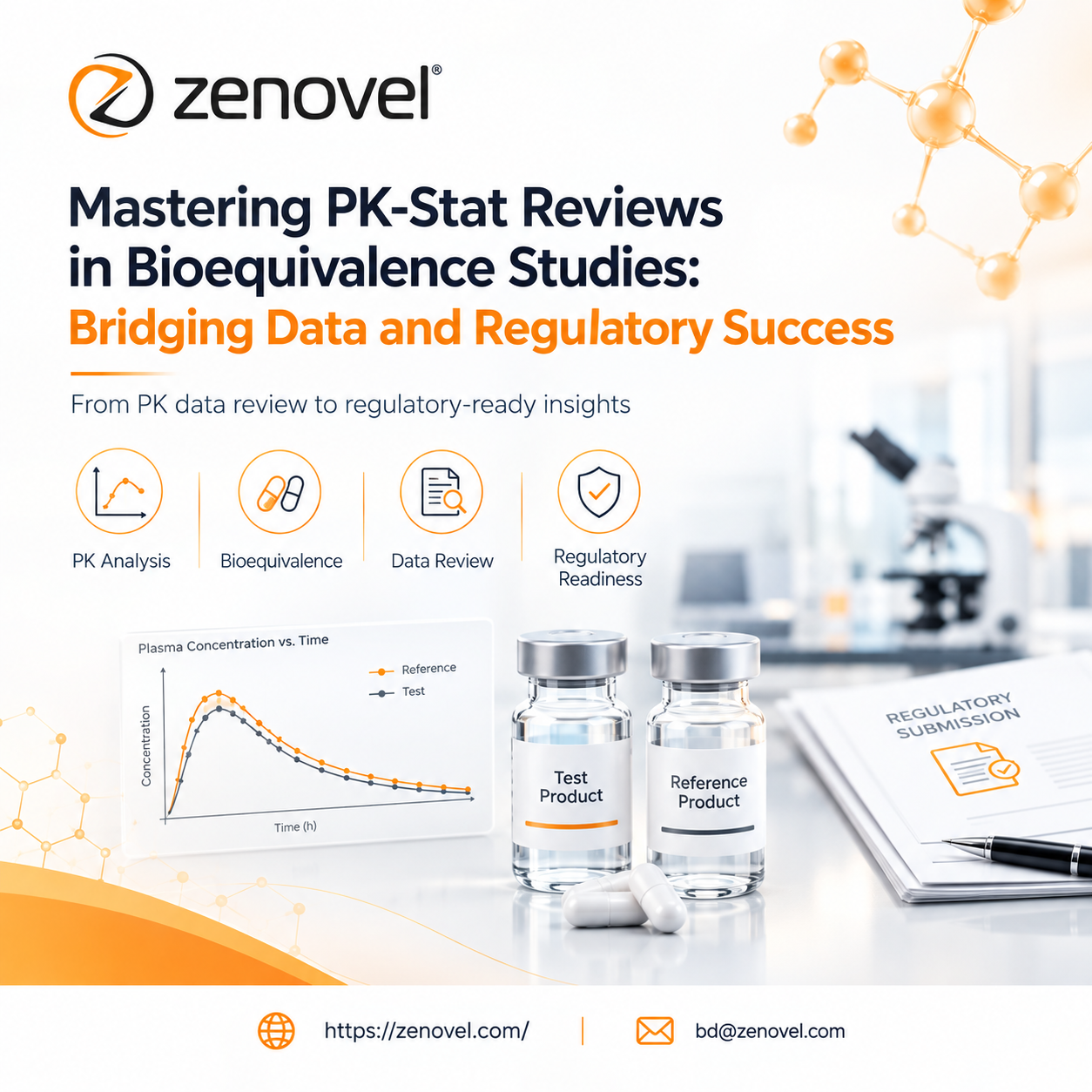
In the rigorous world of pharmaceutical development, proving that a generic or alternative formulation matches a brand-name reference product requires far more than just laboratory similarity. It demands undeniable mathematical and statistical proof. At the heart of this process lies the Pharmacokinetic-Statistical (PK-Stat) Review—the critical link that translates raw plasma concentration-time curves into persuasive regulatory evidence.
Whether preparing submissions for the US FDA, EMA, or CDSCO, sponsors must ensure their pharmacokinetic evaluations withstand intense regulatory scrutiny.
What is a PK-Stat Review?
A PK-Stat review involves the meticulous analysis, interpretation, and validation of pharmacokinetic data collected during clinical or bioequivalence (BE) trials. It bridges clinical pharmacology and biostatistics, ensuring that critical parameters such as maximum concentration ($C_{max}$), total drug exposure ($AUC$), time to peak concentration ($T_{max}$), and elimination half-life are calculated and interpreted without error.
Core Pillars of a Robust PK-Stat Evaluation
-
Non-Compartmental Analysis (NCA) Validation:
Executing NCA requires absolute precision. A thorough PK-Stat review guarantees accurate AUC calculations via linear-log trapezoidal methods, limits extrapolation percentages (typically keeping $AUC_{0-\infty}$ extrapolation under 20%), and correctly identifies the terminal elimination rate constant ($\lambda_z$).
-
Bioequivalence Testing via TOST:
The cornerstone of bioequivalence assessment is the Two One-Sided Tests (TOST) procedure. Analysts construct 90% confidence intervals for the ratio of geometric means between the Test (T) and Reference (R) products. For a successful outcome, these intervals must fall strictly within the conventional 80.00% to 125.00% acceptance range for both $C_{max}$ and $AUC$.
-
Handling Highly Variable Drugs (HVDs):
Some compounds exhibit high intra-subject variability ($CV\% > 30\%$), making standard bioequivalence criteria difficult to meet. Advanced PK-Stat protocols apply Reference-Scaled Average Bioequivalence (RSABE) methods, scaling acceptance limits dynamically based on the variability of the reference product.
-
Data Integrity and Outlier Management:
Raw data preprocessing must account for missing values, partial profiles, and statistical outliers. Ensuring strict ALCOA+ data integrity compliance during data handling prevents costly audit observations or trial rejections.
Navigating Common Pitfalls and For-Cause Investigations
Even well-designed trials can encounter unexpected failures, such as widened confidence intervals or anomalous subject dropouts. Expert PK-Stat reviews often involve for-cause investigations—correlating unexpected pharmacokinetic results with clinical conduct anomalies, bioanalytical deviations, or formulation inconsistencies to map out corrective paths or design superior follow-up studies.
Accelerating Approvals with Expert Support
Because regulatory agencies have zero tolerance for calculation errors or flawed statistical models, partnering with specialized biostatistical and pharmacokinetic experts is essential.
To streamline your bioequivalence pathways, guarantee compliance, and accelerate global regulatory submissions, explore the specialized PK-Stat and clinical research consulting services offered by Zenovel.

 Arabic
 French
 Spanish
 Portuguese
 Deutsch
 Turkish
 Dutch
Dutch
 Italiano
 Russian
 Romaian
 Portuguese (Brazil)
 Greek
Greek