


Taurine Market Forecast 2026 – 2036: Global Market to Reach USD 1,023.6 Million by 2036 at 7.2% CAGR
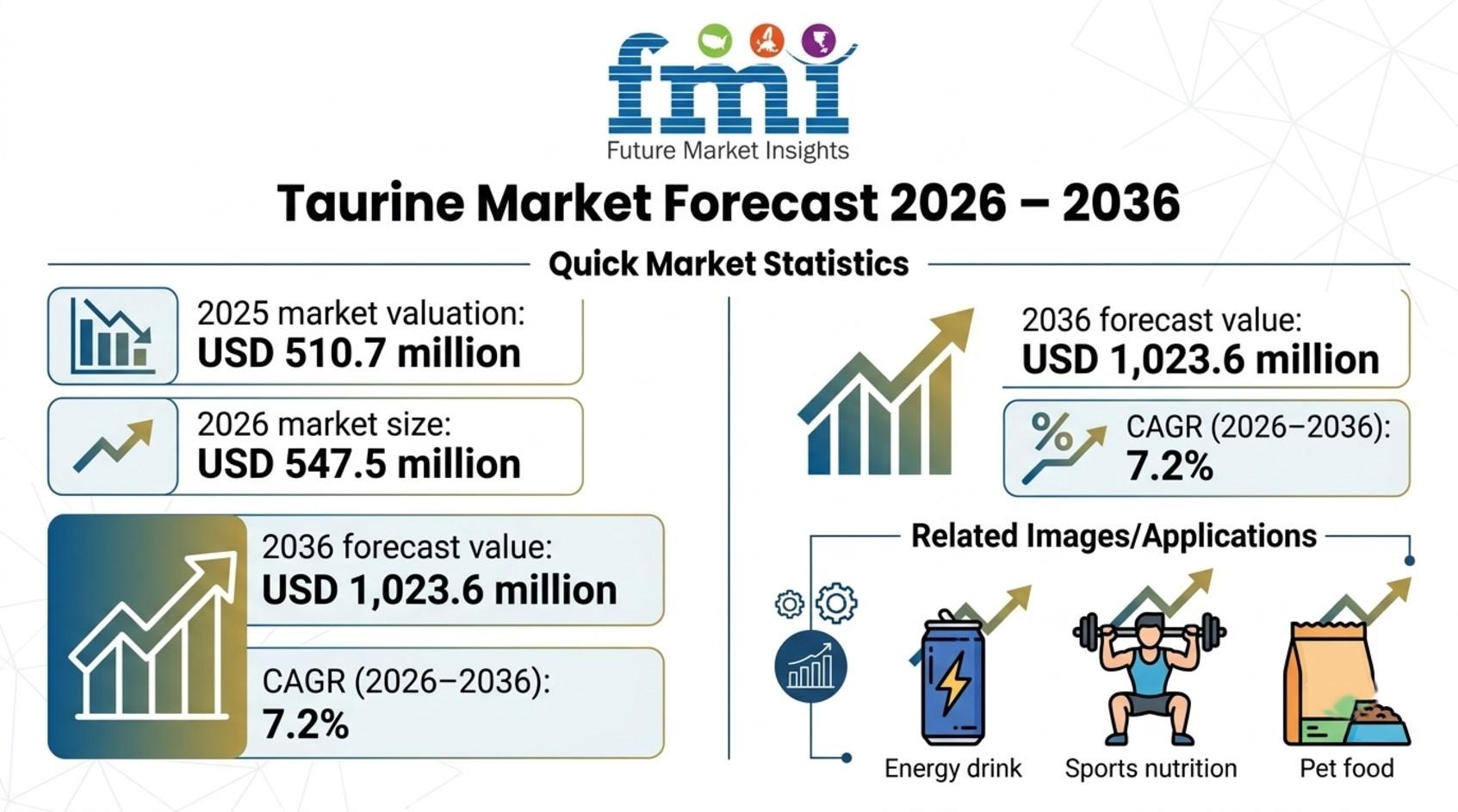
The global taurine market is entering a phase of steady, specification-driven expansion as beverage manufacturers, dietary supplement formulators, and pet nutrition producers transition from commodity ingredient buying toward auditable, high-purity sourcing. Valued at USD 510.7 million in 2025 and estimated at USD 547.5 million in 2026, the sector is projected to reach USD 1,023.6 million by 2036, according to the latest research insights by Future Market Insights (FMI). The forecast implies a 7.2% compound annual growth rate (CAGR) over the 2026–2036 assessment period, generating an incremental growth opportunity of USD 476.1 million. Growth momentum is anchored by the global expansion of functional energy drinks, strict feline dietary requirements in wet pet food, and rising consumer demand for targeted sports performance and metabolic wellness supplements.
Quick Market Statistics
· 2025 market valuation: USD 510.7 million
· 2026 market size: USD 547.5 million
· 2036 forecast value: USD 1,023.6 million
· CAGR (2026–2036): 7.2%
· Incremental opportunity: USD 476.1 million
· Synthetic taurine share of product category (2026): 70.0%
· Energy drinks share of application segment (2026): 55.0%
· Food & beverage manufacturers share of end-use demand (2026): 60.0%
· Food grade share of grade category (2026): 58.0%
· Powder share of form segment (2026): 72.0%
· Japan market forecast CAGR (2026–2036): 7.9%
· United States market forecast CAGR (2026–2036): 6.9%
Request a Sample Report: https://www.futuremarketinsights.com/reports/sample/rep-gb-2746
Market Growth Is Becoming a Dosage-Control and High-Purity Supply Story
A 7.2% CAGR reflects consistent commercial momentum across functional food, beverage, and feed processing. However, the overarching commercial catalyst is shifting toward specification-grade sourcing and supply-chain transparency.
Beverage formulators and supplement blenders face stringent label compliance thresholds and sensory hurdles. In functional energy drinks, taurine is included at significant concentrations often around 4,000 mg/L (approximately 1,000 mg per 250 ml can) to support alertness alongside caffeine and B-vitamins. Maintaining taste neutrality, rapid dissolution, and precise dosage uniformity across millions of cans requires high-purity, free-flowing crystalline powder. In parallel, contract manufacturers and multinational brands prioritize suppliers who provide comprehensive analytical documentation, batch-to-batch traceability, and heavy-metal screening to mitigate regulatory risk.
Synthetic Taurine Commands Product Category Leadership
Synthetic taurine is projected to account for 70.0% of the product segment in 2026, leading natural, animal-extracted, and bio-fermented alternatives.
The dominant position of synthetic taurine stems from industrial synthesis scalability (primarily via ethylene oxide or monoethanolamine routes) and cost discipline. Large-scale chemical synthesis guarantees consistent purity levels exceeding 98.5% to 99% without seasonal harvest variations. While natural taurine serves niche applications in specialized organic or bio-based supplements, synthetic taurine remains the indispensable workhorse for high-volume functional beverage bottling plants and commercial animal feed mills.
Energy Drinks Anchor High-Volume Application Demand
Energy drinks are expected to command 55.0% of total application demand in 2026, while food and beverage manufacturers account for 60.0% of end-use volume.
Taurine remains a foundational component of global energy drink recipes, valued for its cellular hydration, antioxidant, and ergogenic attributes. Furthermore, regulatory policies like sugar reduction levies (such as the UK Soft Drinks Industry Levy) are accelerating the launch of zero-sugar and functional refreshment lines. In these formulations, taurine helps preserve functional credibility without relying on high carbohydrate loads. Dietary supplements represent a strong secondary channel, where powder and capsule blenders incorporate taurine into pre-workout and longevity regimens.
Pet Nutrition Establishes a Critical Contract Floor
Beyond human beverages, companion animal nutrition provides an essential, non-discretionary volume baseline. Because cats cannot synthesize sufficient endogenous taurine, industry standards (such as European Pet Food Industry Federation / FEDIAF guidelines) mandate strict minimum inclusion levels typically requiring 2 to 2.5 times higher taurine concentrations in heat-processed wet canned foods compared to dry kibble to compensate for thermal degradation. As wet cat food consumption expands globally, pet food manufacturers are locking in long-term supply contracts with guaranteed-assay feed-grade taurine producers.
Powder Formats Dominate Handling and Operational Delivery
Powder formats are projected to capture 72.0% of total form demand in 2026.
Crystalline and micro-powder formats offer ambient shelf stability, lower freight overheads, and seamless integration into automated dry-premix blending silos and high-speed capsule-filling machines. Liquid taurine solutions capture a smaller, specialized niche, primarily utilized by local beverage co-packers seeking to eliminate dry ingredient hydration steps in continuous syrup rooms.
Regional Analysis: Asian Innovation Velocity Meets North American Scale
Geographically, the taurine market presents rapid growth across developed Asian functional beverage markets alongside steady, volume-dense demand across North America and Europe.
Japan leads global country-level expansion with a 7.9% CAGR through 2036. Demand is anchored by deep cultural familiarity with functional quasi-drug tonic drinks, an advanced pharmaceutical nutrition industry, and high-quality domestic pet food manufacturing for feline health.
The United States represents a major volume driver, projected to expand at a 6.9% CAGR through 2036. Growth is driven by high per-capita energy drink consumption, expanding personalized sports nutrition subscriptions, and a massive pet care sector where cat owners increasingly prioritize complete, vet-recommended wet diets.
European markets represent regulated, quality-conscious demand corridors:
· United Kingdom (5.6% CAGR): Beverage reformulation under sugar-tax rules keeps taurine central to functional energy positioning, while independent supplement brands drive demand for clean-label powder material.
· Germany (5.5% CAGR): Driven by premium cat nutrition requirements, strict industrial chemical import standards, and a mature functional sports beverage market.
· France (5.3% CAGR): Supported by high pet food penetration—where over 90% of domestic companion animals receive prepared industrial pet diets—and pharmacy-channel dietary supplements.
Competitive Landscape: Chemical Scale Meets Global Distribution
The global taurine competitive landscape features large-scale Asian chemical synthesis corporations operating alongside multinational life-science ingredient platforms and specialized North American distributors.
Key market participants include:
· Ajinomoto Co., Inc.
· Kyowa Hakko Bio Co., Ltd. (Meihua Holdings Group)
· Mitsui Chemicals, Inc.
· Qianjiang Yongan Pharmaceutical Co., Ltd.
· The Honjo Chemical Corporation
· Jiangsu Yuanyang Chemical Co., Ltd.
· New Zealand Pharmaceuticals Ltd.
· Stauber USA
· Foodchem International Corporation
· MTC Industries, Inc.
Dedicated manufacturers like Qianjiang Yongan Pharmaceutical and Jiangsu Yuanyang Chemical provide massive production capacity that establishes global price benchmarks and supplies bulk global exports. Concurrently, life-science leaders like Ajinomoto leverage deep amino acid expertise, global technical sales networks, and rigorous pharmaceutical-grade quality systems to serve top-tier enterprise accounts. Specialized distributors (such as Stauber USA and Foodchem) manage regional warehousing, customs clearance, and local compliance documentation to ensure reliable just-in-time delivery for contract beverage and supplement packers.
Key Challenges for Industry Participants
· Upstream Chemical Feedstock Volatility: Price swings in petrochemical intermediates (ethylene oxide, sulfuric acid, ammonia) directly impact synthetic manufacturing costs and gross margins.
· Geographic Production Concentration: Upstream synthesis remains heavily centralized in East Asia, exposing global supply chains to ocean freight spikes, trade tariffs, and localized environmental shutdowns.
· Stringent Multi-Grade Certification Requirements: Supplying pharmaceutical and food-grade markets requires capital investments in dedicated cleanrooms, cGMP compliance, and costly third-party safety audits.
Strategic Opportunities Through 2036
· Fermentation-Derived Bio-Taurine: Developing commercial-scale precision fermentation pathways to produce 100% bio-based, non-petrochemical taurine to capture eco-conscious and vegan supplement buyers.
· Direct-to-Blender Turnkey Premixes: Formulating pre-dissolved or agglomerated non-caking taurine blends paired with caffeine, B-vitamins, and adaptogens to streamline RTD beverage plant mixing.
· Wet Feline Nutrition Long-Term Partnerships: Establishing multi-year volume agreements with commercial wet pet food canning operations to insulate plant utilization from seasonal beverage fluctuations.
· Ultra-Pure Pharmaceutical Formulations: Expanding pharmaceutical-grade production capacity targeting ophthalmic solutions, cardiovascular therapies, and clinical enteral nutrition formulas.
What the Market Means for C-Level Decision-Makers
For beverage executives, supplement brand owners, and pet food manufacturers, taurine is a critical, non-negotiable functional building block. Long-term supply resilience requires moving beyond transactional spot-market purchases toward strategic procurement agreements with suppliers who can guarantee strict assay purity, auditable food-safety documentation, and multi-regional inventory redundancy.
Exclusive Discounts on Full Report: https://www.futuremarketinsights.com/reports/taurine-market
Executive Takeaways
· The global taurine market is forecast to grow from USD 547.5 million in 2026 to USD 1,023.6 million by 2036.
· Sector expansion will proceed at a 7.2% CAGR over the ten-year forecast timeline, generating USD 476.1 million in incremental value.
· Synthetic taurine dominates product type segmentation with a 70.0% share in 2026 due to manufacturing scale and cost efficiency.
· Energy drinks represent the leading application, accounting for 55.0% of market demand in 2026.
· Food and beverage manufacturers generate 60.0% of end-use demand, while powder formats command 72.0% of total form volume.
· Japan (7.9% CAGR) and the United States (6.9% CAGR) represent the fastest-growing national markets through 2036.
Explore More Related Studies Published by FMI Research
Demand for Taurine in EU: https://www.futuremarketinsights.com/reports/demand-for-taurine-in-eu
Vitamin and Mineral Market: https://www.futuremarketinsights.com/reports/vitamin-and-mineral-market
Australia Fermented Ingredients Market: https://www.futuremarketinsights.com/reports/australia-fermented-ingredients-market
About Future Market Insights (FMI)
Future Market Insights (FMI) delivers actionable, decision-focused market intelligence that goes beyond traditional research reports.
The company provides:
· In-depth pricing and cost benchmarking analysis
· Demand forecasting based on real industry inputs
· Procurement and buyer behavior insights
· Supply chain and trade flow intelligence
· Technology and application trend analysis across industries
FMI follows a robust bottom-up research methodology, combining insights from industry experts, procurement leaders, manufacturers, and technical professionals to ensure accurate and practical market intelligence.
For Press & Corporate Inquiries
Rahul Singh, AVP - Marketing and Growth Strategy
Future Market Insights,
Inc. +1-347-918-3531
For Sales: sales@futuremarketinsights.com
For Media: Rahul.singh@futuremarketinsights.com

 English
 French
 Spanish
 Portuguese
 Deutsch
 Turkish
 Dutch
Dutch
 Italiano
 Russian
 Romaian
 Portuguese (Brazil)
 Greek
Greek