


Packaged Coconut Water Market Size, Share, Demand & Growth Report 2026–2034
Packaged Coconut Water Market Overview
The global Packaged Coconut Water Market comprises ready-to-drink coconut water products packaged for household consumption, sports and fitness, foodservice, hospitality, and other commercial applications. The market includes original or plain coconut water, flavored coconut water, and coconut water blends supplied through supermarkets, hypermarkets, convenience stores, online retailers, foodservice outlets, and specialty stores.
Packaged coconut water is moving from a niche natural beverage into a broader hydration category supported by its positioning around electrolytes, low-calorie refreshment, plant-based consumption, and convenience. Tetra Pak reports that global coconut water grew at approximately 12.6% annually from 2020 to 2025 and identifies hydration and wellness as important consumer associations.
The category is also benefiting from strong branded and private-label activity. The Vita Coco Company reported 26% growth in Vita Coco Coconut Water net sales during 2025, followed by 42% growth in Q1 2026 and 21% growth in Q2 2026. The company also reported strong private-label volume growth, demonstrating that category expansion is occurring across both branded and retailer-owned products.
Packaging technology is an important part of the value chain because coconut water can deteriorate rapidly after extraction. Aseptic processing allows coconut beverages to be distributed at ambient temperature for extended periods, reducing dependence on refrigerated logistics and supporting international distribution.
The market is therefore being shaped by the combination of rising consumer adoption and supply-chain requirements. Coconut sourcing, transportation, tariffs, packaging costs, processing technology, and product quality can influence final pricing and producer margins.
Request Sample Link:
Packaged Coconut Water Market Size
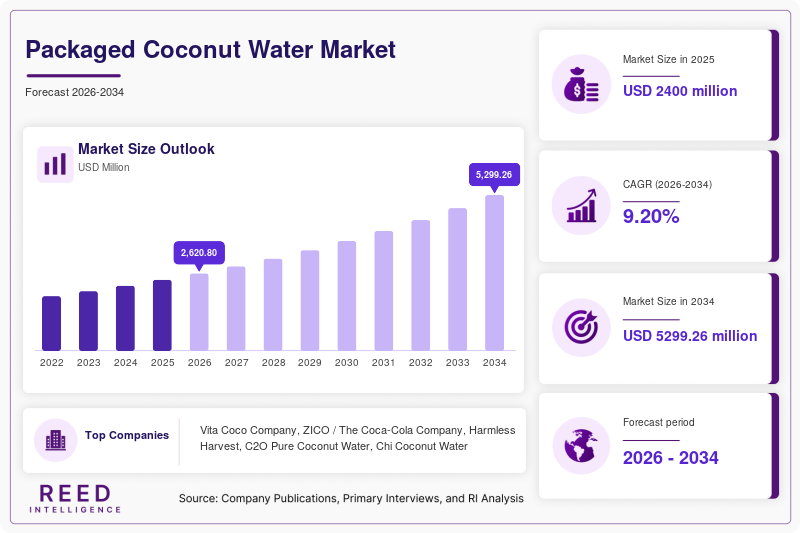
The global Packaged Coconut Water Market size was valued at USD 2.40 billion in 2025 and is projected to grow from USD 2.62 billion in 2026 to USD 5.28 billion by 2034, registering a CAGR of 9.20% during 2026–2034. Expansion of hydration beverages, sports and fitness consumption, premium coconut water, modern retail, online channels, and aseptic packaging is supporting market growth.
North America dominated the market with approximately 35% share in 2025, while APAC is expected to be the fastest-growing region at approximately 12.4% CAGR through 2034. Original/Plain Coconut Water held the leading 61% market share in 2025, while Coconut Water Blends are projected to grow fastest at approximately 11.0% CAGR.
Cartons represented approximately 59% of the Packaging Type segment in 2025, while PET Bottles are projected to grow fastest at approximately 10.4% CAGR. Supermarkets & Hypermarkets accounted for approximately 43% of the Distribution Channel segment, while Online Retail is projected to grow at approximately 12.2% CAGR.
Household/Individual Consumption represented approximately 54% of the End Use segment in 2025, while Sports & Fitness is projected to grow fastest at approximately 11.5% CAGR. North America accounted for approximately 35% of the market, Europe approximately 27%, APAC approximately 23%, Middle East and Africa approximately 8%, and LATAM approximately 7% in 2025.
Packaged Coconut Water Market Trends
Hydration and Wellness Positioning Is Expanding Consumption Occasions
Packaged coconut water is increasingly being positioned as a convenient hydration beverage for exercise, travel, work, and everyday refreshment rather than only as a juice product. Brands emphasize naturally occurring electrolytes, potassium, vitamin C, low-calorie characteristics, and plant-based positioning.
Vita Coco's products are marketed for workout refreshment, on-the-go consumption, smoothies, and everyday hydration. Its 2026 partnership with professional tennis league INTENNSE also demonstrates how brands are connecting coconut water with sports hydration and active lifestyles.
This positioning expands the addressable consumer base beyond traditional juice buyers toward consumers who may otherwise purchase sports drinks, flavored water, or functional beverages.
Aseptic Packaging and Product Innovation Are Expanding Distribution
Packaging technology is becoming increasingly important as manufacturers seek to distribute coconut water across longer distances while maintaining product quality. UHT treatment combined with aseptic packaging can provide approximately six to eight months of ambient shelf life.
Cartons are therefore important for long-life products and international distribution. PET bottles provide portability and visibility for single-serve consumption, while cans and glass bottles support additional premium and convenience applications.
Product innovation is also broadening the category through flavored coconut water, fruit blends, electrolyte-enhanced formulations, and coconut-water-plus products. These products provide alternatives for consumers who prefer additional flavors or functional benefits.
Packaged Coconut Water Market Drivers
Hydration and Electrolyte Positioning Are Expanding the Consumption Occasion
Coconut water is increasingly being marketed as a convenient hydration beverage for exercise, travel, work, and everyday consumption. Its naturally occurring electrolytes and potassium content provide a basis for positioning the product against sports drinks and other functional beverages.
Vita Coco's UK products are promoted for workout refreshment, on-the-go consumption, smoothies, and daily hydration. The company's partnership with professional tennis league INTENNSE further connects coconut water with sports and active lifestyles.
The commercial mechanism is increasing consumption frequency across multiple occasions rather than depending on a single beverage-use occasion. This expands demand among fitness consumers, travelers, health-conscious consumers, and people seeking alternatives to carbonated beverages.
Branded and Private-Label Distribution Is Increasing Category Visibility
Packaged coconut water is gaining visibility through supermarkets, convenience stores, online grocery platforms, foodservice, and specialty retailers. Modern retail provides consumers with access to multiple brands, package sizes, flavors, and price points.
Retail assortments increasingly include specialist coconut-water brands alongside mainstream beverage companies and private-label products. Tesco's UK assortment, for example, includes multiple coconut-water brands and formats.
Private-label participation can lower price barriers and increase retailer control over shelf placement. Vita Coco reported strong private-label volume growth during 2026, demonstrating that category expansion is occurring beyond premium branded products.
Aseptic Packaging Is Reducing Geographic Distribution Constraints
Fresh coconut water is highly perishable after extraction, making processing and packaging technology important for international commercialization. Rapid processing is required to preserve product quality, while UHT treatment and aseptic packaging can extend shelf life.
Ambient cartons allow manufacturers to distribute products across longer distances without relying entirely on refrigerated logistics. This expands access to markets where local coconut production is limited.
Aseptic technology therefore supports supermarkets, convenience stores, export markets, and online distribution while reducing some cold-chain requirements.
Packaged Coconut Water Market Restraints
Coconut Sourcing and Logistics Create Margin Volatility
Packaged coconut water depends on agricultural supply from coconut-producing regions and international movement of raw materials or finished products. Weather, crop conditions, ocean freight, tariffs, transportation costs, and sourcing constraints can affect production costs.
Vita Coco's 2026 filings identified transportation disruptions, ocean freight volatility, tariffs, and coconut-water sourcing as important commercial considerations.
Because coconut water is price-sensitive, producers may not always be able to pass higher costs directly to consumers without affecting sales volume. Companies must therefore manage supplier relationships, inventory, logistics, production locations, and pricing carefully.
Product Quality Limits Processing Flexibility
Coconut water has a delicate flavor and can deteriorate quickly after extraction. Producers must balance microbial safety and shelf life with taste, color, freshness perception, and nutritional characteristics.
Thermal processing can affect product quality, while refrigerated products require more expensive cold-chain infrastructure. Ambient products reduce distribution requirements but depend on controlled UHT and aseptic processing.
This trade-off increases technical requirements and can raise capital and operating costs, particularly for smaller manufacturers entering the market.
Packaged Coconut Water Market Opportunities
Premium and Super-Premium Coconut Water
Premium coconut water provides opportunities for differentiation based on coconut variety, geographic origin, freshness, extraction method, processing technology, and sourcing practices.
In July 2026, Vita Coco acquired Copra, a producer of Thai Nam Hom coconut water. The acquisition added a Thailand factory, access to Nam Hom coconuts, an extract-and-fill-on-site model, and exposure to the super-premium cold-chain segment.
This creates opportunities for products positioned around specific coconut varieties, origin, freshness, and higher-quality processing rather than competing only on price.
Premium and private-label production can also allow suppliers to serve retailers seeking differentiated products and consumers willing to pay more for specialty coconut water.
Flavor Innovation and Functional Blends
Flavor innovation provides an opportunity to expand coconut water consumption among consumers who may not prefer the taste of plain coconut water.
Brands are developing flavored products, fruit blends, coconut-water-plus beverages, and products positioned around hydration and active lifestyles. These formulations can include combinations with fruit flavors or additional functional ingredients.
The commercial benefit is a broader range of consumption occasions and greater product variety. Flavor innovation can also help coconut-water brands compete more directly with flavored water, sports beverages, juices, and other functional drinks.
Challenges in Packaged Coconut Water Market
Supply Chain Complexity and Product Quality Management
Packaged coconut-water producers must balance raw-material availability, transportation costs, processing requirements, packaging performance, product quality, shelf life, and retail pricing.
Coconut production is concentrated in specific geographic regions, meaning international brands can be exposed to weather, agricultural conditions, logistics disruptions, and transportation costs. Premium products may require particular coconut varieties or specialized sourcing arrangements, adding another layer of supply-chain complexity.
Processing also requires careful control because coconut water can experience changes in flavor and quality after extraction. Producers therefore need reliable processing facilities, quality-control systems, appropriate packaging, and efficient distribution networks.
The challenge is particularly significant for companies attempting to scale internationally while maintaining consistent taste and quality across markets.
Top Players in Packaged Coconut Water Market
- Vita Coco Company
- ZICO / The Coca-Cola Company
- Harmless Harvest
- C2O Pure Coconut Water
- Chi Coconut Water
- innocent Drinks
- UFC Coconut Water
- Taste Nirvana
- Amy & Brian Naturals
- Once Upon a Coconut
- Tropicana Brands Group
- PepsiCo
Packaged Coconut Water Market Segments
By Product Type
- Original/Plain Coconut Water
- Flavored Coconut Water
- Coconut Water Blends
By Packaging Type
- Cartons
- PET Bottles
- Cans
- Glass Bottles
By Distribution Channel
- Supermarkets & Hypermarkets
- Convenience Stores
- Online Retail
- Foodservice & Specialty Stores
By End Use
- Household/Individual Consumption
- Sports & Fitness
- Foodservice & Hospitality
- Other Commercial Uses
By Region
- North America
- Europe
- APAC
- Middle East and Africa
- LATAM
Conclusion
The global Packaged Coconut Water Market is projected to grow from USD 2.62 billion in 2026 to USD 5.28 billion by 2034 at a CAGR of 9.20%. Expansion of hydration and wellness beverages, sports and fitness consumption, premium coconut water, aseptic packaging, modern retail, online channels, and product innovation is supporting market expansion.
Original/Plain Coconut Water currently leads the Product Type segment with approximately 61% share, while Coconut Water Blends are projected to grow fastest at approximately 11.0% CAGR. Cartons account for approximately 59% of the Packaging Type segment, while PET Bottles are projected to grow at approximately 10.4% CAGR. Supermarkets & Hypermarkets lead the Distribution Channel segment with approximately 43% share, while Online Retail is projected to grow fastest at approximately 12.2% CAGR. Household/Individual Consumption represents approximately 54% of the End Use segment, while Sports & Fitness is projected to grow at approximately 11.5% CAGR. North America remains the dominant regional market with approximately 35% share, while APAC is projected to record the fastest regional growth at approximately 12.4% CAGR through 2034.
Report Link:

 English
 Arabic
 Spanish
 Portuguese
 Deutsch
 Turkish
 Dutch
Dutch
 Italiano
 Russian
 Romaian
 Portuguese (Brazil)
 Greek
Greek