


Venous Leak: Symptoms, Causes, Diagnosis and Treatment
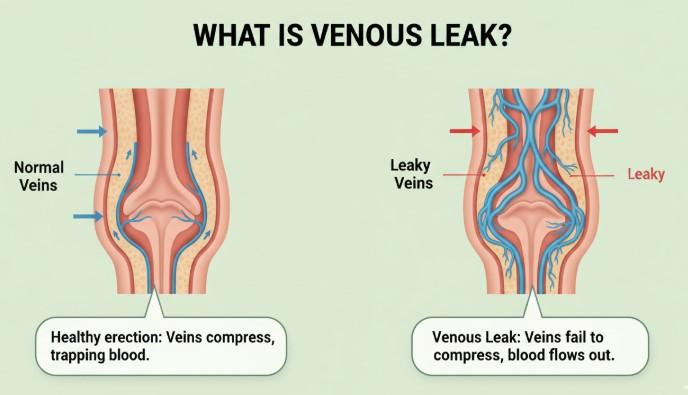
Venous leak, also known as veno-occlusive erectile dysfunction, is a condition associated with difficulty maintaining a firm erection. A normal erection requires adequate blood to enter the penis and remain there long enough to produce and sustain rigidity. When the mechanism responsible for restricting blood from leaving the penis does not work effectively, an erection may become soft or disappear during sexual activity.
Many men describe this problem as being able to achieve an erection but losing it quickly. While this can occur with venous leak, the same symptom can also result from other physical or psychological factors. Therefore, a proper medical evaluation is important before concluding that a venous leak is the cause.
Erectile difficulties can affect confidence, intimate relationships, and quality of life. Fortunately, several treatment approaches are available depending on the underlying cause.
What Is a Venous Leak?
The term venous leak is commonly used to describe a problem with the penis's ability to retain blood during an erection.
During sexual stimulation, signals from the nervous system cause the arteries supplying the penis to relax. Blood then flows into the erectile chambers, causing them to expand. As these chambers fill, pressure within the penis increases and compresses the veins that normally carry blood away.
This process is called the veno-occlusive mechanism.
When this mechanism is inadequate, blood may continue to leave the penis while an erection is being maintained. The result can be an erection that is difficult to sustain.
It is important to understand that the phrase "venous leak" does not necessarily mean that there is literally a hole or damaged vein. Erectile function is complex, and problems with blood flow, smooth muscle, nerves, hormones, medications, or psychological factors can produce similar symptoms.
What Happens During a Normal Erection?
A healthy erection involves coordination between the brain, nerves, blood vessels, hormones, and erectile tissues.
The basic process includes:
-
Sexual stimulation activates the nervous system.
-
Signals cause penile blood vessels to relax.
-
Blood flow into the erectile tissue increases.
-
The erectile chambers expand as they fill with blood.
-
Increasing pressure compresses veins that drain blood from the penis.
-
Blood is retained, allowing the penis to remain firm.
If blood flow into the penis is insufficient, an erection may not become adequately firm. If blood leaves the erectile tissue too quickly, the erection may not remain firm.
This is why determining the actual cause of erectile dysfunction is important.
Common Symptoms of Venous Leak
The symptoms associated with suspected venous leak can vary between individuals.
Common complaints include:
-
Difficulty maintaining an erection
-
Losing firmness shortly after becoming erect
-
An erection that becomes softer during intercourse
-
Difficulty keeping an erection without continuous stimulation
-
An erection that is not firm enough for penetration
-
Repeated loss of erection during sexual activity
-
Reduced confidence because of recurring erection problems
Some men may notice that they can achieve an erection relatively easily but struggle to maintain it.
However, these symptoms alone cannot confirm a venous leak.
What Causes Venous Leak?
Several factors can contribute to problems with erectile function and the penile veno-occlusive mechanism.
Diabetes
Long-term diabetes can affect blood vessels and nerves. Poorly controlled blood sugar may contribute to erectile dysfunction by damaging systems involved in normal sexual function.
Cardiovascular Problems
The health of the blood vessels plays an important role in erections. High blood pressure, high cholesterol, atherosclerosis, and other cardiovascular conditions may contribute to erectile difficulties.
Penile or Pelvic Injury
Trauma involving the penis, pelvis, or surrounding tissues can sometimes affect erectile function.
Peyronie's Disease
Peyronie's disease causes scar tissue to develop within the penis. It may result in curvature, discomfort, changes in penile structure, and erectile difficulties.
Pelvic Surgery
Procedures involving the prostate, bladder, rectum, or other pelvic structures can sometimes affect nerves and blood vessels involved in erections.
Hormonal Problems
Hormonal abnormalities, including low testosterone in appropriate clinical contexts, can contribute to sexual difficulties. Hormonal problems should be assessed rather than assumed to be the cause.
Neurological Conditions
The nerves involved in sexual arousal and erection can be affected by neurological disorders, spinal problems, injuries, or certain medical conditions.
Lifestyle Factors
Smoking, excessive alcohol consumption, obesity, physical inactivity, and poor cardiovascular health can increase the risk of erectile dysfunction.
Age-Related Changes
Erectile function may change with age because of alterations in blood vessels, hormones, medications, and general health. Persistent erectile dysfunction should not automatically be attributed to aging.
Is Venous Leak the Same as Erectile Dysfunction?
No.
Erectile dysfunction (ED) is a broad term describing difficulty achieving or maintaining an erection that is adequate for satisfactory sexual activity.
Venous leak is one possible mechanism associated with erectile dysfunction.
ED can also result from:
-
Reduced arterial blood flow
-
Nerve problems
-
Hormonal abnormalities
-
Medication side effects
-
Diabetes
-
Cardiovascular disease
-
Psychological factors
-
Relationship difficulties
-
Pelvic surgery or injury
-
Penile structural conditions
In some cases, several factors contribute simultaneously.
How Is Venous Leak Diagnosed?
Diagnosis should be based on a complete evaluation rather than symptoms alone.
A doctor may begin by asking about:
-
When the erection problem started
-
Whether erections can be achieved
-
How long erections usually last
-
Morning or spontaneous erections
-
Sexual desire
-
Medical conditions
-
Current medications
-
Previous surgeries or injuries
-
Smoking and alcohol consumption
-
Stress and psychological factors
A physical examination may also be performed.
Penile Doppler Ultrasound
A penile Doppler ultrasound may be used when a vascular cause of erectile dysfunction is suspected.
During the examination, ultrasound is used to evaluate blood flow in the penile arteries. A medication may be administered to produce an erection so that blood-flow patterns can be assessed.
The examination can provide information about arterial inflow and the veno-occlusive mechanism.
Because interpretation can be affected by the technique, medication response, degree of erection, and other variables, results should be assessed by an experienced medical professional.
Blood Tests for Erectile Dysfunction
Depending on the patient's history and symptoms, a doctor may recommend laboratory testing.
Possible tests can include:
-
Blood glucose
-
HbA1c
-
Lipid profile
-
Testosterone
-
Thyroid-related tests
-
Other hormone tests when clinically appropriate
Not every person with erectile dysfunction needs the same tests.
Treatment Options for Venous Leak
Treatment depends on the underlying cause, severity, general health, and response to previous treatments.
There is no single treatment that is appropriate for every patient.
Lifestyle Modification
Improving general health can support better erectile function.
Recommended measures may include:
-
Regular exercise
-
Maintaining a healthy weight
-
Stopping smoking
-
Limiting excessive alcohol
-
Managing diabetes
-
Controlling blood pressure
-
Managing cholesterol
-
Improving sleep
-
Reducing excessive stress
Because erections depend heavily on healthy blood vessels, cardiovascular health is an important part of men's sexual health.
Oral ED Medications
PDE5 inhibitors are commonly prescribed for erectile dysfunction.
Examples include:
-
Sildenafil
-
Tadalafil
-
Vardenafil
-
Avanafil
These medications improve the signaling involved in penile blood flow and can help some men achieve and maintain an erection when sexual stimulation occurs.
They are not suitable for everyone. For example, PDE5 inhibitors can interact dangerously with nitrate medications used for certain heart conditions.
A doctor should determine whether these medications are appropriate.
Vacuum Erection Devices
A vacuum erection device uses controlled negative pressure to draw blood into the penis.
A constriction ring may then be used to help maintain the erection.
This can be a non-surgical option for some men with erectile dysfunction.
Penile Injections
Intracavernosal injections involve injecting medication directly into the erectile tissue.
They can produce an erection independently of some of the normal mechanisms involved in sexual stimulation.
Because incorrect dosing can cause complications, these medications should only be used after appropriate medical assessment and instruction.
Penile Implant Surgery
For men with persistent and severe erectile dysfunction who do not obtain satisfactory results from other treatments, a penile prosthesis may be considered.
A penile implant is placed surgically inside the penis and can provide a mechanical solution for achieving an erection.
As with any surgery, potential benefits, complications, recovery, and long-term expectations should be discussed carefully with a qualified urologist.
Can Shockwave Therapy Treat Venous Leak?
Low-intensity extracorporeal shockwave therapy has been studied as a potential treatment for certain forms of erectile dysfunction.
Research is ongoing, and results vary depending on the patient population, treatment protocol, and underlying cause of ED.
It should not automatically be promoted as a guaranteed cure for venous leak.
Patients considering shockwave therapy should discuss the available evidence, expected outcomes, limitations, and alternatives with a qualified healthcare professional.
Can PRP Treat Venous Leak?
Platelet-rich plasma, or PRP, has also been investigated for erectile dysfunction.
The concept involves using a patient's own platelet-rich blood preparation with the goal of supporting tissue responses.
However, evidence for PRP in erectile dysfunction remains an area of ongoing research, and it should not be presented as a universally established treatment or guaranteed cure for venous leak.
A qualified specialist can explain whether a particular treatment is appropriate based on the patient's diagnosis.
Can Venous Leak Be Cured Permanently?
The answer depends on the underlying cause.
If erectile difficulties are associated with reversible factors such as uncontrolled diabetes, smoking, medication effects, or poor cardiovascular health, addressing those factors may improve erectile function.
If there is a significant structural or vascular problem, treatment may focus on achieving reliable erections rather than completely reversing the underlying condition.
This is why an accurate diagnosis is more important than choosing a treatment based solely on symptoms.
Venous Leak and Psychological Factors
Psychological factors can influence erectile function even when a physical problem exists.
For example, a man who repeatedly loses his erection may become worried that it will happen again. This anxiety can increase stress during sexual activity and potentially make maintaining an erection more difficult.
Performance anxiety, relationship stress, depression, and other psychological factors can therefore coexist with physical causes.
Counseling or sex therapy may be beneficial for some patients, particularly when anxiety or relationship difficulties contribute to ED.
Can Lifestyle Changes Prevent Erectile Dysfunction?
Healthy habits can reduce the risk of many conditions associated with erectile dysfunction.
Important measures include:
Exercise Regularly
Physical activity supports cardiovascular health and circulation.
Stop Smoking
Smoking damages blood vessels and is associated with an increased risk of erectile dysfunction.
Maintain a Healthy Weight
Excess body weight can be associated with diabetes, cardiovascular disease, hormonal changes, and other factors that affect sexual health.
Manage Diabetes
Good blood-sugar control can help reduce the risk of complications involving nerves and blood vessels.
Control Blood Pressure and Cholesterol
Healthy blood pressure and cholesterol levels support vascular health.
Limit Excessive Alcohol
Heavy alcohol consumption can negatively affect sexual function and overall health.
Get Adequate Sleep
Poor sleep and sleep disorders can contribute to reduced energy, hormonal disturbances, and sexual difficulties.
When Should You See a Doctor?
Occasional erection difficulties can happen to many men, particularly during periods of stress, fatigue, or excessive alcohol use.
However, persistent or recurring problems should be evaluated.
Consider speaking with a qualified doctor if:
-
You regularly lose your erection during sexual activity
-
You cannot maintain sufficient firmness for intercourse
-
Erectile problems are becoming more frequent
-
You have diabetes or cardiovascular risk factors
-
You have experienced pelvic or penile trauma
-
You have undergone pelvic surgery
-
You have penile curvature or pain
-
You are concerned about a possible vascular cause
A medical evaluation can help identify whether the problem is vascular, hormonal, neurological, psychological, medication-related, or due to another condition.
Frequently Asked Questions
What is the main symptom of venous leak?
The most commonly reported symptom is difficulty maintaining an erection. A man may achieve an erection but lose firmness shortly afterward.
Can venous leak cause complete erectile dysfunction?
It can contribute to significant erectile dysfunction, but the severity varies. Some men can still achieve erections but cannot maintain adequate rigidity.
Is venous leak caused by low testosterone?
Not necessarily. Low testosterone and veno-occlusive dysfunction are different issues, although hormonal problems can contribute to erectile difficulties.
How is venous leak confirmed?
A healthcare professional may use medical history, physical examination, and vascular testing such as penile Doppler ultrasound when appropriate.
Can medication help?
Some men with erectile dysfunction benefit from PDE5 inhibitor medications. Whether they are appropriate depends on the individual's medical history and other medications.
Can exercise improve erectile function?
Regular physical activity can support cardiovascular health and may improve erectile function, particularly when vascular and metabolic risk factors are involved.
Is venous leak common?
Erectile dysfunction itself is common, but not every case of difficulty maintaining an erection represents a true structural venous leak. Proper diagnosis is important.
Should I see a urologist?
If erection problems are persistent or recurring, a urologist or qualified men's health specialist can evaluate possible causes and discuss treatment options.
Final Thoughts
Venous leak, or veno-occlusive erectile dysfunction, involves difficulty maintaining penile rigidity because the normal mechanism responsible for restricting blood outflow may not function adequately.
However, losing an erection does not automatically mean that a venous leak is present. Erectile dysfunction can have many causes, including vascular disease, diabetes, nerve problems, hormonal abnormalities, medications, lifestyle factors, psychological stress, and structural conditions.
A proper diagnosis is therefore the first step toward appropriate treatment. Depending on the underlying cause, management may include lifestyle changes, oral medications, vacuum devices, injectable treatments, or surgical options.
If you are experiencing repeated difficulty maintaining an erection, professional evaluation can help determine the underlying cause and identify appropriate treatment options.

 English
 Arabic
 French
 Spanish
 Portuguese
 Deutsch
 Dutch
Dutch
 Italiano
 Russian
 Romaian
 Portuguese (Brazil)
 Greek
Greek