


Tourniquet Systems Market: The Shift Toward Digital Pressure Monitoring
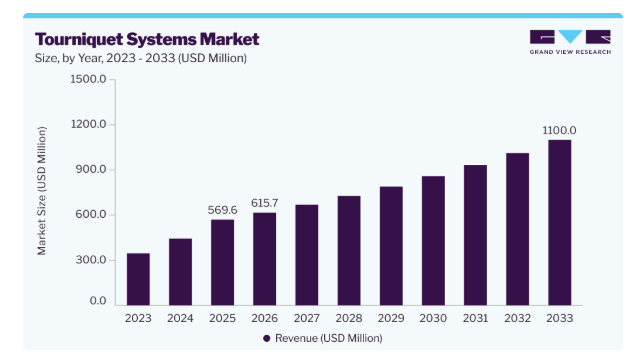
The global Market Tourniquet Systems was valued at USD 569.6 million in 2025 and is projected to reach USD 1,100 million by 2033, expanding at a CAGR of 8.1% from 2026 to 2033. Rising trauma cases, road accidents, sports injuries, orthopedic procedures, and growing awareness of emergency bleeding control are strengthening demand for these systems.
Why Is the Tourniquet Systems Market Gaining Momentum?
Tourniquet systems have become increasingly important across emergency, trauma, and surgical care because they enable rapid control of severe bleeding.
Several factors are supporting market expansion:
- Rising incidence of road accidents, sports injuries, and trauma cases
- Growing geriatric population and higher susceptibility to orthopedic conditions
- Increasing healthcare expenditure and access to surgical care
- Greater investments in emergency medical infrastructure
- Growing patient awareness about bleeding-control techniques
- Technological improvements in pressure control and safety monitoring
The adoption of advanced systems in civilian emergency care is also expanding. In February 2026, the Naperville Fire Department became the first in the Edward Hospital EMS system to deploy the SAM Junctional Tourniquet for severe hemorrhage control in difficult-to-access areas such as the pelvis and groin.
Which Product Segment Holds the Strongest Position?
Tourniquet cuffs accounted for approximately 73.0% of market revenue in 2025, making them the leading product segment.
Their widespread use in orthopedic procedures, lower-limb injuries, and joint replacement surgeries continues to support demand. Disposable and reusable cuffs are also gaining attention because of their role in patient safety, comfort, and infection control.
At the same time, tourniquet instruments are expected to register significant growth through 2033. Automated and digital systems with advanced pressure-monitoring capabilities are making these instruments more precise and easier to operate.
Why Are Pneumatic Cuffs Dominating?
Pneumatic cuffs represented approximately 88.0% of revenue in 2025. Their ability to provide standardized pressure makes them particularly valuable during orthopedic and trauma procedures.
The segment is also benefiting from:
- Increasing orthopedic and trauma surgeries
- Demand for precise pressure control
- Development of sterile, single-use cuff designs
- Focus on reducing infection and bacterial-transfer risks
- Growing adoption of advanced surgical equipment
Non-pneumatic cuffs, meanwhile, are expected to experience significant growth. Their affordability, ease of deployment, and suitability for prehospital, military, emergency, and ambulatory settings make them attractive, particularly in cost-sensitive healthcare environments.
How Important Are Hospitals to Market Growth?
Hospitals accounted for around 46.0% of total revenue in 2025 and remain the leading application segment.
Tourniquet systems are widely used during orthopedic, trauma, and vascular procedures, as well as for controlling life-threatening external hemorrhage. Hospitals and trauma systems are also incorporating hemorrhage-control practices into emergency protocols and first-responder training.
Beyond institutional care, non-institutional use is expanding as public awareness of first aid increases. User-friendly tourniquet systems are becoming more accessible for personal medical kits, outdoor activities, and adventurous sports.
Which Region Leads the Tourniquet Systems Market?
North America dominated the global market with approximately 45.0% revenue share in 2025.
Its strong position is linked to established healthcare infrastructure, high volumes of orthopedic and trauma surgeries, and widespread adoption of advanced hemorrhage-control solutions.
The U.S. represents a major contributor, supported by healthcare infrastructure, a large patient pool, and public training initiatives involving laypeople, law enforcement, and firefighters.
Europe is also positioned for significant growth. An aging population, increasing orthopedic disorders, minimally invasive procedures, favorable reimbursement policies, and established healthcare systems are supporting demand. Germany benefits from advanced hospital infrastructure and high orthopedic and trauma surgery volumes, while the UK is seeing demand supported by emergency admissions, technological advancement, and hemorrhage-control preparedness.
Asia Pacific is projected to record the fastest CAGR through 2033. Rising healthcare expenditure and population growth across India, China, and Indonesia are creating new opportunities. In India, increasing road accidents and falls are contributing to the need for emergency tourniquet solutions.
Who Are the Key Companies in the Tourniquet Systems Market?
The competitive landscape includes companies focusing on product development, technological improvements, partnerships, acquisitions, and new product launches.
Key companies include:
- Delfi Medical Innovations Inc.
- AneticAid
- Zimmer Biomet
- DESSILLIONS & DUTRILLAUX
What Role Is Technology Playing in Future Adoption?
Technology is becoming an important differentiator within the tourniquet systems market. Improved pressure-control mechanisms, digital monitoring, automated systems, and ergonomic cuff designs are helping manufacturers address safety and precision requirements.
The broader shift toward faster hemorrhage management is also encouraging the integration of advanced tourniquets into emergency medical services and civilian trauma care.
What Does the Future Hold for the Tourniquet Systems Market?
The market is moving beyond traditional surgical applications toward a broader ecosystem of emergency, trauma, prehospital, and non-institutional bleeding control. Rising trauma incidence, orthopedic procedures, emergency preparedness, and technological innovation are expected to keep demand on an upward trajectory through 2033.
With North America maintaining its leadership and Asia Pacific emerging as the fastest-growing regional market, manufacturers that combine precision, safety, affordability, and ease of use are likely to find stronger opportunities across both developed and emerging healthcare systems.
Explore Our Research & Intelligence Solutions
Prism AI: Ask. Analyze. Get Cited Market Insights. – Explore Now
U.S. Healthcare Facility Intelligence: Make Better Decisions with Comprehensive Data – Explore the Platform

 English
 Arabic
 French
 Spanish
 Portuguese
 Deutsch
 Turkish
 Dutch
Dutch
 Italiano
 Romaian
 Portuguese (Brazil)
 Greek
Greek