


How can IVF Lab Design Consultant minimize the risk of cross-contamination?
INTRODUCTION
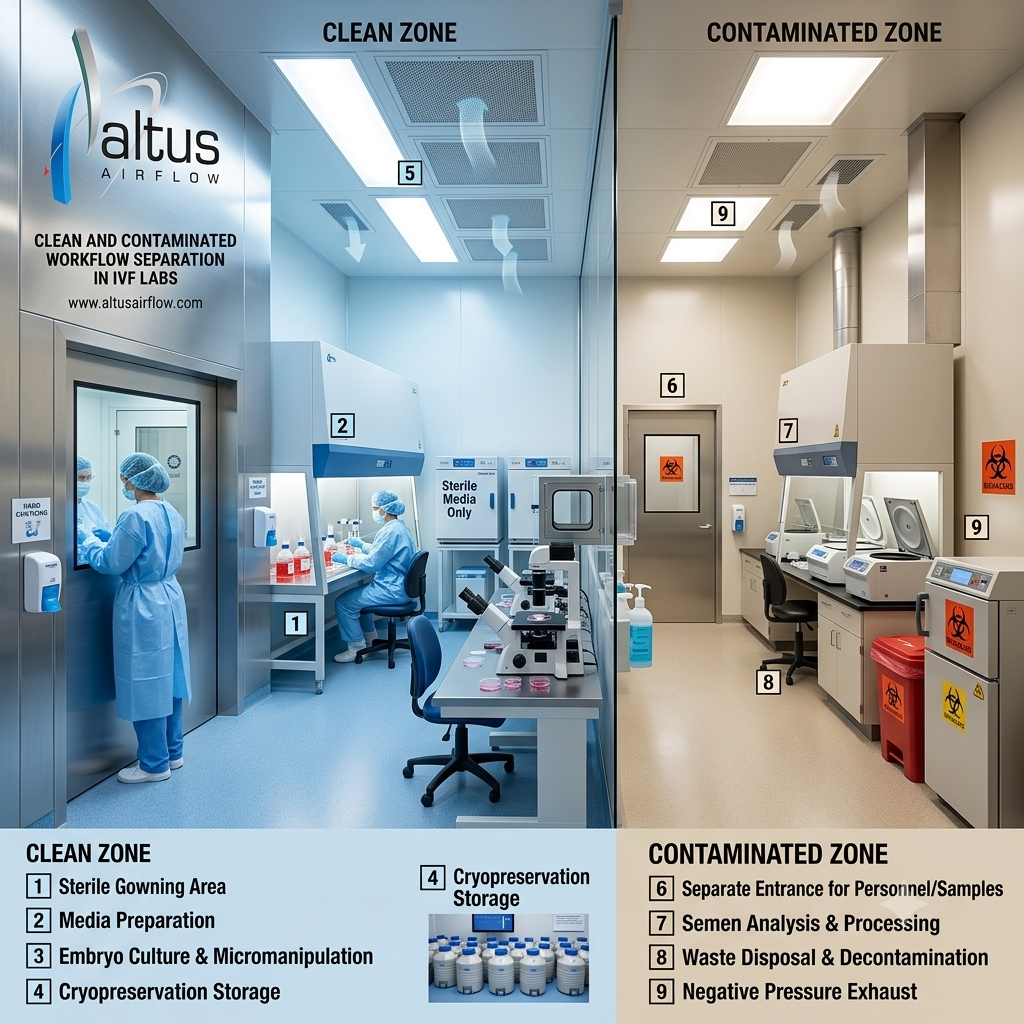
Cross-contamination prevention is one of the most important considerations when planning a modern fertility laboratory. An experienced IVF Lab Design Consultant helps fertility clinics develop a controlled environment that protects reproductive cells, supports aseptic procedures, and minimizes the risk of contamination from air, surfaces, equipment, personnel, and laboratory materials. Effective IVF laboratory design combines appropriate zoning, ventilation, HEPA filtration, volatile organic compound (VOC) control, hygienic construction materials, and carefully planned workflows. By addressing these factors from the initial design stage, fertility clinics can establish a reliable environment for handling sperm, oocytes, and embryos throughout assisted reproductive technology (ART) procedures.
Why Is Cross-Contamination Prevention Important in IVF Laboratories?
IVF laboratories handle sensitive biological materials under carefully controlled conditions. Contamination can arise from microorganisms, particles, chemical residues, unsuitable materials, or the transfer of biological material between work areas. Certain airborne chemicals, including VOCs released by paints, adhesives, furnishings, and construction materials, may also adversely affect reproductive cells and embryo culture conditions.
The European Society of Human Reproduction and Embryology (ESHRE) emphasizes appropriate laboratory design, controlled air quality, staff hygiene, and documented environmental monitoring in its recommendations for good practice in IVF laboratories. These principles provide an important foundation for contamination risk management.
An experienced consultant translates these requirements into practical design decisions that support laboratory cleanliness, operational consistency, and the protection of reproductive material.
1. Develop Separate Laboratory Zones
A well-planned layout helps prevent contamination from spreading between activities. An IVF facility may include areas for sperm preparation, oocyte handling, fertilization, embryo culture, cryopreservation, equipment support, staff preparation, and material storage.
The precise arrangement depends on the clinic's procedures, facility size, and risk assessment.
An IVF Lab Design Consultant can establish clear separation between:
-
Areas where reproductive cells and embryos are handled.
-
Staff changing and preparation spaces.
-
Cleaning and sterilization areas.
-
Administrative offices and general circulation routes.
-
Chemical analysis areas where hazardous or volatile reagents are used.
-
Cryostorage and associated support facilities.
Activities involving fixatives or other potentially harmful chemicals should be separated from sensitive embryo-handling operations. Cleaning activities should also be organized so that dirty equipment and waste do not travel through clean work zones unnecessarily.
Why it matters: Defined zones reduce unnecessary movement, help control contamination sources, and make cleaning procedures easier to implement.
2. Design an Effective HVAC and Air Filtration System
Air quality is a critical component of IVF laboratory environmental control. Air can carry particles, microorganisms, and chemical contaminants that may affect laboratory conditions.
A properly engineered heating, ventilation, and air-conditioning (HVAC) system should be designed around the laboratory's intended activities and applicable standards. Depending on the risk assessment, its design may include:
-
HEPA filtration for airborne particulate control.
-
Appropriate outdoor-air supply and air-change performance.
-
Positive pressure relative to adjacent, less-clean areas where suitable.
-
Controlled temperature and humidity.
-
Carefully planned supply and return air locations.
-
Monitoring of critical environmental parameters.
-
Suitable maintenance and filter replacement access.
Positive pressure can help reduce the entry of contaminated air from adjacent spaces when the system is properly designed and balanced. However, pressure relationships must be established for the specific facility rather than copied from a generic cleanroom design.
An effective ventilation strategy should also address chemical contamination, because HEPA filters capture particles but do not, by themselves, remove all gaseous VOCs.
3. Control Volatile Organic Compounds (VOCs)
Chemical contamination is an important risk in embryology laboratories. VOCs may originate from construction products, paints, sealants, adhesives, cleaning agents, furniture, packaging, and certain consumables.
An IVF Lab Design Consultant can help minimize this risk by specifying materials suitable for sensitive laboratory environments and planning adequate off-gassing time after construction or renovation.
Important measures include:
-
Selecting low-emission paints, flooring, adhesives, and sealants.
-
Avoiding unsuitable materials near embryo-handling areas.
-
Evaluating furnishings and work surfaces for chemical emissions.
-
Using suitable air-purification technologies for VOC control.
-
Reviewing the emissions potential of laboratory consumables.
-
Allowing sufficient time for construction materials to off-gas before laboratory use.
-
Assessing air quality before operational commissioning.
Where required, VOC monitoring and trend analysis can help identify changes in environmental conditions. The laboratory should establish acceptance criteria and corrective actions based on its documented quality and risk-management procedures.
4. Establish Hygienic Construction and Finishing Standards
Laboratory surfaces should be durable, smooth, and compatible with routine cleaning and disinfection. Damaged finishes, open joints, difficult-to-clean corners, and deteriorating sealants can create areas where contamination accumulates.
During planning, the consultant should consider:
-
Seamless or appropriately sealed flooring.
-
Smooth, cleanable wall and ceiling finishes.
-
Sealed service penetrations and joints.
-
Work surfaces compatible with laboratory disinfectants.
-
Furniture with minimal inaccessible gaps.
-
Doors and access points that support controlled movement.
-
Materials selected to minimize particle shedding and chemical emissions.
Material selection should consider both cleanliness and chemical compatibility. A finish that is easy to clean but releases unsuitable VOCs may not be appropriate for a sensitive IVF environment.
Construction quality also matters. Proper sealing, finishing, and inspection help prevent dust accumulation and make the laboratory easier to maintain throughout its operating life.
5. Plan Controlled Entry for Personnel and Materials
People and incoming materials can introduce particles, microorganisms, and chemical contaminants. Laboratory access should therefore be controlled from the design stage.
A consultant can plan a clean-entry arrangement that includes a dedicated changing area, handwashing facilities, appropriate laboratory clothing storage, and a defined transition into controlled spaces. A double-door entry or suitable transfer arrangement may be appropriate depending on the laboratory's design and risk assessment.
Practical measures include:
-
Restricting access to authorized personnel.
-
Providing designated laboratory clothing and footwear.
-
Establishing hand-hygiene facilities and procedures.
-
Using suitable hair coverings, masks, and gloves where required.
-
Documenting entry by visitors and non-specialist personnel.
-
Providing controlled transfer points for supplies and consumables.
-
Keeping office activities and unnecessary personal items outside the laboratory.
The design should make correct behavior convenient. Clear entry routes and adequate changing facilities reduce the likelihood that staff will bypass hygiene procedures during busy periods.
6. Separate Cleaning, Sterilization, and Waste Handling
Cleaning and sterilization activities generate different contamination risks from those associated with embryo handling. These activities should be planned so that contaminated items do not cross clean work areas.
The laboratory layout should provide appropriate space for cleaning reusable equipment, storing cleaning supplies, and managing waste. Where the facility performs sterilization, the process should follow the applicable equipment requirements and validated procedures.
Key design considerations include:
-
Separating dirty and clean material routes.
-
Providing designated waste collection points.
-
Using suitable, clearly identified waste containers.
-
Avoiding unnecessary movement of used equipment through embryo-handling areas.
-
Ensuring surfaces and equipment can be cleaned effectively.
-
Providing appropriate hand-hygiene facilities.
-
Establishing a safe route for removing waste from the laboratory.
Cleaning agents and disinfectants must be compatible with IVF laboratory use. Their effectiveness, residue characteristics, and potential effects on reproductive material should be considered before selection.
7. Provide Appropriate Workstations and Equipment Placement
Equipment positioning influences both contamination control and the time reproductive cells remain outside controlled conditions. Poorly planned workstations can cause unnecessary movement, crowding, repeated handling, and interruptions.
An IVF Lab Design Consultant should coordinate the layout of incubators, microscopes, laminar-flow workstations, centrifuges, warming equipment, and other essential devices according to the clinic's workflow.
The design should support:
-
Short, logical routes between related procedures.
-
Adequate space for aseptic handling.
-
Separation of incompatible activities.
-
Easy cleaning around equipment.
-
Reliable access to utilities and maintenance points.
-
Appropriate environmental conditions during cell handling.
-
Reduced crowding and unnecessary movement.
Vertical laminar-flow workstations or other suitable controlled work environments may be used for particular procedures when appropriate. Their selection and placement should follow the equipment's intended use and the laboratory's validated operating procedures.
Equipment should also be qualified, maintained, and checked according to manufacturer recommendations and the facility's quality-management system.
8. Use Sterile, Single-Use Consumables Correctly
Consumables can introduce biological or chemical contamination if they are unsuitable, improperly stored, or handled incorrectly.
The laboratory should establish clear specifications for sterile, single-use materials used in ART procedures. These products should be suitable for their intended application and meet relevant regulatory and quality requirements.
Good design and storage practices include:
-
Dedicated storage for clean, sterile consumables.
-
Protection from dust, moisture, and unnecessary handling.
-
Separation of incoming supplies from used materials.
-
Adequate inventory space to prevent overcrowding.
-
Clear identification and traceability of supplies.
-
Immediate disposal of single-use items after use.
-
Review of packaging and consumables for potential chemical emissions.
Reusable tools, where permitted and appropriate, should follow validated cleaning, disinfection, or sterilization procedures. Consumables should never be assumed suitable solely because they are labeled sterile; their intended use and compatibility with reproductive cells must also be considered.
9. Implement Environmental Monitoring and Validation
A carefully designed laboratory requires verification before it begins processing reproductive material. Commissioning and validation help establish whether the installed systems perform according to their specified requirements.
The monitoring plan should be risk-based and may include:
-
Temperature and humidity measurements.
-
Differential pressure checks.
-
HVAC performance and airflow verification.
-
HEPA filter integrity testing where applicable.
-
Airborne particle assessments.
-
VOC assessment and trend monitoring where indicated.
-
Microbial monitoring of selected work surfaces.
-
Verification of critical equipment performance.
The ESHRE recommendations support regular assessment of laboratory air cleanliness and work-surface microbial contamination based on documented risk assessment. Monitoring frequency and sampling locations should reflect the laboratory's activities, applicable requirements, and previous results.
Results should be documented, reviewed, and compared with established acceptance criteria. Any deviation should trigger investigation, corrective action, and verification that the problem has been resolved.
10. Establish Standard Operating Procedures and Staff Training
Laboratory design alone cannot eliminate cross-contamination. Staff must consistently follow procedures for hygiene, aseptic handling, cleaning, equipment use, and material transfer.
Standard operating procedures (SOPs) should clearly describe how each activity is performed and how contamination risks are controlled. Staff training should cover hand hygiene, protective clothing, disinfectant use, waste handling, environmental alarms, and the response to contamination events.
The laboratory should also maintain records of cleaning, maintenance, environmental monitoring, staff training, and corrective actions.
Where an incident or unexpected result suggests possible contamination, the facility should have a documented process for investigation, risk assessment, and escalation to the laboratory's quality and clinical leadership.
11. Plan for Maintenance and Future Modifications
Contamination controls can deteriorate if ventilation systems, filters, seals, and equipment are not maintained. Changes to the laboratory may also introduce dust, VOCs, or airflow disturbances.
A preventive maintenance plan should cover HVAC systems, filtration equipment, environmental sensors, incubators, and other critical devices. Renovations or equipment changes should undergo a documented impact assessment before implementation.
After significant changes, the laboratory may require additional cleaning, off-gassing, environmental testing, or requalification before resuming normal operations.
Designing accessible maintenance points and allowing adequate service space helps reduce disruption while supporting long-term reliability.
Frequently Asked Questions
1. How can an IVF Lab Design Consultant minimize cross-contamination?
An IVF Lab Design Consultant can minimize cross-contamination through laboratory zoning, controlled access, appropriate HVAC and HEPA filtration, VOC management, hygienic construction materials, separated cleaning areas, and validated environmental monitoring.
2. Why is HVAC design important for an IVF Lab Design Consultant?
An IVF Lab Design Consultant considers HVAC design essential for controlling airborne particles, temperature, humidity, and pressure relationships while supporting appropriate air quality for sensitive reproductive cells and embryos.
3. How does an IVF Lab Design Consultant control chemical contamination?
An IVF Lab Design Consultant helps reduce chemical contamination by specifying low-emission construction materials, planning adequate off-gassing time, evaluating consumables, and incorporating suitable VOC-control measures where required.
4. What role does laboratory zoning play in preventing contamination?
An IVF Lab Design Consultant uses laboratory zoning to separate embryo-handling activities from cleaning, storage, administrative work, and potentially hazardous chemical processes, reducing unnecessary movement between areas.
5. Does an IVF Lab Design Consultant provide contamination-control validation?
An IVF Lab Design Consultant can coordinate validation and commissioning activities, including airflow checks, HEPA integrity testing where applicable, environmental monitoring, and equipment performance verification according to the project specifications.
Conclusion
Minimizing cross-contamination in an IVF laboratory requires coordinated planning, suitable materials, controlled airflow, effective zoning, disciplined handling procedures, and ongoing verification. By integrating these measures into the facility from the beginning, fertility clinics can create a cleaner and more reliable environment for sensitive reproductive procedures. A well-designed laboratory must also support staff efficiency, preventive maintenance, and continuous quality improvement. For specialized IVF laboratory planning, engineering, and turnkey infrastructure solutions, Altus Airflow supports healthcare facilities in developing environments tailored to their operational requirements.
Read Our Previous Blog------>What is the importance of workflow separation in Modular Ophthalmic OT Turnkey Project Company?

 English
 Arabic
 French
 Spanish
 Portuguese
 Deutsch
 Dutch
Dutch
 Italiano
 Russian
 Romaian
 Portuguese (Brazil)
 Greek
Greek