


The Businesses across North America are adopting Managed SIEM Services to strengthen security operations and address evolving cyber threats in increasingly complex digital environments.
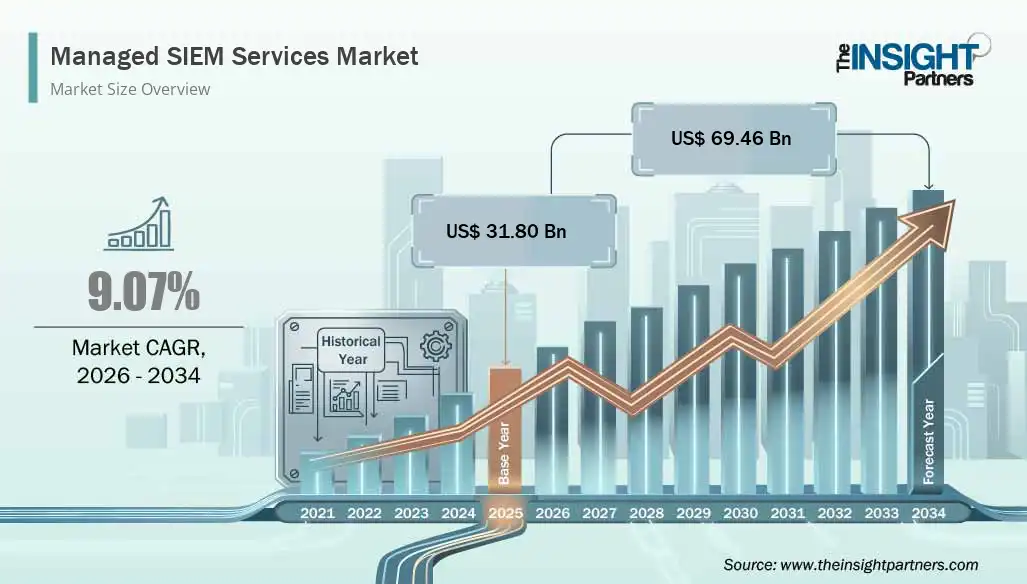
The Managed SIEM Services market size is expected to reach US$ 69.46 Billion by 2034 from US$ 31.80 Billion in 2025. The market is anticipated to register a CAGR of 9.07% during the forecast period 2026–2034.
Market Overview
The Managed SIEM services let an organization hand over some or all of its SIEM operations to an external provider. The provider typically handles platform deployment, log ingestion, correlation rule development, alert triage, threat hunting and incident escalation. Customers get enterprise-grade monitoring without building a full security operations center (SOC).
Get Sample PDF @ https://www.theinsightpartners.com/sample/TIPRE00039516
Market Segmentation
The Insight Partners segments the market by service model into Fully Managed and Co-Managed offerings. The two models suit different buyers.
- Fully managed services:-The provider runs the SIEM end to end, from infrastructure and content engineering to 24/7 monitoring and response. This model appeals to organizations with small security teams, limited budgets for specialist hiring, or a need to reach mature security operations quickly. Small and mid-sized enterprises are natural adopters. So are organizations in sectors where a breach would be costly but cybersecurity is not a core competency.
- Co-managed services:- The customer keeps ownership of the SIEM platform and some operational duties, while the provider supplements them with expertise, extended coverage or overflow capacity. Large enterprises with existing SOC teams often prefer this approach. It preserves control over sensitive data and detection logic while closing gaps such as overnight coverage or advanced threat hunting.
Key Growth Drivers
- Escalating threat sophistication:- Attackers use automation, stolen credentials, ransomware-as-a-service and supply-chain compromises to reach their targets. Broader industry research names the growth and sophistication of the threat landscape as the key driver of managed SIEM demand. Detecting these threats takes continuous monitoring and correlation across many data sources. That is exactly what a managed SIEM provides.
- Growing IT complexity:-Hybrid and multi-cloud environments, remote workforces, SaaS sprawl and connected devices all multiply the log sources that must be monitored. Industry research points to the increasing complexity of IT environments as a major force behind managed SIEM adoption. Few internal teams can keep pace with the expanding data volumes and integration work.
- The cybersecurity skills shortage:- Qualified security analysts, detection engineers and threat hunters are scarce and expensive. Industry analysis identifies the global shortage of skilled cybersecurity professionals as a persistent challenge. For the buyer, outsourcing turns that shortage into an operating expense and gives access to a bench of specialists.
- Regulatory and compliance pressure:- Data protection laws, sector-specific mandates and audit requirements increasingly demand log retention, continuous monitoring and demonstrable incident response. Managed SIEM providers typically offer compliance reporting out of the box, which cuts the burden on internal teams.
- Cost efficiency and predictable spending:- Building an in-house SIEM means paying for licenses, infrastructure, storage and a 24/7 staffing model. A managed service replaces much of that with a subscription, which makes budgeting easier and shortens time to value.
Emerging Trends
- AI and machine learning in detection:-Providers are embedding analytics that spot anomalous behavior in real time and cut false positives. Industry research notes that managed SIEM services increasingly use AI and ML to analyze data and detect anomalous patterns in real time. Analysts spend less time on noise and more on genuine threats.
- Cloud-native and hybrid coverage:- As workloads migrate, buyers expect seamless visibility across on-premises, hybrid and multi-cloud estates. Cloud deployments are expected to be among the fastest-growing segments. Other market research anticipates the cloud segment will show the highest growth rate during its forecast period.
- Convergence with MDR and EDR:-The line between managed SIEM and managed detection and response (MDR) is blurring. Providers are integrating with endpoint detection and response tools to give a more comprehensive security view across endpoints. Buyers increasingly want a single outcome-focused service rather than separate tools.
- Cost and architecture pressures:-Data ingestion volumes keep rising, and so does the cost of storing and processing logs. Some analysts report that recent tariff and cost pressures have pushed buyers toward cloud-native ingestion and modular deployment strategies for resilient managed SIEM operations. Expect more demand for tiered storage, data filtering and flexible pricing.
Competitive Landscape
- IBM
- AT&T
- VERIZON
- NTT DATA
- CAPGEMINI
- BT
- NCC GROUP
- TCS
- UNISYS
- OPTIV
Regional Perspective
North America has historically led managed security adoption, thanks to mature cybersecurity spending and strict disclosure rules. Asia Pacific is often highlighted as a high-growth region. Other industry research points out that Asia Pacific’s digital transformation and data-driven operations are accelerating adoption of managed SIEM services. Europe is shaped by regulatory frameworks such as GDPR and NIS2, which push organizations toward continuous monitoring. The Middle East, Africa and Latin America are earlier in the adoption curve, with expanding digital infrastructure creating new demand.
Opportunities
- Mid-market expansion:-Mid-sized organizations face enterprise-level threats with limited resources, and they represent a large, under-served customer base.
- Industry-specific offerings:-Tailored services for sectors such as finance, healthcare, government and critical infrastructure can command premium pricing.
- Outcome-based and co-managed models:- Flexible engagements that blend technology, people and process can fit varied customer maturity levels.
- Automation and orchestration:-Combining SIEM with automated response playbooks can reduce response times and lower delivery costs for providers.
Strategic Implications
For buyers: Choose the service model that matches your internal maturity. Fully managed fits lean teams, while co-managed suits organizations that want to retain control. Insist on clarity about data ownership, detection coverage, escalation procedures and exit terms.
For providers: Invest in AI-driven detection, cloud-native architecture and strong integration with endpoint and identity tools. Differentiate through measurable outcomes rather than log volume or alert counts.
For investors: The growth trajectory is attractive, but consolidation is likely. Providers with scale, proprietary detection content and recurring revenue are best placed.
Future Outlook
The Insight Partners’ outlook for managed SIEM services reflects a market driven by durable forces: relentless cyber threats, expanding IT complexity, talent scarcity and regulatory demands. The projected rise from US$ 31.80 billion in 2025 to US$ 69.46 billion by 2034 underlines how central outsourced security monitoring has become to enterprise risk management.
About The Insight Partners
The Insight Partners delivers market intelligence and consulting services to help clients make informed decisions. The firm covers industries such as Aerospace and Defense, Automotive and Transportation, Semiconductor and Electronics, Biotechnology, Healthcare IT, Manufacturing, Medical Devices, Technology, Media, and Chemicals and Materials.
Contact Us:
If you have any queries about this report or if you would like further information, please contact us:
Contact Person: Ankit Mathur
E-mail: sales@theinsightpartners.com
Phone: +1-646-491-9876
Also Available in : Korean | German | Japanese |French | Chinese | Italian | Spanish

 Arabic
 French
 Spanish
 Portuguese
 Deutsch
 Turkish
 Dutch
 Italiano
 Russian
 Romaian
 Portuguese (Brazil)
 Greek