


Can You Put a Driver Shaft in a Fairway Wood? Complete Guide
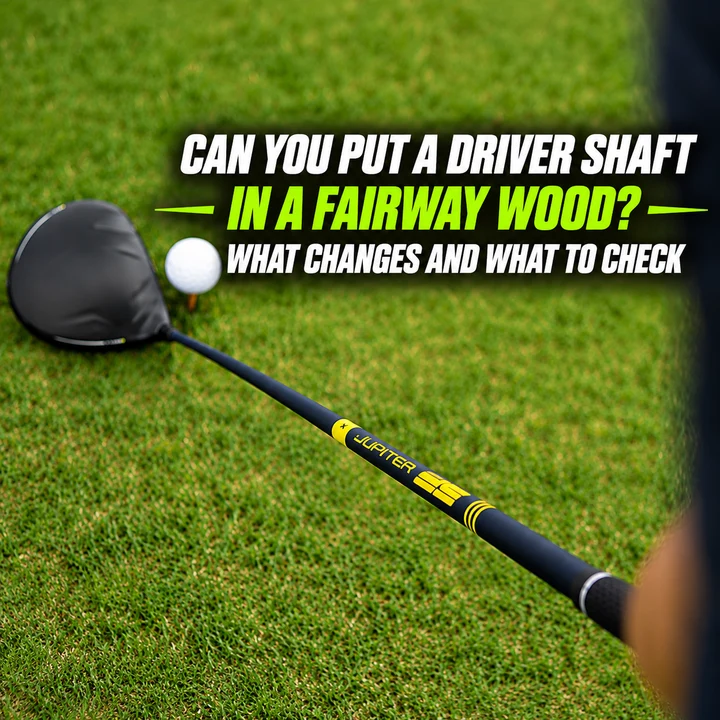
Yes, you can put a Driver Shaft in a fairway wood in many cases, but it requires more than simply switching the shaft. Most modern drivers and fairway woods use a 0.335-inch shaft tip, making them potentially compatible. However, shaft length, flex, adapter compatibility, and swing weight must be considered to maintain proper club performance.
If you've ever wondered whether your favorite driver shaft could work in a 3 wood or 5 wood, you're not alone. Golfers often explore this option to create a consistent feel throughout their clubs, reuse an existing shaft, or experiment with different launch characteristics.
However, a shaft that performs well in your driver won't necessarily deliver the same results in a fairway wood.
Understanding the differences can help you decide whether modifying your current shaft makes sense or investing in a dedicated fairway wood shaft is the better option.
What Is the Difference Between a Driver Shaft and a Fairway Wood Shaft?
The biggest differences between driver and fairway wood shafts are their playing length, weight, trimming specifications, and intended clubhead characteristics.
Although both are designed to transfer energy during the golf swing, they are typically configured for different clubhead weights and playing conditions.
1. Shaft length
A standard men's driver commonly measures around 45.5 inches, while a 3 wood typically measures approximately 43 inches and a 5 wood around 42 inches.
These measurements refer to the assembled club's playing length, not necessarily the uninstalled shaft's physical length.
Shorter clubs can be easier for some golfers to control, but reducing shaft length also changes the club's overall balance and feel.
2. Shaft weight
Fairway wood shafts are often heavier than driver shafts.
For example, a golfer using a 55-gram driver shaft might consider a fairway wood shaft weighing approximately 60–70 grams, depending on the shaft model and fitting requirements.
The additional weight may help achieve a preferred balance and tempo with the heavier fairway wood head.
However, heavier isn't automatically better. Golfers with slower swing speeds or smoother transitions may prefer lighter configurations.
3. Shaft stiffness and profile
A driver shaft and a fairway wood shaft may share the same labeled flex while having different trimming requirements and playing characteristics.
The shaft's bend profile influences how it loads and unloads during the swing.
A properly fitted High Performance Golf Shaft should complement your swing speed, transition, delivery, and desired ball flight rather than simply match a stiffness label.
Will a Driver Shaft Fit a 3 Wood or 5 Wood?
In many cases, yes. Modern drivers and fairway woods commonly use a 0.335-inch tip diameter, allowing compatible shafts to be installed in either type of clubhead.
However, matching tip diameter alone does not guarantee compatibility.
Understanding shaft tip diameter
The tip diameter refers to the width of the shaft where it connects to the clubhead.
A 0.335-inch tip is common in modern metal woods. Some older clubs and certain other designs use different dimensions.
Before attempting a shaft conversion, confirm the specifications of both the shaft and the clubhead.
Adapter compatibility matters
Many modern golf clubs use manufacturer-specific adjustable adapters.
A shaft fitted with one brand's adapter may not fit another brand's clubhead. Compatibility can also differ between models and generations from the same manufacturer.
For example, a driver shaft with a particular adjustable adapter may require a different adapter to fit a 3 wood.
Always confirm the exact head model, adapter design, and shaft specifications before making changes.
What about hybrid golf clubs?
Hybrid shafts require separate consideration.
Many hybrids use a 0.370-inch tip diameter, although specifications vary by manufacturer and model.
Therefore, never assume that a driver shaft compatible with a fairway wood will also fit a hybrid.
What Happens When You Cut a Driver Shaft for a Fairway Wood?
Shortening a driver shaft changes the club's playing length, balance, and potentially its effective stiffness.
However, the outcome depends heavily on how the shaft is trimmed and how the completed club is assembled.
Butt trimming vs. tip trimming
There are two primary methods of shortening a golf shaft.
Butt trimming removes material from the grip end. It reduces length while generally preserving more of the shaft's original tip-section characteristics.
Tip trimming removes material from the clubhead end. Depending on shaft construction, it can increase effective stiffness and alter how the shaft responds during the swing.
Not every shaft is designed to be tip-trimmed, and excessive trimming can make a shaft unsuitable for its intended installation.
Always follow the shaft manufacturer's trimming instructions.
Does shortening a driver shaft make it stiffer?
Shortening a shaft can increase its structural stiffness, but the club's actual playing feel also depends on head weight, trimming location, and final assembly.
A heavier fairway wood head may change how the shortened shaft loads during the swing.
This is why simply cutting a driver shaft to fairway wood length does not guarantee a predictable flex or ball flight.
Understanding Driver Shaft Flex is essential before making modifications, particularly when trying to preserve a familiar feel.
How Does Swing Weight Change After a Shaft Conversion?
Swing weight describes how a golf club's weight is distributed relative to a standardized balance point.
It is not the same as the club's total weight.
When a driver shaft is shortened, the club's swing weight generally decreases if other components remain unchanged. Installing a heavier fairway wood head can offset some or all of that change.
The final result depends on several factors, including:
-
Playing length
-
Clubhead weight
-
Shaft balance point
-
Grip weight
-
Adapter and other components
A professional club builder can measure the completed club and make adjustments based on the golfer's preferred feel.
Swing weight matters because two clubs with similar overall weights can feel noticeably different during the swing.
For golfers considering Custom Golf Shafts, proper assembly and balance are just as important as selecting the correct flex.
Can a Driver Shaft Change Fairway Wood Distance and Accuracy?
Yes. Changing the shaft can affect how a golfer delivers the clubhead, potentially influencing launch angle, spin, contact consistency, dispersion, and distance.
However, these changes are golfer-dependent.
A shaft that helps one player produce a more consistent ball flight may not deliver the same results for another.
Distance considerations
Golfers searching for the Best Golf Shaft for Distance should understand that shaft performance depends on more than stiffness or material.
Swing speed, centered contact, launch angle, spin rate, and clubhead delivery all influence distance.
A poorly matched shaft can make consistent contact more difficult, while a properly fitted shaft may help a golfer deliver the club more repeatably.
Accuracy considerations
Choosing a Driver Shaft for Accuracy involves evaluating shot dispersion, face control, strike consistency, and feel.
A shaft that feels stable during the driver swing may not provide the same sensation when paired with a heavier fairway wood head.
For this reason, accuracy should be evaluated using actual shot patterns rather than marketing claims.
Launch and spin
A shaft's weight, bend profile, and stiffness can influence the golfer's delivery and resulting launch conditions.
However, shaft specifications alone cannot reliably predict launch angle or spin.
Testing with a launch monitor is the most useful way to compare different configurations.
How Do You Choose the Right Driver Shaft Flex for a Fairway Wood?
Choosing the correct shaft flex starts with your swing speed, but tempo, transition, and ball flight also matter.
A golfer with a smooth transition may prefer a different shaft profile from someone who swings at the same speed but changes direction aggressively.
Steadfast Golf provides the following starting ranges for its JUPITER One shafts:
-
Senior Flex: 70–89 mph
-
Regular Flex: 90–99 mph
-
Stiff Flex: 100–109 mph
-
X-Stiff Flex: 110–129 mph
These are manufacturer-specific fitting guidelines, not universal rules for every shaft brand.
Fiber Golf Shafts+1
Golfers researching the best senior driver shafts should pay particular attention to shaft weight, comfortable loading, and consistent contact.
A lighter shaft may help some golfers maintain clubhead speed, while others prefer a slightly heavier shaft for better tempo.
Likewise, a Carbon fiber golf shaft can be manufactured with different weights, torque characteristics, and bend profiles. The material alone does not determine whether a shaft is suitable for your swing.
The Best Driver Shaft for your game is the one that helps you produce repeatable contact, suitable launch conditions, and consistent dispersion.
When Does Putting a Driver Shaft in a Fairway Wood Make Sense?
Converting a driver shaft may be worth considering when you already own a suitable spare shaft, prefer its feel, and want to experiment with a shorter club configuration.
It is more practical when:
-
Your driver and fairway wood swings have similar tempos.
-
You already know how the shaft performs.
-
The shaft's tip diameter and adapter requirements are compatible.
-
A professional club builder can perform the work.
-
The conversion costs less than purchasing a suitable fairway wood shaft.
-
You understand the possible warranty implications.
Even when these conditions are met, testing the finished club is important.
A successful conversion should be judged by consistent contact, launch conditions, dispersion, and on-course performance.
When Is a Dedicated Fairway Wood Shaft the Better Choice?
A dedicated fairway wood shaft is often the more practical choice when you want a predictable starting point without modifying an existing driver shaft.
Fairway woods are commonly used from both the tee and the turf, so a suitable setup should help you deliver the club consistently in different situations.
A purpose-configured shaft can offer several practical advantages.
Appropriate playing length: It is supplied or built for the intended fairway wood configuration.
Suitable weight options: You can select a weight that complements the clubhead and your swing.
Manufacturer-defined specifications: Trimming and assembly can follow the intended product configuration.
Simpler installation: Choosing the correct adapter can reduce unnecessary modifications.
Golfers comparing the Best Performance Golf Shafts should focus on measurable fitting results rather than assuming one shaft design will outperform every alternative.
A dedicated wood shaft from a familiar product family can also help maintain a consistent feel throughout the top of the bag.
For a related comparison, read Steadfast Golf's Mini Driver vs. 3 Wood: Which Shaft to Pick?.
Can You Use a Steadfast Golf JUPITER One Driver Shaft in a Fairway Wood?
A Steadfast Golf JUPITER One driver shaft may be physically adaptable to certain fairway wood heads, but choosing the corresponding JUPITER One fairway wood shaft is generally the better starting point.
Steadfast Golf offers dedicated shafts for drivers, 3 woods, and 5 woods, allowing golfers to select a configuration intended for each club.
JUPITER One Driver Shaft
The JUPITER One driver is offered at a 45.5-inch playing length.
Its listed weights vary by flex:
-
Senior: 50 grams
-
Regular: 55 grams
-
Stiff: 58 grams
-
X-Stiff: 61 grams
This provides a range of shaft weights for golfers with different swing speeds and preferences.
JUPITER One 3 Wood Shaft
The JUPITER One 3 Wood Shaft is designed for a 43-inch playing length.
Its listed weights are:
-
Senior: 59 grams
-
Regular: 62 grams
-
Stiff: 65 grams
-
X-Stiff: 68 grams
Compared with the matching driver shaft, the 3 wood model is approximately 7–9 grams heavier, depending on flex.
This reflects a common fitting approach of using a somewhat heavier shaft in a fairway wood.
Fiber Golf Shafts
JUPITER One 5 Wood Shaft
The JUPITER One 5 Wood Shaft is configured for a 42-inch playing length.
Its listed weights are:
-
Senior: 58 grams
-
Regular: 62.5 grams
-
Stiff: 67.5 grams
-
X-Stiff: 71.2 grams
These options allow golfers to explore different weight and flex combinations without relying on an improvised driver shaft conversion.
What About Custom Builds?
Golfers who need a particular playing length or configuration can explore Steadfast Golf's JUPITER One 3-Wood Shaft Custom Build.
Custom fitting can be especially useful when a golfer prefers a nonstandard length or needs a specific adapter and grip configuration.
Steadfast Golf also offers a JUPITER One 2 Shaft Bundle for golfers who want to pair their driver with a 3 wood or 5 wood shaft.
Before modifying an existing shaft, review the manufacturer's current warranty terms and shaft flex satisfaction guarantee. Modifications may affect warranty eligibility, and custom orders may have different conditions.
What Should You Check Before Changing Your Golf Shaft?
Before replacing or modifying any Golf Shaft, confirm the technical details and fitting requirements.
A simple pre-installation checklist can help prevent expensive mistakes.
1. Confirm tip compatibility. Check the shaft's tip diameter and the clubhead's hosel requirements.
2. Identify the correct adapter. Make sure the adapter is designed for your exact fairway wood model.
3. Check trimming instructions. Never assume every shaft can safely be tip-trimmed.
4. Choose an appropriate playing length. Consider your height, swing characteristics, and contact consistency.
5. Evaluate shaft weight and flex. Match the configuration to your swing rather than relying on labels alone.
6. Measure swing weight. Have a club builder evaluate the completed assembly.
7. Review warranty conditions. Understand whether alterations affect the manufacturer's coverage.
8. Test performance. Compare launch, spin, dispersion, and strike consistency before deciding whether the conversion works.
The goal isn't simply to make a shaft fit. It's to build a club that performs reliably for your swing.
Frequently Asked Questions
1. Can I put a driver shaft in a 3 wood?
Yes, many driver shafts can be installed in a 3 wood because both commonly use a 0.335-inch tip diameter. However, the shaft must have the correct adapter and be configured for the appropriate playing length. Trimming, shaft weight, flex, and swing weight should be evaluated by a qualified club builder before installation.
2. Is a driver shaft the same as a fairway wood shaft?
No. Although they may share the same tip diameter and shaft family, driver and fairway wood shafts are generally configured differently. Fairway wood shafts are usually shorter and often heavier. Their trimming requirements may also differ to accommodate the heavier clubhead and the golfer's preferred playing characteristics.
3. Will shortening a driver shaft make it stiffer?
Shortening a shaft changes its mechanical characteristics, but the effect depends on where material is removed. Tip trimming generally increases effective stiffness, while butt trimming primarily reduces length. Clubhead weight and final assembly also influence playing feel. Always consult the shaft manufacturer's trimming instructions before modifying a shaft.
4. Should my 3 wood shaft be heavier than my driver shaft?
A 3 wood shaft is often somewhat heavier than the matching driver shaft, but this is not a universal requirement. Some golfers prefer similar weights throughout their woods, while others benefit from additional weight. Swing speed, tempo, balance, and contact consistency should guide the decision.
5. Can the wrong shaft affect fairway wood accuracy?
Yes. An unsuitable shaft can influence a golfer's timing, club delivery, strike consistency, and shot dispersion. However, the effects vary between players. A shaft fitting that compares different weights, flexes, and bend profiles can help identify a configuration that produces more repeatable results.
6. Are carbon fiber golf shafts good for fairway woods?
Yes. Carbon fiber shafts are widely used in modern fairway woods because they can be manufactured in a variety of weights, stiffness profiles, and torque characteristics. Their suitability depends on the specific design and the golfer's needs, rather than the material alone.
7. Will changing my driver shaft void my golf club warranty?
It depends on the manufacturer and the modification. Some brands permit conventional reshafting, provided the work does not cause the damage being claimed. Others may restrict coverage after alterations. Review both the clubhead and shaft warranty terms before making permanent changes.
8. Should I buy a fairway wood shaft instead of modifying a driver shaft?
For many golfers, purchasing a dedicated fairway wood shaft is the simpler option. It avoids unnecessary trimming and provides a configuration intended for the club. Converting an existing driver shaft may still be worthwhile when the shaft is compatible, the cost is reasonable, and a qualified builder performs the work.
Final Thoughts: Should You Put a Driver Shaft in a Fairway Wood?
A Driver Shaft can often be adapted for a fairway wood, but compatibility is only the first consideration.
Playing length, shaft weight, flex, swing weight, adapter design, and manufacturer trimming instructions all influence the finished club.
If you already own a compatible shaft and want to experiment, professional club building and proper testing can help determine whether the conversion is worthwhile.
However, for golfers who want a simpler and more predictable starting point, a dedicated fairway wood shaft from the same shaft family is often the better choice.
Ready to explore your options? Visit Steadfast Golf to compare driver and fairway wood shafts and find a configuration that suits your swing.

 English
 Arabic
 French
 Spanish
 Portuguese
 Deutsch
 Turkish
 Dutch
 Italiano
 Russian
 Romaian
 Portuguese (Brazil)