


Chrome Ores Market Growth, Trends, DROT, Analysis & Forecast Analysis By Fact.MR
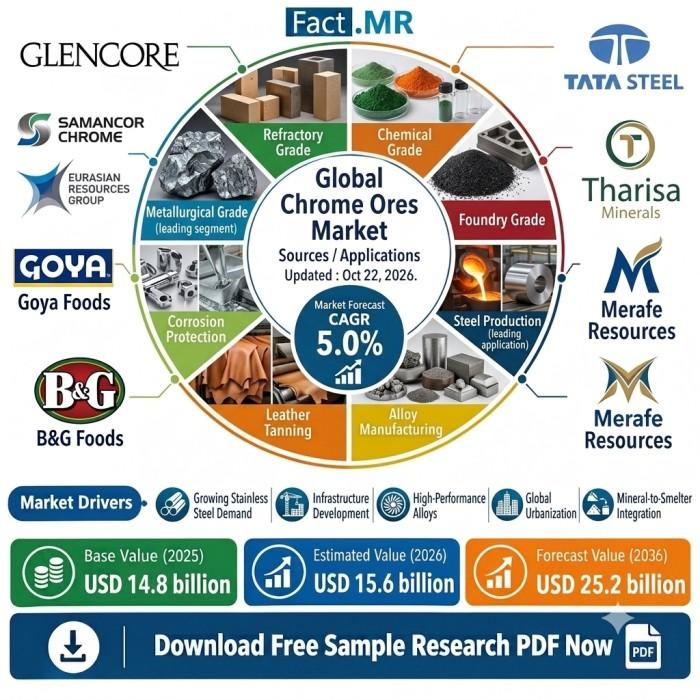
Rockville, Maryland, 2 November 2026 – The global chrome ores market is estimated at USD 15.6 billion in 2026 and is projected to reach USD 25.2 billion by 2036, expanding at a CAGR of 5.0% during the forecast period, according to Fact.MR.
The market generated USD 14.8 billion in 2025. Forecast growth reflects demand from ferrochrome smelters, steel manufacturers and specialist mineral processors seeking chrome ore with consistent chromium content and suitable impurity specifications. Metallurgical-grade chrome ore accounts for 62.3% of product revenue, while metallurgy represents 54.7% of application demand in 2026.
Mining companies, mineral traders and industrial procurement teams can examine the latest market forecasts, segment shares and country-level opportunities in Fact.MR's research. Get a Sample of the Detailed Market Study:
The short version
- The global chrome ores market is forecast to increase from USD 15.6 billion in 2026 to USD 25.2 billion by 2036, creating an additional market opportunity of USD 9.6 billion.
- Metallurgical-grade chrome ore leads product demand with a 62.3% share, while metallurgy accounts for 54.7% of application revenue.
- Germany leads the five-country growth forecast at 6.2% CAGR. The United Kingdom follows at 5.6%, while Brazil is projected to grow at 4.7%.
Three numbers that matter
USD 25.2 billion: Projected global market value by 2036.
62.3%: Share of 2026 market revenue attributed to metallurgical-grade chrome ore.
54.7%: Revenue share of metallurgy applications in 2026.
These figures point towards a market where chromium recovery, ore consistency, mineral processing efficiency and reliable supply arrangements influence purchasing decisions.
Where growth is strongest
Fact.MR identifies five country markets in its forecast. Germany records the highest projected growth, followed by the United Kingdom. Brazil offers opportunities linked to domestic chromite production, while the United States remains dependent on international chromium supply.
- Germany: CAGR (2026–2036) of 6.2% — Growth opportunity: Specialty steel production, ferrochrome consumption and quality-focused alloy manufacturing.
- United Kingdom: CAGR (2026–2036) of 5.6% — Growth opportunity: Specialist alloy requirements and imported chromium-bearing materials.
- Brazil: CAGR (2026–2036) of 4.7% — Growth opportunity: Domestic chromite production, mineral processing and ferroalloy supply.
- USA: CAGR (2026–2036) of 4.3% — Growth opportunity: Imported chromium materials, industrial-grade requirements and supply diversification.
- Japan: CAGR (2026–2036) of 3.9% — Growth opportunity: Established steel production and precision-alloy manufacturing.
Why these markets matter
- Germany: Specialty steel and heat-resistant alloy manufacturers require dependable chromium-bearing inputs. The country's projected CAGR of 6.2% makes it the fastest-growing market among the five countries covered.
- United Kingdom: Manufacturers using corrosion-resistant and specialist alloys require consistent material specifications. The market is forecast to expand at 5.6% CAGR.
- Brazil: Chromite production in Bahia supports domestic mineral processing and ferroalloy activities. The country's projected CAGR is 4.7%.
- USA: High dependence on imported chromium materials creates opportunities for suppliers capable of delivering consistent quality and dependable shipments. The projected CAGR is 4.3%.
- Japan: Established metalworking and alloy industries continue to require chromium-bearing materials with controlled composition. The projected CAGR is 3.9%.
Who is moving: dated developments and key players
The competitive landscape includes mining companies, mineral processors and integrated chromium producers. Their market positions differ according to mining locations, ore grades, processing capabilities, concentrate specifications and access to ferrochrome customers.
Developments highlighted in the report
- January 2025 – United States: The U.S. Geological Survey's Mineral Commodity Summaries 2025 estimated that net import reliance accounted for 77% of apparent chromium consumption in 2024. This highlights the importance of international supply chains for American chromium users.
- October 2025 – Brazil: The Brazilian National Mining Agency reported approximately 530,000 tonnes of chromite production in 2024 in its 2025 mineral summary. Domestic production supports Brazil's position in the chrome ore and ferroalloy supply chain.
- January 2026 – Global steel industry: World Steel Association reporting highlighted global crude steel production trends, providing important downstream context for chromium-bearing alloy demand.
- February 2026 – European steel industry: World Stainless Association reported that the European Union produced 5.7 million tonnes of stainless steel in 2025. This provides context for chromium-bearing material requirements across European steel production.
Key players profiled by Fact.MR
- Glencore
- Samancor Chrome
- Eurasian Resources Group
- Tata Steel
- Tharisa Minerals
- Merafe Resources
- Yilmaden Holding
- Afarak Group
Glencore and Samancor Chrome operate within the South African chromium supply chain. Eurasian Resources Group and Yilmaden have mining and ferroalloy activities, while Tharisa Minerals markets chrome concentrates alongside other mineral products.
Merafe Resources participates in the Glencore-Merafe Chrome Venture. Tata Steel has links to the chrome ore and ferroalloy value chain, while Afarak Group serves specialist chromium operations.
The competitive opportunity extends beyond extracting chromite. Suppliers must deliver ore with suitable chromium content, controlled gangue levels and consistent shipment characteristics. These factors influence smelter efficiency, blending requirements and the commercial value of individual consignments.
Where to act
Prioritise metallurgical-grade production: Metallurgical-grade chrome ore accounts for 62.3% of product revenue. Mining companies should focus on chromium recovery, ore beneficiation and consistent concentrate specifications to meet ferrochrome smelter requirements.
Strengthen relationships with ferrochrome producers: Metallurgy represents 54.7% of application revenue. Suppliers can develop long-term contracts with smelters by demonstrating stable mineral composition and dependable shipment quality.
Develop specialised mineral processing capabilities: Chemical, refractory and foundry applications require different mineral characteristics. Producers can explore these markets through grade-specific processing, impurity management and customer qualification.
Improve mine-to-smelter logistics: Transportation and port constraints affect delivered ore costs. Integrated logistics planning, shipment tracking and reliable export arrangements can improve supply-chain performance.
Prioritise high-growth markets: Germany and the United Kingdom offer the strongest projected country growth. Suppliers should assess customer requirements across specialty steel, ferrochrome and chromium-bearing alloy industries.
Where to be careful
- Electricity costs: Ferrochrome production is energy-intensive. Higher electricity costs can affect smelter operating economics and purchasing decisions.
- Ore grade variability: Changes in chromium content and gangue composition can increase blending requirements and reduce processing efficiency.
- Freight and port constraints: Delays and transportation costs can affect export competitiveness and delivered material prices.
- Ferrochrome market fluctuations: Changes in downstream alloy demand can influence smelter purchasing volumes and chrome ore procurement.
- Customer qualification: Chemical, refractory and foundry processors require specific mineral characteristics. Suppliers may need additional testing before securing repeat contracts.
The commercial priority should be to balance production efficiency, consistent mineral quality and dependable logistics while developing relationships with downstream processors.
Analyst quote
Shambhu Nath Jha, Principal Consultant at Fact.MR, explains:
"Chrome ore contracts depend on recoverable chromium and the consistency of each shipment. Smelters often prefer a stable mineral composition because changes in the feed can raise blending and processing costs."
His assessment highlights why mining companies and mineral traders need to demonstrate consistent ore quality. Chromium recovery, impurity levels and shipment specifications should guide commercial discussions with ferrochrome producers and industrial buyers.
Unlock Actionable Insights from the Complete Report:
Questions for your next planning meeting
- Which ferrochrome producers and steel manufacturers should we approach for long-term chrome ore supply agreements?
- Can our current mining and beneficiation capabilities consistently deliver the chromium content and impurity specifications required by smelters?
- How can we improve mine-to-smelter logistics while reducing freight exposure and shipment delays?
- Should we prioritise metallurgical-grade production or develop chemical, refractory and foundry-grade product capabilities?
- Which country markets offer the strongest opportunities for expanding our chrome ore export business?
Explore More Related Studies Published by Fact.MR Research
Diethylene Glycol Monomethyl Ether Market
2,3-Pyridinedicarboxylic Acid Market
Expanded Polystyrene (EPS) Recycling Market
About Fact.MR
Fact.MR is a market research and consulting firm providing market intelligence, industry analysis and strategic insights to businesses across multiple sectors.
Its research covers market sizing, forecasts, competitive landscapes, segment analysis, country-level opportunities and industry developments. Fact.MR supports manufacturers, investors, procurement teams and business leaders with information for strategic planning and commercial decision-making.
Media Contact
Fact.MR
Email: sales@factmr.com
Website: https://www.factmr.com

 English
 Arabic
 French
 Spanish
 Portuguese
 Deutsch
 Dutch
 Italiano
 Russian
 Romaian
 Portuguese (Brazil)
 Greek