


Biochar Market Set to Hit USD 1.399 Billion by 2036, Featuring Charm Industrial, Airex Energy and Pacific Biochar
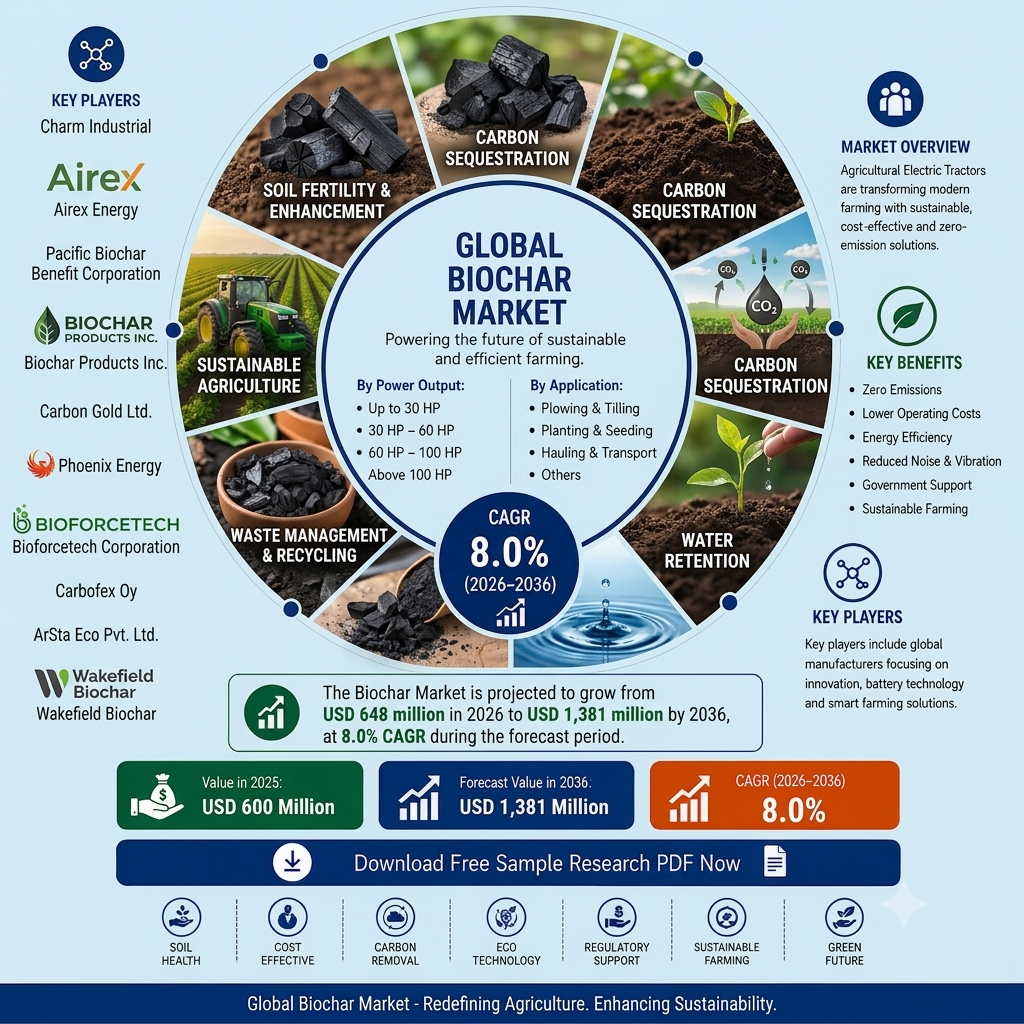
The global biochar market is projected to increase from approximately USD 600 million in 2025 to USD 648 million in 2026 and reach USD 1.399 billion by 2036, expanding at a compound annual growth rate (CAGR) of 8.0% during the forecast period. The market is gaining momentum as agricultural producers seek solutions for soil degradation and businesses explore carbon removal technologies. Government-backed sustainability initiatives and growing interest in carbon credit markets are also creating opportunities for biochar manufacturers.
Biochar is a carbon-rich material produced by heating biomass, such as agricultural residues, forestry waste, and animal manure, through thermochemical processes including pyrolysis. Its ability to improve soil structure, support nutrient retention, and store carbon for extended periods is expanding its role across agriculture, environmental management, and industrial applications.
Get detailed market forecasts, competitive benchmarking, and pricing trends: https://www.factmr.com/connectus/sample?flag=S&rep_id=3781
Market Snapshot
- 2025 Market Value: USD 600 million
- 2026 Market Value: USD 648 million
- 2036 Forecast Value: USD 1.399 billion
- Forecast CAGR (2026–2036): 8.0%
- Absolute Dollar Opportunity: USD 742 million
- Key Feedstock Categories: Agricultural waste, forestry residues, animal manure, and others
- Production Technologies: Pyrolysis, gasification, and hydrothermal carbonization
- Key Applications: Soil amendment, animal feed, water treatment, and construction materials
Soil Restoration and Carbon Markets Expand Biochar Demand
Agriculture remains an important demand center for biochar. Declining soil fertility, water stress, and concerns about long-term agricultural productivity are encouraging farmers to consider soil amendments that improve water retention and nutrient availability. Biochar can support these objectives while providing a way to convert agricultural residues into value-added materials.
Carbon sequestration is creating another growth avenue. Biochar stores carbon in a relatively stable form, making it relevant to carbon removal projects and voluntary carbon markets. Producers are increasingly looking beyond physical product sales toward certified carbon removal offerings and partnerships with corporate buyers.
Pyrolysis remains an important production technology because it converts biomass into stable carbon-rich material. Advances in processing systems and localized production facilities are helping manufacturers improve feedstock utilization and manage transportation costs.
Demand is also expanding beyond agriculture. Water treatment applications use biochar's adsorption properties, while construction companies are exploring its potential in carbon-conscious building materials. Livestock feed applications provide another area for product development.
India Leads Country Growth Outlook
India is projected to record the fastest growth among the countries covered, with a 9.5% CAGR through 2036. Its large agricultural base, government-backed soil health initiatives, and growing interest in organic farming and carbon sequestration are supporting market expansion.
China follows with an anticipated CAGR of 8.8%, driven by carbon neutrality initiatives, biomass availability, and investments in pyrolysis infrastructure. Japan and Canada are each forecast to grow at 7.2%, supported by sustainable land management and carbon sequestration investments. The United States is projected to register a 6.0% CAGR, while Germany is expected to expand at 5.4%.
Strategic Outlook
Fact.MR's analysis indicates that the market is moving beyond conventional agricultural biochar toward specialized products linked to carbon certification and application-specific performance. Producers are increasingly focusing on consistent carbon content, product quality, and measurable soil or environmental outcomes. Businesses combining production capabilities with carbon certification, feedstock security, and technical advisory services are positioned to address this changing demand.
Competitive Landscape
The biochar market remains relatively fragmented, with climate technology companies and biomass processing specialists competing to expand production and develop differentiated applications.
Key companies profiled in the Fact.MR report include Charm Industrial, Airex Energy, Pacific Biochar Benefit Corporation, Biochar Products Inc., Carbon Gold Ltd., Phoenix Energy, Bioforcetech Corporation, Carbofex Oy, ArSta Eco Pvt. Ltd., and Wakefield Biochar.
Competition increasingly centers on production scalability, feedstock sourcing, carbon measurement, product consistency, and application-specific performance. Companies are investing in advanced pyrolysis systems and decentralized production models to secure biomass supplies and reduce logistics costs. Carbon certification and partnerships with carbon marketplaces are also becoming important ways to differentiate offerings.
However, feedstock availability, energy expenses, and transportation costs can affect production economics. Limited access to reliable biomass supplies and evolving carbon certification requirements may also influence project development. Suppliers that establish stable sourcing networks and demonstrate measurable environmental outcomes can strengthen their market position.
To View Related Reports
https://sportgalax.com/read-blog/27100
https://afgbfh.blogspot.com/2026/11/voice-prosthesis-devices-market.html
About Fact.MR
Fact.MR is a market research and competitive intelligence provider delivering market intelligence, competitive analysis, and forecasting across global industries. Its research helps businesses evaluate market demand, understand competitive developments, and identify growth opportunities.

 English
 Arabic
 French
 Spanish
 Portuguese
 Deutsch
 Turkish
 Dutch
 Russian
 Romaian
 Portuguese (Brazil)
 Greek