


United States Chocolate Market Size, Share, Demand, Trends and Forecast 2026-2034
IMARC Group has recently released a new research study titled "United States Chocolate Market Report by Product Type (White Chocolate, Milk Chocolate, Dark Chocolate, and Others), Product Form (Molded, Countlines, and Others), Application (Food Products, Beverages, and Others), Pricing (Everyday Chocolate, Premium Chocolate, Seasonal Chocolate), Distribution (Direct Sales (B2B), Supermarkets and Hypermarkets, Convenience Stores, Online Stores, and Others), and Region 2026-2034", offering a detailed analysis of the market drivers, segmentation, growth opportunities, trends, and competitive landscape to understand the current and future market scenarios.
United States Chocolate Market Size & Share 2026-2034
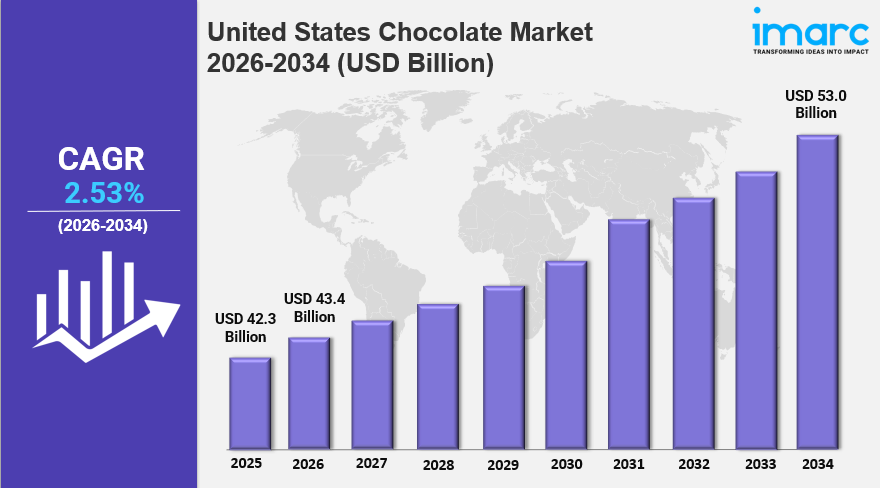
The United States chocolate market grew from USD 42.3 Billion in 2025 to USD 43.4 Billion in 2026 and is projected to reach USD 53.0 Billion by 2034, expanding at a CAGR of 2.53% during 2026-2034. In 2026, the market is being shaped by a shift toward premium, artisanal, and dark chocolate, continued flavor and ingredient innovation, and seasonal gifting, while elevated prices and cautious household spending are keeping unit volumes under pressure.
The market is segmented by product type (white chocolate, milk chocolate, dark chocolate, and others), product form (molded, countlines, and others), application (food products, beverages, and others), pricing (everyday chocolate, premium chocolate, and seasonal chocolate), distribution (direct sales (B2B), supermarkets and hypermarkets, convenience stores, online stores, and others), and region (Northeast, Midwest, South, and West). Widespread availability across retail channels and rising demand for health-oriented and ethically sourced products are expected to support the United States chocolate market demand of both established confectioners and specialty producers throughout the forecast period.
Key Market Statistics at a Glance
- Base Year: 2025
- Historical Years: 2020-2025
- Forecast Period: 2026-2034
- Market Size (2025): USD 42.3 Billion
- Market Size (2026): USD 43.4 Billion
- Projected Market Size (2034): USD 53.0 Billion
- Growth Rate: CAGR of 2.53% (2026-2034)
Explore Opportunities in the United States Chocolate Market: Download the IMARC Sample Report: https://www.imarcgroup.com/united-states-chocolate-market/requestsample
Key Growth Drivers and Trends in the United States Chocolate Market
Growth in the United States chocolate market is being driven primarily by changing consumer preferences toward premium and artisanal chocolate. Shoppers are moving from traditional mass brands toward chocolatiers that use higher-quality beans and more natural processing, and they prioritize quality and uniqueness over mass-produced products. Rising incomes and gourmet food culture have lifted demand for specialty and luxury chocolate, and ethical sourcing, fair trade, and sustainable production are increasingly used to appeal to socially conscious buyers.
One of the leading United States chocolate market trends is rising health consciousness and the popularity of dark chocolate. Its higher cocoa content, antioxidant properties, and lower sugar content relative to milk chocolate align with the preference for healthier indulgence, and manufacturers are widening their ranges with different cocoa percentages and flavor profiles. The same preference is pushing brands toward better-for-you positioning: Mondelez agreed in October 2026 to acquire Undercover Snacks, known for chocolate-covered quinoa crisps, and vegan, functional, and low-sugar chocolates continue to gain shelf space.
Another key factor supporting United States chocolate market growth is innovation in flavors, ingredients, and formats, together with seasonal demand. Manufacturers are introducing combinations such as chocolate with berries, spices, nuts, seeds, and crisp inclusions, and a growing number of makers are moving into bean-to-bar production. Holidays such as Christmas, Easter, Valentine's Day, and Halloween remain major sales periods, and Ferrero's April 2026 opening of a USD 75 Million Nutella Peanut production line in Franklin Park, Illinois reflects continued investment in new products and domestic manufacturing.
Speak to an Analyst: https://www.imarcgroup.com/request?type=report&id=19264&flag=C
United States Chocolate Industry Segmentation Insights
Breakup by Product Type:
- White Chocolate: Valued for its creamy texture and sweet flavor, and used as a versatile ingredient in baking and desserts; flavor infusions and gift assortments support demand.
- Milk Chocolate: The broadest-appeal category, offered in bars, bites, and coated nuts and fruits, and widely used in snacks and bakery products.
- Dark Chocolate: Supported by health-conscious buyers seeking higher cocoa content, lower sugar, and antioxidant benefits, as well as ethical sourcing claims.
- Others: Includes ruby chocolate, vegan chocolate, and chocolates with functional ingredients such as protein or superfoods.
Breakup by Product Form:
- Molded: Chocolate in decorative shapes and designs, often bought as gifts and for festive occasions and associated with premium quality.
- Countlines: Bars and individually wrapped pieces combining chocolate with nuts, caramel, or nougat for convenient on-the-go snacking, backed by strong brands.
- Others: Includes novelties, seasonal items, and chocolate-covered snacks, including limited-edition products.
Breakup by Application:
- Food Products: Covers bakery products, sugar confectionery, desserts, and others, where chocolate is used as an ingredient, filling, or coating in convenient and ready-to-eat foods.
- Beverages: Includes hot chocolate, chocolate-flavored drinks, and functional beverages, supported by clean-label and indulgent flavor trends.
- Others: Covers niche and emerging uses such as plant-based alternatives, premium artisanal items, and fair-trade products.
Breakup by Pricing:
- Everyday Chocolate: Mass-market bars and snacks sold in supermarkets and convenience stores, supported by affordability, wide pack-size choice, and frequent promotions.
- Premium Chocolate: High-cocoa, organic, and artisanal products made with ethically sourced cocoa, bought by consumers willing to pay more for quality and exclusivity.
- Seasonal Chocolate: Themed products for Christmas, Easter, Valentine's Day, and Halloween, with limited editions and decorative packaging driving impulse and gift purchases.
Breakup by Distribution:
- Direct Sales (B2B): Bulk and customized supply to hotels, restaurants, caterers, bakeries, and corporate gifting buyers.
- Supermarkets and Hypermarkets: One-stop retail with broad brand choice, competitive pricing, promotions, and in-store displays.
- Convenience Stores: Impulse and on-the-go purchases through single-serve formats in high-traffic locations; this channel is sensitive to higher fuel prices that squeeze shoppers.
- Online Stores: E-commerce with doorstep delivery, wide selection, exclusive brands, and subscription and personalized chocolate services.
- Others: Includes specialty stores and duty-free shops that offer curated, artisanal, and souvenir chocolates.
Breakup by Region:
- Northeast: A large and affluent market with strong demand for premium, specialty, and organic chocolate, concentrated in urban centers such as New York and Boston, and supported by tourism and European culinary heritage.
- Midwest: Strong baking and food-application demand and family-oriented holiday consumption, with local manufacturing and large retail chains supporting distribution.
- South: Driven by a taste for indulgent and comfort foods, festival culture such as Mardi Gras, and a diverse population with varied flavor preferences.
- West: Led by health-conscious and sustainability-minded consumers, with demand for organic, vegan, and ethically sourced chocolate in cities such as San Francisco and Los Angeles.
Key Challenges and Growth Opportunities in the United States Chocolate Market
The primary challenge for the United States chocolate market is cocoa price volatility. Global cocoa prices reached a record of about USD 10,710 per metric ton in January 2025 and have since come well off those highs, but manufacturers spent the past year raising prices to recover costs. Hershey reported net price realization of about 11% in the third quarter of 2026 alongside a volume decline of roughly 10 points, and it warned that higher gasoline prices, inflation, and interest rates are making shoppers more deliberate, with US candy, gum, and mint sales in convenience stores falling nearly 5% in September. Government data show candy and gum prices up 44% over the five years through September 2026. Sugar concerns, labeling requirements, and competition from other snacks and confectionery also weigh on the market.
The market nonetheless offers growth opportunities. Cocoa costs are normalizing, which Hershey says supports margin recovery, and Mondelez has pointed to a cocoa surplus as supply improves. Demand for premium, organic, dark, and better-for-you chocolate opens room for higher-value products, while innovation, seasonal programs, and e-commerce expansion can help brands win back volume. Mars has said it plans to invest USD 2 Billion in US manufacturing by the end of 2026, and Ferrero continues to expand domestic production, supporting capacity and product launches through 2034.
Competitive Landscape
The United States chocolate market is concentrated at the top and competitive, with large multinational confectioners competing alongside premium, artisanal, and bean-to-bar producers. Competition is centered on product innovation, flavor and ingredient quality, premium positioning, sustainable sourcing, digital marketing, and distribution that includes e-commerce. Leading players are also using seasonal and limited-edition launches and are adding better-for-you brands through acquisitions. Key players include The Hershey Company, Mars, Mondelez International, Ferrero, Lindt & Sprungli, and Nestle, along with specialty makers such as Godiva and Ghirardelli. The IMARC report covers detailed profiles of all major companies operating in the market.
Recent Developments in the United States Chocolate Market
- October 2026: Hershey reported third-quarter net sales up 3% to USD 3,275.5 Million, with North America Confectionery sales up 1.6% to USD 2.66 Billion on about 13% higher pricing and an 11% volume/mix decline; the company said it expects previously announced seasonal price increases to continue into 2027.
- October 2026: Mondelez reported North America third-quarter net revenue up 1.1% to USD 2.85 Billion with flat volume/mix, and announced an agreement to acquire Undercover Snacks, a US better-for-you brand of chocolate-covered quinoa crisps.
- October 2026: Ahead of Halloween, Hershey warned that high gas prices and inflation were weighing on candy purchases, while government data showed candy and gum prices up 44% over five years through September.
- April 2026: Ferrero North America opened a USD 75 Million Nutella Peanut production line in Franklin Park, Illinois, creating 50 jobs and marking the first US-made Nutella product.
- 2025-2026: Mars set a plan to invest USD 2 Billion in US manufacturing and innovation by the end of 2026, building on USD 6 Billion committed over the preceding five years.
Author IMARC Group
IMARC Group is a leading global market research company providing data-driven insights and expert consulting services to businesses seeking to achieve their strategic objectives. With a multidisciplinary team of industry experts, IMARC delivers reliable market intelligence across sectors including Chemicals and Materials, Healthcare, Technology, Agriculture, and Retail.
Contact Us:
IMARC Group
Email: sales@imarcgroup.com
United States: +1-201-971-6302

 English
 Arabic
 Spanish
 Portuguese
 Deutsch
 Turkish
 Dutch
 Italiano
 Russian
 Romaian
 Portuguese (Brazil)
 Greek