


Palletizing Robot Market Forecast to Reach USD 5.74 Billion by 2036
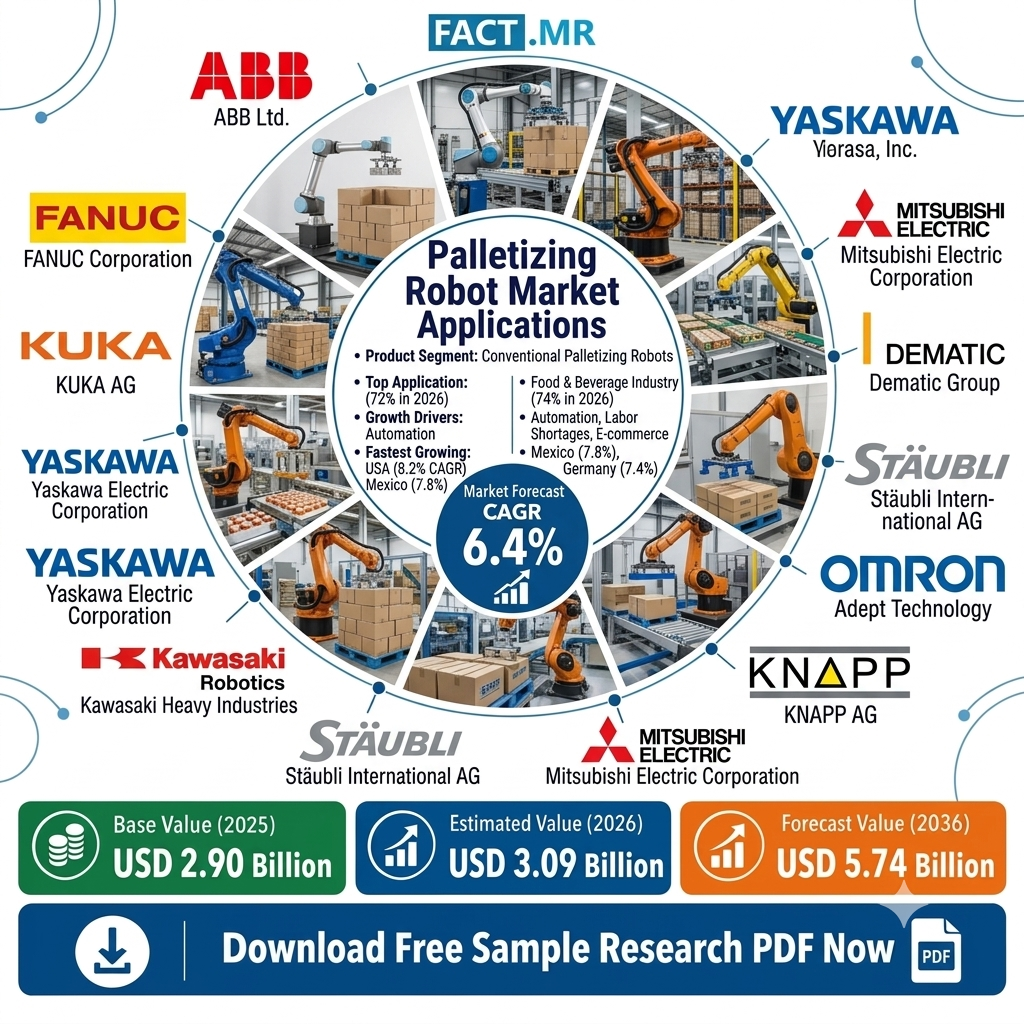
Rockville, MD, November 23, 2026 — The global palletizing robot market is projected to grow from USD 2.90 billion in 2025 to USD 5.74 billion by 2036, expanding at a compound annual growth rate (CAGR) of 6.4% during the forecast period, according to Fact.MR. The market is estimated to reach USD 3.09 billion in 2026, creating an absolute dollar opportunity of USD 2.65 billion between 2026 and 2036. Increasing automation across manufacturing facilities, warehouse labor shortages, and rising e-commerce fulfillment requirements are supporting investment in robotic palletizing systems.
Request for PDF Report Sample Pages: https://www.factmr.com/connectus/sample?flag=S&rep_id=8265
Palletizing robots are programmable automation systems designed to pick, place, and stack products onto pallets at the end of production and packaging lines. Demand is particularly strong in food and beverage manufacturing, where companies require consistent end-of-line operations at high throughput rates. The growing availability of collaborative robots is also bringing automated palletizing within reach of mid-sized manufacturers and third-party logistics providers.
The Short Version: Palletizing Robot Market Outlook
The palletizing robot market is moving beyond large-scale industrial installations. Manufacturers are increasingly evaluating systems that can operate within existing production layouts, handle different product configurations, and reduce dependence on manual pallet stacking.
According to Fact.MR, conventional palletizing robots will account for 72% of the product segment in 2026. The food and beverage industry will represent 74% of application demand during the same year. These figures underline the importance of established industrial applications even as collaborative and mobile systems gain attention.
The market is expected to generate USD 2.65 billion in additional revenue opportunities over the 2026–2036 period.
Collaborative Palletizing Robots Reshape Automation Demand
Conventional palletizing robots retain their leading position because of established industrial applications, broad product availability, and consistent demand from food processing and logistics operations. Their high-speed articulated arms support repetitive stacking tasks where throughput requirements remain substantial.
However, the next phase of adoption is increasingly associated with collaborative palletizing robots. These systems can operate alongside workers without requiring traditional safety fencing, making them suitable for facilities with limited floor space.
The practical difference matters. Smaller manufacturers often cannot justify the capital expenditure associated with conventional robotic installations. Collaborative systems offer a more accessible entry point through simpler programming and quicker deployment.
Payload capacity is expanding, too. Collaborative palletizing robots approaching the 20-to-25-kilogram payload range can accommodate a wider selection of packaging configurations. This extends their potential applications beyond lightweight consumer goods.
Vision-guided systems are also gaining relevance. E-commerce fulfillment centers and multi-product distribution facilities increasingly need equipment capable of recognizing mixed stock-keeping units (SKUs) and handling random case configurations. These requirements increase the importance of object recognition, specialized grippers, and software integration.
Three Numbers That Matter
- USD 5.74 billion: Projected global market value by 2036.
- 72%: Share of conventional palletizing robots in the product segment in 2026.
- 74%: Expected application share of the food and beverage industry in 2026.
The opportunity is not without constraints. High initial investment limits conventional robotic adoption among smaller manufacturers and third-party logistics operators. Existing facilities may also lack sufficient floor space for large robotic installations.
Mixed-SKU applications introduce another challenge. Vision equipment, gripper selection, and software integration can increase deployment costs and implementation time.
USA Leads Country-Level Growth
The USA is projected to record the fastest growth among the covered country markets, with an 8.2% CAGR through 2036. Its large installed equipment base, established distribution networks, and active end-use industries support both new installations and replacement demand.
Mexico follows at 7.8%, supported by industrial expansion and its proximity to North American supply chains. Germany is projected to expand at 7.4%, reflecting engineering-grade procurement standards and replacement cycles. France follows at 7%.
South Korea is expected to register a 6.6% CAGR, while the UK and Japan are projected to grow at 6.1% and 6%, respectively.
North America remains a leading regional market. Europe maintains demand through technology adoption and regulatory requirements, while Asia Pacific is emerging as a high-growth region.
Competitive Landscape and Industry Developments
The competitive environment includes established industrial automation manufacturers and warehouse technology providers. Key participants include FANUC Corporation, ABB Ltd., KUKA AG, Yaskawa Electric Corporation, Kawasaki Heavy Industries, Ltd., KNAPP AG, Dematic Group (a member of the KION Group), Stäubli International AG, Mitsubishi Electric Corporation, and Adept Technology, Inc. (a subsidiary of Omron Corporation).
Recent developments reflect changing customer requirements. FANUC Corporation expanded its palletizing robot lineup in January 2026 with payload capacity and cycle-speed improvements. ABB Ltd. advanced standardized collaborative palletizing configurations and simplified programming tools in 2025.
KUKA AG upgraded vision-guided mixed-case handling capabilities during 2025. Yaskawa Electric Corporation introduced compact palletizing robot cells in February 2026, targeting facilities where installation space remains limited.
Manufacturers are also competing through application support and aftermarket services. Gripper tooling, replacement components, and software upgrades represent additional revenue opportunities as the installed equipment base expands.
Analyst Perspective
Shambhu Nath Jha, Principal Consultant at Fact.MR, observes, "The structural labor shortage in warehousing and manufacturing is making manual palletizing increasingly difficult to staff and sustain. That is changing purchasing decisions."
He adds, "The opportunity is shifting toward collaborative and mobile palletizing solutions. Mid-sized operators need systems that are easier to install, train workers on, and maintain. Companies offering standardized, quick-deploy palletizing cells will be well placed to serve these first-time automation buyers."
Research Methodology and Market Coverage
Fact.MR's analysis combines secondary research, primary interviews, and forecast modelling. The research draws on more than 120 secondary sources and benchmarks over 65 company portfolios. Market sizing covers more than 30 countries, supported by 25-plus interviews with manufacturers, operators, and end users.
Fact.MR is a market research provider that delivers industry analysis, market sizing, competitive assessments, and long-term demand forecasts for business decision-makers.
The report examines palletizing robots by product, application, end use, formulation, distribution channel, and region. It also evaluates pricing, technology adoption, market constraints, and competitive positioning.
View Related Reports :
Laser Welding and Cutting Robots Market : https://www.factmr.com/report/laser-welding-and-cutting-robots-market
Offshore Backpacks Market : https://www.factmr.com/report/offshore-backpacks-market
Marine Heater Equipment Market : https://www.factmr.com/report/marine-heater-equipment-market
Stamping Robots Market : https://www.factmr.com/report/stamping-robots-market
About Fact.MR
Fact.MR is a market research and consulting firm providing industry analysis, market intelligence, and strategic insights across global markets. Its research supports businesses in evaluating market opportunities, understanding competitive developments, and making informed commercial decisions.

 English
 Arabic
 French
 Spanish
 Portuguese
 Deutsch
 Dutch
 Italiano
 Russian
 Romaian
 Portuguese (Brazil)
 Greek