


Healthcare Interoperability Solutions Market: Connected Health Technologies, Seamless Data Exchange, and Digital Healthcare Transformation
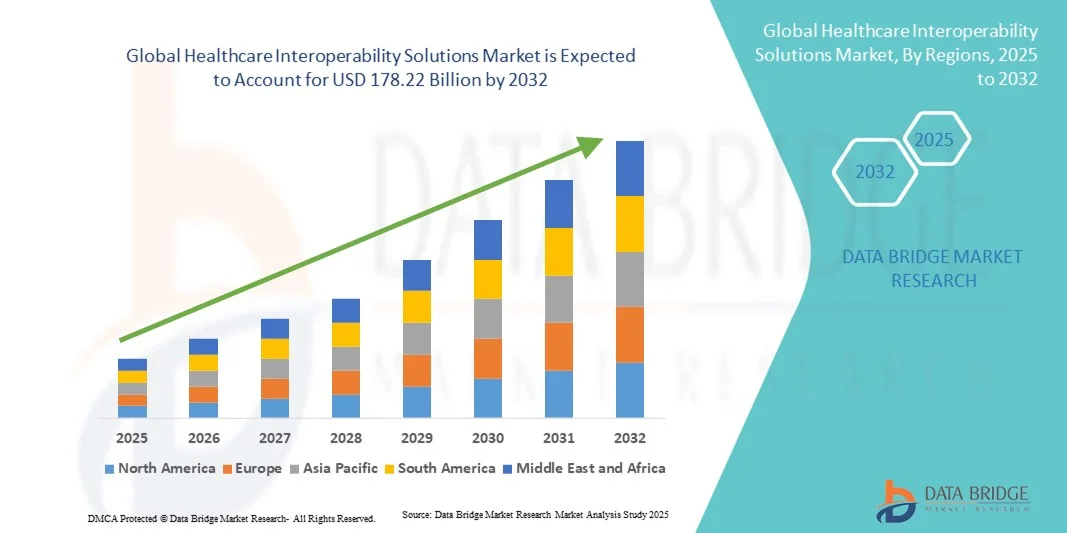
According to the latest report published by Data Bridge Market Research, the Healthcare Interoperability Solutions Market
The global healthcare interoperability solutions market size was valued at USD 93.48 billion in 2024 and is expected to reach USD 178.22 billion by 2032, at a CAGR of 8.40% during the forecast period
Market definition mentioned in this Healthcare Interoperability Solutions Market document covers the market drivers which indicate the factors causing rise in the market and market restraints which indicates the factors causing fall in the market growth. The report is generated based on the market type, size of the organization, availability on-premises, the end-users’ organization type, and the availability in areas such as North America, South America, Europe, Asia-Pacific and Middle East & Africa. Significant industry trends, estimations of market size and market share are analysed and discussed in this report. Different markets, marketing strategies, trends, future products and emerging opportunities are taken into account while studying market and preparing this Healthcare Interoperability Solutions Market document.
Stay informed with our latest keyword market research covering strategies, innovations, and forecasts. Download full report: https://www.databridgemarketresearch.com/reports/global-healthcare-interoperability-solutions-market
Healthcare Interoperability Solutions Market Segmentation and Market Companies
Segments
- Based on the type, the global healthcare interoperability solutions market can be segmented into software solutions, hardware solutions, and services. The software solutions segment is expected to dominate the market due to the increasing adoption of electronic health records (EHR) and healthcare IT systems. These software solutions help in seamless data exchange between different healthcare systems, improving operational efficiency and patient care. Hardware solutions such as medical devices and communication devices play a crucial role in enabling interoperability in healthcare settings. The services segment includes consulting, implementation, and support services, which are essential for the successful implementation of interoperability solutions.
- On the basis of interoperability level, the market can be categorized into foundational interoperability, semantic interoperability, and organizational interoperability. Foundational interoperability involves the basic ability of two or more healthcare IT systems to exchange data. Semantic interoperability focuses on the meaning of exchanged information, ensuring that data shared between systems is accurately interpreted. Organizational interoperability addresses the need for alignment between different healthcare organizations in terms of policies, procedures, and workflows to enable seamless data exchange.
Market Players
- Some of the key players operating in the global healthcare interoperability solutions market include Cerner Corporation, Epic Systems Corporation, Allscripts Healthcare Solutions, Inc., InterSystems Corporation, Orion Health Group Limited, Infor, Koninklijke Philips N.V., ViSolve Inc., Medicity, Inc., and IBM Corporation. These companies are investing in research and development activities to introduce advanced interoperability solutions that meet the evolving needs of healthcare providers. Strategic partnerships, acquisitions, and collaborations are common strategies adopted by players to expand their market presence and enhance their product offerings.
For more detailed insights and market trends, you can refer to The global healthcare interoperability solutions market is witnessing significant growth driven by the increasing demand for seamless data exchange among healthcare systems to improve operational efficiency and patient care. The market is segmented based on types into software solutions, hardware solutions, and services. Software solutions are poised to dominate the market as the adoption of electronic health records and healthcare IT systems continues to rise. These solutions facilitate the exchange of data between different healthcare systems, leading to improved patient outcomes. Hardware solutions, including medical devices and communication devices, also play a crucial role in enabling interoperability in healthcare settings. Services such as consulting, implementation, and support services are essential for the successful implementation of interoperability solutions, further driving market growth.
Interoperability levels categorize the market into foundational interoperability, semantic interoperability, and organizational interoperability. Foundational interoperability focuses on the basic ability of healthcare IT systems to exchange data efficiently. Semantic interoperability emphasizes the accurate interpretation of exchanged information to ensure meaningful data exchange between systems. Organizational interoperability addresses the alignment of policies, procedures, and workflows among healthcare organizations to facilitate seamless data exchange, enhancing overall interoperability within the market.
Key players in the global healthcare interoperability solutions market include Cerner Corporation, Epic Systems Corporation, Allscripts Healthcare Solutions, Inc., InterSystems Corporation, Orion Health Group Limited, Infor, Koninklijke Philips N.V., ViSolve Inc., Medicity, Inc., and IBM Corporation. These companies are at the forefront of developing advanced interoperability solutions to meet the evolving needs of healthcare providers. Research and development activities are a key focus for market players to introduce innovative solutions and stay competitive. Strategic partnerships, acquisitions, and collaborations are common strategies adopted by players to expand their market presence and enhance their product offerings, driving further market growth.
In conclusion, the global healthcare interoperability solutions market is poised for continued growth driven by the increasing adoption of electronic health records, the development of advanced interoperability solutions, and the emphasis on seamless data exchange to improve patient care outcomes. Market players are investing in research and development initiatives, strategic partnerships, and innovative solutions to address the evolving needs of healthcare providers, further driving market expansion and competitiveness.The global healthcare interoperability solutions market is experiencing robust growth as the demand for seamless data exchange in healthcare systems continues to escalate. One of the key drivers propelling this growth is the increasing adoption of electronic health records (EHR) and healthcare IT systems across the industry. As healthcare providers strive to enhance operational efficiency and elevate patient care quality, the importance of software solutions in facilitating smooth data exchange cannot be overstated. Software solutions are anticipated to dominate the market due to their pivotal role in enabling interoperability between various healthcare systems. By streamlining data exchange processes, these solutions contribute significantly to improving patient outcomes and operational effectiveness within healthcare settings.
Moreover, hardware solutions such as medical devices and communication devices play an integral part in fostering interoperability within healthcare environments. These hardware components not only support the seamless integration of different systems but also help in enhancing connectivity and communication across various healthcare platforms. Alongside software and hardware solutions, services like consulting, implementation, and support services are essential for the successful deployment of interoperability solutions. These services provide crucial assistance to healthcare organizations in navigating the complexities of interoperability implementation, further fueling market growth.
In terms of interoperability levels, the market is segmented into foundational interoperability, semantic interoperability, and organizational interoperability. Foundational interoperability focuses on establishing the basic data exchange capabilities between healthcare IT systems, laying the groundwork for more advanced interoperability functionalities. Semantic interoperability emphasizes the accurate interpretation of shared information to ensure meaningful communication between systems, thereby enhancing the overall efficacy of data exchange processes. Organizational interoperability addresses the alignment of policies, procedures, and workflows across different healthcare organizations to promote seamless data exchange and collaboration.
Key players in the global healthcare interoperability solutions market, such as Cerner Corporation, Epic Systems Corporation, and IBM Corporation, are actively engaged in research and development endeavors to introduce cutting-edge interoperability solutions that cater to the evolving needs of healthcare providers. These market leaders leverage strategic partnerships, acquisitions, and collaborations to expand their market footprint and enhance their product portfolios, positioning themselves at the forefront of market innovation and competitiveness. Overall, the market is set for sustained growth as advancements in technology, increasing regulatory requirements, and a growing focus on improving patient care outcomes continue to drive the demand for healthcare interoperability solutions.
Frequently Asked Questions About This Report
What is the degree of vertical integration in the Healthcare Interoperability Solutions Market?
What is the long-term future outlook for the Healthcare Interoperability Solutions Market (2033 and beyond)?
How do cultural factors influence Healthcare Interoperability Solutions Market demand globally?
What role does Customer Experience play in Healthcare Interoperability Solutions Market strategy?
What strategic moves are companies making to combat [Restraint X]?
What is the adoption rate of Healthcare Interoperability Solutions Market among SMEs?
How are emerging economies shaping the future of the Healthcare Interoperability Solutions Market?
What are the strategic recommendations for stakeholders in the Healthcare Interoperability Solutions Market?
How will the Healthcare Interoperability Solutions Market respond to Universal Basic Income (UBI)?
What are the recent mergers and acquisitions in the Healthcare Interoperability Solutions Market?
What challenges does the Healthcare Interoperability Solutions Market currently face regarding risk?
What is the projected impact of autonomous shipping on Healthcare Interoperability Solutions Market margins?
What are the primary factors driving the growth of the Healthcare Interoperability Solutions Market?
Browse More Reports:
Global Photomedicine Devices Market
Global Thyroid Function Test Market
Global Automated Sortation System Market
Global Citrus Seeds Market
Global Cetyl Palmitate Market
Global Power Transmission Market
Global Alpha Olefins Market
Global Portable Immunoassay Analyzer Market
Global Feed Enzymes Market
Global Automotive Pillars Market
Global Satellite Internet Market
Global Collagen Biomaterial Market
Global Muscle Hypotonia Market
Global 5-Dimensional Printing in Healthcare Market
Global Thermochromic Fabrics Market
Contact Us:
Data Bridge Market Research
Email:- corporatesales@databridgemarketresearch.com

 English
 Arabic
 French
 Spanish
 Deutsch
 Turkish
 Dutch
 Italiano
 Russian
 Romaian
 Portuguese (Brazil)
 Greek