


Bean-to-Bar Chocolate Gains Consumer Interest Through Premium Quality, Ethical Sourcing, and Artisanal Production
"
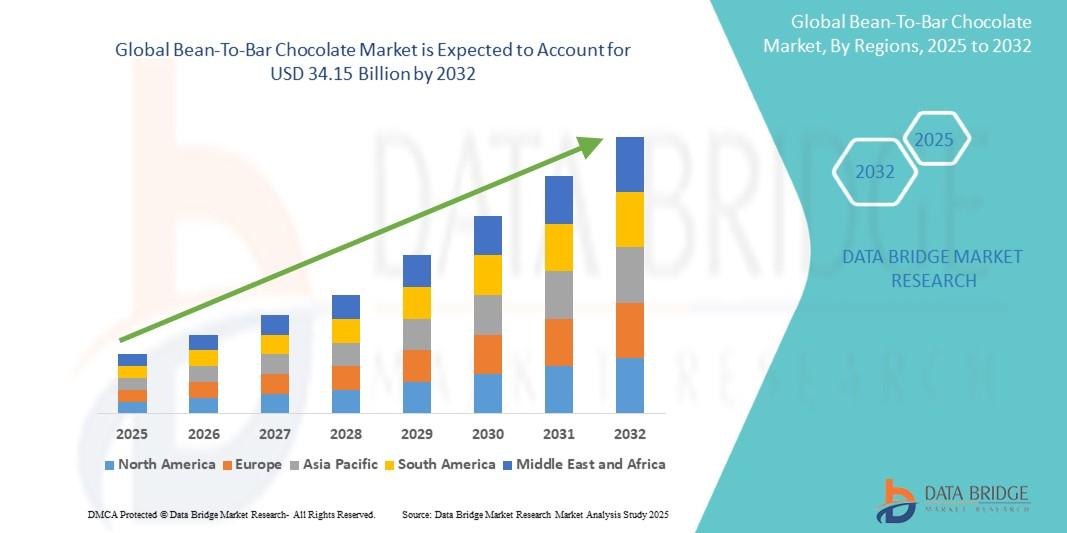
According to the latest report published by Data Bridge Market Research, the Bean-To-Bar Chocolate Market
- During the forecast period of 2025 to 2032 the market is likely to grow at a CAGR of 11.20%, primarily driven by increasing consumer demand for premium, organic, and ethically sourced chocolates
With the effectual use of technology, innovative applications and expertise, Bean-To-Bar Chocolate Market research report has been generated which successfully manages bulky and complex market data tables. This report displays market segmentation in the most-detailed pattern as well as carries out thorough analysis of patents and major market players to provide a competitive landscape. The business report has been worked out with the accurate use of tools like SWOT analysis and Porter’s Five Forces analysis methods. The reliable Bean-To-Bar Chocolate Market report also highlights the reviews about key players, major collaborations, merger & acquisitions along with trending innovation and business policies.
Stay informed with our latest keyword market research covering strategies, innovations, and forecasts. Download full report: https://www.databridgemarketresearch.com/reports/global-bean-to-bar-chocolate-market
Bean-To-Bar Chocolate Market Segmentation and Market Companies
Segments
- Type: The bean-to-bar chocolate market can be segmented based on type into dark chocolate, milk chocolate, and white chocolate. Dark chocolate is expected to dominate the market due to its perceived health benefits and high cacao content.
- Distribution Channel: The market can also be segmented by distribution channel into supermarkets/hypermarkets, specialty stores, online retail, and others. Online retail is witnessing significant growth due to the increasing trend of e-commerce and convenience of shopping from home.
- Region: Geographically, the market can be segmented into North America, Europe, Asia-Pacific, and the rest of the world. North America is anticipated to lead the market due to the high consumption of premium and gourmet chocolates in the region.
Market Players
- Dandelion Chocolate
- Taza Chocolate
- Firetree Chocolate
- Ritual Chocolate
- Madre Chocolate Co.
- Fresco Chocolate
- Sirene Chocolate
- Fruition Chocolate
- Marou Chocolate
- Cao Chocolates
The global bean-to-bar chocolate market is witnessing significant growth due to the increasing consumer preference for premium and artisanal chocolates. Consumers are becoming more conscious about the sourcing of ingredients and the production process, leading to a shift towards bean-to-bar chocolates that offer transparency and quality assurance. The dark chocolate segment is particularly gaining traction due to its antioxidant properties and perceived health benefits.
Distribution channels play a crucial role in reaching consumers, and online retail is emerging as a key channel for bean-to-bar chocolate manufacturers to expand their reach and cater to a wider audience. Supermarkets/hypermarkets and specialty stores also continue to be important distribution channels, especially for attracting impulse buyers and showcasing a variety of chocolate brands.
Region-wise, North America dominates the bean-to-bar chocolate market, driven by the presence of key market players, high consumer awareness about premium chocolates, and a growing trend of indulgent snacking. Europe is also a significant market for bean-to-bar chocolates, with consumers in countries like Switzerland, Belgium, and France showing a strong preference for high-quality and artisanal chocolates.
Market players in the global bean-to-bar chocolate industry are focusing on product innovation, sustainable sourcing practices, and expanding their distribution networks to gain a competitive edge. Collaborations with cocoa farmers, introduction of new flavors and formulations, and marketing strategies emphasizing the bean-to-bar production process are key trends observed among market players.
The bean-to-bar chocolate market is experiencing a transformation in consumer preferences, with a growing demand for unique flavor profiles and sustainable production practices. Artisanal bean-to-bar chocolatiers are leveraging this trend by showcasing their commitment to high-quality ingredients, ethical sourcing, and handcrafted processes. This shift towards transparency and authenticity is resonating with consumers who seek a more authentic and premium chocolate experience.
In terms of type segmentation, the market is witnessing a rise in the popularity of single-origin chocolates, where the beans used in the chocolate production are sourced from a specific region. This trend highlights the increasing importance of terroir and flavor nuances in the bean-to-bar chocolate market. Single-origin chocolates allow consumers to explore the diverse flavor profiles inherent to different cacao regions, enhancing their appreciation for the artistry and complexity of chocolate production.
Moreover, the distribution channel landscape for bean-to-bar chocolates is evolving to meet the changing consumer preferences and shopping behaviors. E-commerce platforms are providing chocolatiers with a direct-to-consumer avenue to showcase their products, share their brand stories, and build a loyal customer base. This direct engagement with consumers enables bean-to-bar chocolate brands to communicate their values, craftsmanship, and commitment to sustainability effectively.
In terms of regional segmentation, emerging markets in Asia-Pacific are presenting growth opportunities for bean-to-bar chocolate manufacturers. Rising disposable incomes, a growing middle-class population, and a burgeoning foodie culture in countries like Japan, South Korea, and China are driving the demand for premium chocolates. This shift towards gourmet chocolates reflects changing consumer lifestyles, evolving taste preferences, and a willingness to explore new culinary experiences.
Furthermore, market players in the bean-to-bar chocolate industry are investing in research and development to innovate new flavor combinations, textures, and packaging formats that appeal to a wider range of consumers. Collaborations with local artisans, pastry chefs, and mixologists are also enabling chocolatiers to create unique product offerings that cater to the growing demand for experiential and indulgent treats.
Overall, the bean-to-bar chocolate market is poised for continued growth as consumers seek out authentic, high-quality, and ethically sourced chocolate experiences. With an emphasis on sustainability, transparency, and innovation, market players are well-positioned to capture the evolving tastes and preferences of the modern chocolate connoisseur.The bean-to-bar chocolate market is currently experiencing a significant transformation driven by evolving consumer preferences towards premium and artisanal chocolates. This shift is primarily fueled by a growing awareness among consumers regarding the sourcing of ingredients and the production processes involved in chocolate making. As a result, there is a rising demand for bean-to-bar chocolates that offer transparency, quality assurance, and unique flavor profiles. Market players are responding to this demand by focusing on product innovation, sustainable sourcing practices, and expanding their distribution networks to capitalize on the increasing popularity of premium chocolates.
Single-origin chocolates are gaining traction within the market, highlighting a trend towards emphasizing the specific regional origins of cacao beans used in chocolate production. This trend underscores the importance of terroir and flavor nuances, allowing consumers to explore a diverse range of flavor profiles inherent to various cacao regions. By offering single-origin chocolates, bean-to-bar chocolatiers can cater to consumers seeking unique and authentic chocolate experiences.
In terms of distribution channels, the rise of e-commerce platforms has provided bean-to-bar chocolate manufacturers with a direct avenue to connect with consumers, share their brand stories, and showcase their commitment to quality and sustainability. This direct-to-consumer approach enables chocolatiers to communicate their values effectively and build a loyal customer base by offering a seamless shopping experience and personalized interactions.
While North America currently dominates the bean-to-bar chocolate market, emerging markets in Asia-Pacific present growth opportunities for industry players. Countries like Japan, South Korea, and China are witnessing an increasing demand for premium chocolates driven by rising disposable incomes, a growing middle-class population, and a heightened interest in gourmet food experiences. Market players are leveraging these opportunities by introducing innovative flavor combinations, collaborating with local artisans, and exploring unique product offerings to cater to the diverse preferences of consumers in these evolving markets.
Overall, the bean-to-bar chocolate market is poised for continued growth as consumers continue to seek out authentic, ethically sourced, and high-quality chocolate products. With a focus on sustainability, transparency, and innovation, market players are well-positioned to meet the changing preferences of consumers and capitalize on the increasing demand for premium and artisanal chocolates globally.
Frequently Asked Questions About This Report
What are the compliance requirements for Bean-To-Bar Chocolate Market players?
What are the procurement strategies in the Bean-To-Bar Chocolate Market industry?
How do cultural factors influence Bean-To-Bar Chocolate Market demand globally?
How is the shift toward sustainability driving Bean-To-Bar Chocolate Market trends?
Which raw material segment currently dominates the Bean-To-Bar Chocolate Market?
What is the expected exit strategy for Bean-To-Bar Chocolate Market start-ups?
How much is the Services segment projected to be worth in 2033?
What growth opportunities exist in the Bean-To-Bar Chocolate Market for new entrants?
How is Regulatory Risk impacting Bean-To-Bar Chocolate Market valuation?
How much is the Bean-To-Bar Chocolate Market in the Middle East projected to grow by 2033?
How are companies using Machine Learning to predict Bean-To-Bar Chocolate Market demand?
Browse More Reports:
Global Kidney Stone Market
Global Air Filters Market
Global Edible Cosmetics Market
Global IMO Compliant Marine Fuel Market
Global Network Monitoring Market
Global Pet Water Dispenser Market
Global Radio Frequency Identification (RFID) and Barcode Printer Market
Global Screw Piles Market
Global Solar Simulator Market
Global Water Saving Shower Heads Market
Global Digital Mobile Radio (DMR) Market
Global Graph Analytics Market
Global Heart Failure Drugs Market
Global Independent Software Vendors Market
Global Leather Chemicals Market
"

 English
 Arabic
 French
 Spanish
 Deutsch
 Turkish
 Dutch
 Italiano
 Russian
 Romaian
 Portuguese (Brazil)
 Greek