


Asia Pacific Accelerates Indigenous Satellite Propulsion Manufacturing
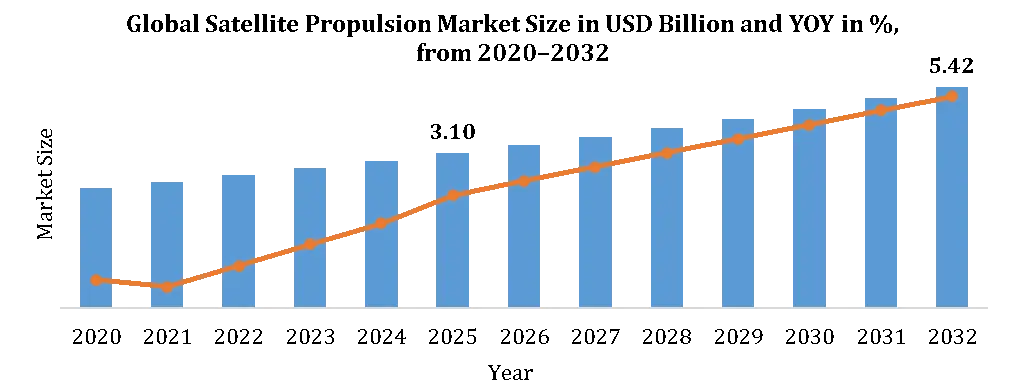
The global Satellite Propulsion Market is valued at USD 3.10 billion in 2025 and is projected to reach USD 5.42 billion by 2032 at an 8.3% CAGR, according to Stellar Market Research. As low-Earth orbit congestion intensifies and regulatory deorbit timelines tighten, propulsion shifts from a mission-enabling subsystem into a core commercial necessity.
Satellite propulsion is moving away from bespoke, defense-led hardware toward repeatable, mass-producible modules engineered for multi-satellite constellations and active orbital management. Operators managing hundreds or thousands of spacecraft face mounting pressure to cut propellant mass at launch while maintaining precise station-keeping, collision avoidance, and controlled end-of-life disposal.
Key Findings from the Report
-
Market Valuation & Trajectory: Valued at USD 3.10 billion in 2025 (base year) and forecast to hit USD 5.42 billion through 2032 at an 8.3% CAGR, reflecting steady multi-year constellation deployment and lifecycle servicing demand.
-
Technology Split: Chemical propulsion supports high-thrust orbit raising and rapid maneuvers, while electric propulsion expands rapidly where fuel efficiency, lower mass, and extended service life dictate spacecraft economics.
-
Platform & End-User Shift: Small-satellite constellations and commercial broadband, Earth observation, and Internet of Things operators anchor volume demand alongside sustained government and military programs.
-
Leading & Emerging Geographies: North America leads near-term revenue scale through vertically integrated space primes and launch providers, while Asia Pacific registers fast expansion as indigenous launch and satellite ecosystems scale.
-
Demand-Supply Dynamics: High-volume constellation manufacturing rewards suppliers with automated assembly, flight-proven heritage, and resilient supply chains for specialized valves, tanks, and power processing electronics.
-
Investor & Buyer Relevance: Capital is concentrating in modular electric thrusters, non-toxic/green propellants, and propulsion architectures suited for orbital lifecycle extension and end-of-life deorbit compliance.
For further information, click the following link:https://www.stellarmr.com/report/req_sample/satellite-propulsion-market/2918
Market Drivers and Restraints
Key Drivers
-
Stringent Orbital Debris Mitigation and Deorbit Mandates: Regulators and space agencies are enforcing shorter post-mission disposal windows, requiring reliable propulsion on small and medium satellites for controlled deorbiting and collision avoidance.
-
Proliferation of Commercial Constellations: Large-scale deployments for communications, Earth observation, and connectivity create recurring, multi-unit demand for compact, cost-effective orbit-raising and drag-compensation hardware.
-
Efficiency Gains in Electric and Non-Toxic Propulsion: Higher specific impulse reduces propellant mass budgets, while non-toxic propellants streamline ground handling, storage, and integration schedules compared with legacy toxic fuels.
Key Restraints
-
Qualification Timelines and Flight-Heritage Barriers: Spaceflight hardware demands rigorous environmental testing and proven orbital heritage, slowing market entry for novel propulsion designs and newer entrants.
-
Supply Chain and Specialized Component Bottlenecks: Tight availability of space-grade electronics, precision valves, pressure regulators, and specialty materials can delay delivery schedules as constellation production scales.
Technology, Regulation, and Sustainability Trends
Electric propulsion—including Hall-effect and ion architectures—is gaining ground in mass-constrained missions by delivering higher fuel efficiency and longer operational lifetimes. Alongside electric systems, operators are evaluating green monopropellants and modular propulsion units to lower ground-handling hazards and simplify integration.
Regulatory scrutiny around space traffic management and orbital debris is turning propulsion into a compliance requirement rather than an optional upgrade. Sustainability in orbit now centers on minimizing derelict hardware, supporting controlled atmospheric re-entry, and enabling future servicing or refueling architectures that keep active assets operating longer.
Regional Insights
North America leads the global market, anchored by high commercial constellation launch cadence, deep venture and defense funding, and concentrated aerospace manufacturing across the United States. Domestic primes, launch providers, and specialized thruster developers benefit from continuous government and commercial procurement.
Asia Pacific is a high-momentum growth region, driven by expanding space budgets and commercial participation in India, China, Japan, and South Korea. Investments in indigenous small satellites, Earth observation fleets, and regional launch capabilities are broadening domestic demand for reliable propulsion subsystems.
Recent Industry Developments
-
York Space Systems (2026): Acquired Hall-effect electric thruster maker Orbion Space Technology in March 2026 to strengthen constellation-scale electric propulsion supply and vertical integration for U.S. spacecraft manufacturing.
-
Safran (2026): Inaugurated a dedicated final assembly line in Vernon in February 2026 for PPS X00 plasma thrusters, scaling production capacity to meet growing commercial and institutional satellite demand.
-
Dawn Aerospace (2026): Closed a USD 25 million Series B round in June 2026 and launched its Loop on-orbit refueling network in April 2026 with funding through its 2028 demonstration phase, expanding non-toxic propulsion and in-space servicing capabilities.
-
Busek (2025–2026): Demonstrated multi-year orbital resilience with its iodine-fueled BIT-3 ion thruster in July 2025 and advanced high-power BHT-6000 Hall thrusters for NASA's Power and Propulsion Element, highlighting electric propulsion readiness for both constellation and deep-space platforms.
-
Enpulsion (2025): Launched the Nexus propulsion system in June 2025 based on its Field Emission Electric Propulsion architecture, building on flight-proven micro-thruster heritage for precision small-satellite maneuvering.
Competitive Landscape
Competition spans established aerospace and defense primes—including Northrop Grumman, Safran, Airbus Defence and Space, Thales Alenia Space, Lockheed Martin, and Boeing—alongside specialized electric and green-propulsion innovators. Large primes leverage system-level spacecraft integration and long-term defense contracts, while agile thruster specialists compete on modular design, faster delivery cycles, and high-efficiency electric or non-toxic solutions.
Strategic moves increasingly center on securing guaranteed propulsion supply for constellation builds, expanding manufacturing throughput, and pairing propulsion hardware with end-to-end bus or mission services.
Analyst Commentary
"Propulsion choices now determine satellite unit economics and regulatory compliance long before launch," said a Senior Research Analyst at Stellar Market Research. "Operators scaling constellations or extending orbital lifetimes are prioritizing flight-proven electric and safer propulsion architectures that simplify integration and support accountable end-of-life disposal."
Future Outlook
Through 2032, demand will expand as commercial constellations mature, orbital traffic management rules tighten, and multi-orbit missions require greater agility. Suppliers that combine scalable manufacturing with high-efficiency electric or non-toxic propulsion will capture share as competition shifts from one-off custom builds to repeatable, high-reliability space infrastructure.
For further information, click the following link:https://www.stellarmr.com/report/req_sample/satellite-propulsion-market/2918
About Stellar Market Research
Stellar Market Research is a multifaceted market research and consulting company with professionals from several industries. Some of the industries we cover include medical devices, pharmaceutical manufacturers, science and engineering, electronic components, industrial equipment, technology and communication, cars and automobiles, chemical products and substances, general merchandise, beverages, personal care, and automated systems. To mention a few, we provide market-verified industry estimations, technical trend analysis, crucial market research, strategic advice, competition analysis, production and demand analysis, and client impact studies.
Address
Phase 3, Navale IT Zone, S.No. 51/2A/2, Office No. 202, 2nd floor, Near, Navale Brg, Narhe, Pune, Maharashtra 411041
Email
sales@stellarmr.com
Mobile
+91 9607365656

 English
 Arabic
 French
 Spanish
 Portuguese
 Deutsch
 Turkish
 Dutch
 Russian
 Romaian
 Portuguese (Brazil)
 Greek