


0 Comments
0 Shares
252 Views
0 Reviews

Directory
Discover new people, create new connections and make new friends
-
-
6 Lifestyle Changes to Improve Your Lipid Profile Naturally
Everyday Habits That Can Support Your Lipid Profile
Many people believe that improving cholesterol means avoiding all fats or depending entirely on medicines. While medication is important for some people, it isn't the only way to improve your heart health.
Your lipid profile is greatly influenced by your daily habits. The food you eat, how active you are, your sleep, stress levels, and even whether you smoke all play a role. If you're wondering how to improve lipid profile naturally, the answer lies in making consistent lifestyle changes not following quick fixes.
What Is a Lipid Profile?
A lipid profile is a blood test that measures the different types of fats in your blood. It includes:
LDL (Low-Density Lipoprotein): Often called bad cholesterol because excess LDL can build up in the arteries.
HDL (High-Density Lipoprotein): Known as good cholesterol because it helps remove excess cholesterol from the bloodstream.
Triglycerides: A type of fat that stores excess energy. High levels increase the risk of heart disease.
Total Cholesterol: The overall amount of cholesterol in your blood.
Maintaining the right balance between good and bad cholesterol while keeping triglycerides under control is essential for long-term heart health.
1. Eat More Fibre-Rich Whole Foods
One of the most effective foods to lower LDL cholesterol is fibre-rich whole foods.
Green leafy vegetables, gourds, cruciferous vegetables, whole pulses, seasonal fruits, nuts, and seeds contain soluble fibre, which helps remove excess cholesterol from the body. These foods also support gut health and keep you fuller for longer, making it easier to maintain a healthy weight.
Building cholesterol healthy meals around whole, minimally processed foods is one of the simplest ways to improve your lipid profile.
2. Reduce Ultra-Processed Foods
Highly processed foods are often rich in refined flour, added sugars, unhealthy fats, and excess calories. Regularly consuming sugary beverages, packaged snacks, bakery products, and deep-fried foods can increase LDL cholesterol, raise triglycerides, and promote inflammation.
Replacing processed foods with fresh, home-cooked meals is a small change that can have a big impact on your heart health.
Browse full blog-
https://www.freedomfromdiabetes.org/blog/post/how-to-improve-lipid-profile-naturally/5394
Contact us :-
Mob : +91-7776077760
Email-Id : info@freedomfromdiabetes.org
Also connect with us on our website , Facebook page, and youtube
6 Lifestyle Changes to Improve Your Lipid Profile Naturally Everyday Habits That Can Support Your Lipid Profile Many people believe that improving cholesterol means avoiding all fats or depending entirely on medicines. While medication is important for some people, it isn't the only way to improve your heart health. Your lipid profile is greatly influenced by your daily habits. The food you eat, how active you are, your sleep, stress levels, and even whether you smoke all play a role. If you're wondering how to improve lipid profile naturally, the answer lies in making consistent lifestyle changes not following quick fixes. What Is a Lipid Profile? A lipid profile is a blood test that measures the different types of fats in your blood. It includes: LDL (Low-Density Lipoprotein): Often called bad cholesterol because excess LDL can build up in the arteries. HDL (High-Density Lipoprotein): Known as good cholesterol because it helps remove excess cholesterol from the bloodstream. Triglycerides: A type of fat that stores excess energy. High levels increase the risk of heart disease. Total Cholesterol: The overall amount of cholesterol in your blood. Maintaining the right balance between good and bad cholesterol while keeping triglycerides under control is essential for long-term heart health. 1. Eat More Fibre-Rich Whole Foods One of the most effective foods to lower LDL cholesterol is fibre-rich whole foods. Green leafy vegetables, gourds, cruciferous vegetables, whole pulses, seasonal fruits, nuts, and seeds contain soluble fibre, which helps remove excess cholesterol from the body. These foods also support gut health and keep you fuller for longer, making it easier to maintain a healthy weight. Building cholesterol healthy meals around whole, minimally processed foods is one of the simplest ways to improve your lipid profile. 2. Reduce Ultra-Processed Foods Highly processed foods are often rich in refined flour, added sugars, unhealthy fats, and excess calories. Regularly consuming sugary beverages, packaged snacks, bakery products, and deep-fried foods can increase LDL cholesterol, raise triglycerides, and promote inflammation. Replacing processed foods with fresh, home-cooked meals is a small change that can have a big impact on your heart health. Browse full blog- https://www.freedomfromdiabetes.org/blog/post/how-to-improve-lipid-profile-naturally/5394 Contact us :- Mob : +91-7776077760 Email-Id : info@freedomfromdiabetes.org Also connect with us on our website , Facebook page, and youtube0 Comments 0 Shares 790 Views 0 Reviews -
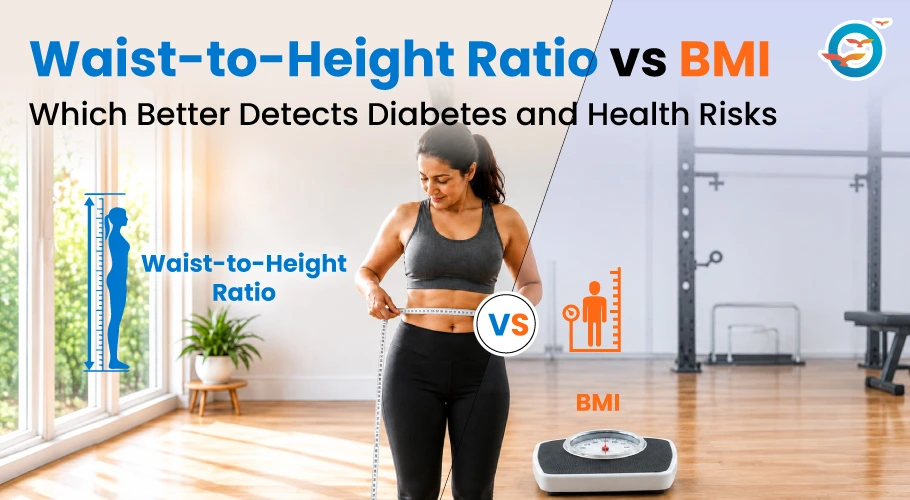
Waist-to-Height Ratio vs BMI: Which Better Detects Diabetes and Health Risks?
Waist-to-Height Ratio vs BMI: Which Predicts Diabetes Risk?
You know the feeling!
You step on the scale after a month of trying to eat better, only to see the number hasn't gone down. Meanwhile, your favourite pair of trousers feels suspiciously tighter around the waist.
Isn’t it frustrating?
We have all been deeply interested in Body Mass Index (BMI), thinking that it is the best measure of our health. Yet have you ever come across a person who has a "normal" BMI and appears entirely fit on paper and yet is still suffering from high blood sugar or high blood pressure?
That is precisely the reason why we should consider factors other than body size. A better and more accurate measure exists which could alter the way you see your health: the waist-to-height ratio (WHtR).
What Is Waist-to-Height Ratio?
WHtR is a figure that helps assess how body fat is distributed, especially around the waist; to calculate it, you divide your waist circumference by your height.
For instance, if your height is 170 cm and your waist size is 85 cm:
WHtR = 85 ÷ 170 = 0.5
If you'd like to know how to calculate your waist-to-height ratio, that's exactly what you need to do. Or else you can use an online waist-to-height ratio calculator to obtain quick and easy results.
It is a practical and accurate method that enables you to find out your body shape and health risks from the comfort of your own home; unlike BMI, this height-to-waist ratio shows you where fat is stored in the body.
Browse full blog-
https://www.freedomfromdiabetes.org/blog/post/waist-to-height-ratio-vs-bmi-diabetes-risk/5399
Contact us :-
Mob : +91-7776077760
Email-Id : info@freedomfromdiabetes.org
Also connect with us on our website , Facebook page, and youtube
Waist-to-Height Ratio vs BMI: Which Better Detects Diabetes and Health Risks? Waist-to-Height Ratio vs BMI: Which Predicts Diabetes Risk? You know the feeling! You step on the scale after a month of trying to eat better, only to see the number hasn't gone down. Meanwhile, your favourite pair of trousers feels suspiciously tighter around the waist. Isn’t it frustrating? We have all been deeply interested in Body Mass Index (BMI), thinking that it is the best measure of our health. Yet have you ever come across a person who has a "normal" BMI and appears entirely fit on paper and yet is still suffering from high blood sugar or high blood pressure? That is precisely the reason why we should consider factors other than body size. A better and more accurate measure exists which could alter the way you see your health: the waist-to-height ratio (WHtR). What Is Waist-to-Height Ratio? WHtR is a figure that helps assess how body fat is distributed, especially around the waist; to calculate it, you divide your waist circumference by your height. For instance, if your height is 170 cm and your waist size is 85 cm: WHtR = 85 ÷ 170 = 0.5 If you'd like to know how to calculate your waist-to-height ratio, that's exactly what you need to do. Or else you can use an online waist-to-height ratio calculator to obtain quick and easy results. It is a practical and accurate method that enables you to find out your body shape and health risks from the comfort of your own home; unlike BMI, this height-to-waist ratio shows you where fat is stored in the body. Browse full blog- https://www.freedomfromdiabetes.org/blog/post/waist-to-height-ratio-vs-bmi-diabetes-risk/5399 Contact us :- Mob : +91-7776077760 Email-Id : info@freedomfromdiabetes.org Also connect with us on our website , Facebook page, and youtube0 Comments 0 Shares 376 Views 0 Reviews


 Arabic
 French
 Spanish
 Portuguese
 Deutsch
 Turkish
 Dutch
Dutch
 Italiano
 Russian
 Romaian
 Portuguese (Brazil)
 Greek
Greek