Every founder in Dubai hits this question early: do you really need a professionally designed website, or can you get by with a free builder and an Instagram page until the business grows? Money is tight in the early days, and a website can feel like a cost you can push down the list.
At RedSpider Web & Art Design, we've watched enough startups launch across this city to have a clear answer: yes, it's worth it, but only if you know what you're actually paying for and why it matters at this specific stage of your business. Here's the honest case for it.
Why Dubai Is Different From Other Markets
Dubai isn't a market where a website is a nice-to-have. Internet penetration in the UAE sits at around 99%, smartphone penetration is above 95%, and the vast majority of that traffic happens on mobile. People here are online constantly, and they expect to find, evaluate, and contact a business digitally before ever picking up the phone.
That changes the math for startups. In slower-moving markets, you can build a reputation through word of mouth over years and let the website catch up later. In Dubai, a customer who can't find you, or finds you and isn't convinced by what they see, has three competitors one search away. Your website isn't a brochure sitting in the background. For most startups here, it's the first real interaction a potential customer has with your business.
What a Website Actually Does for a Startup
It Builds Trust Before You've Built a Track Record
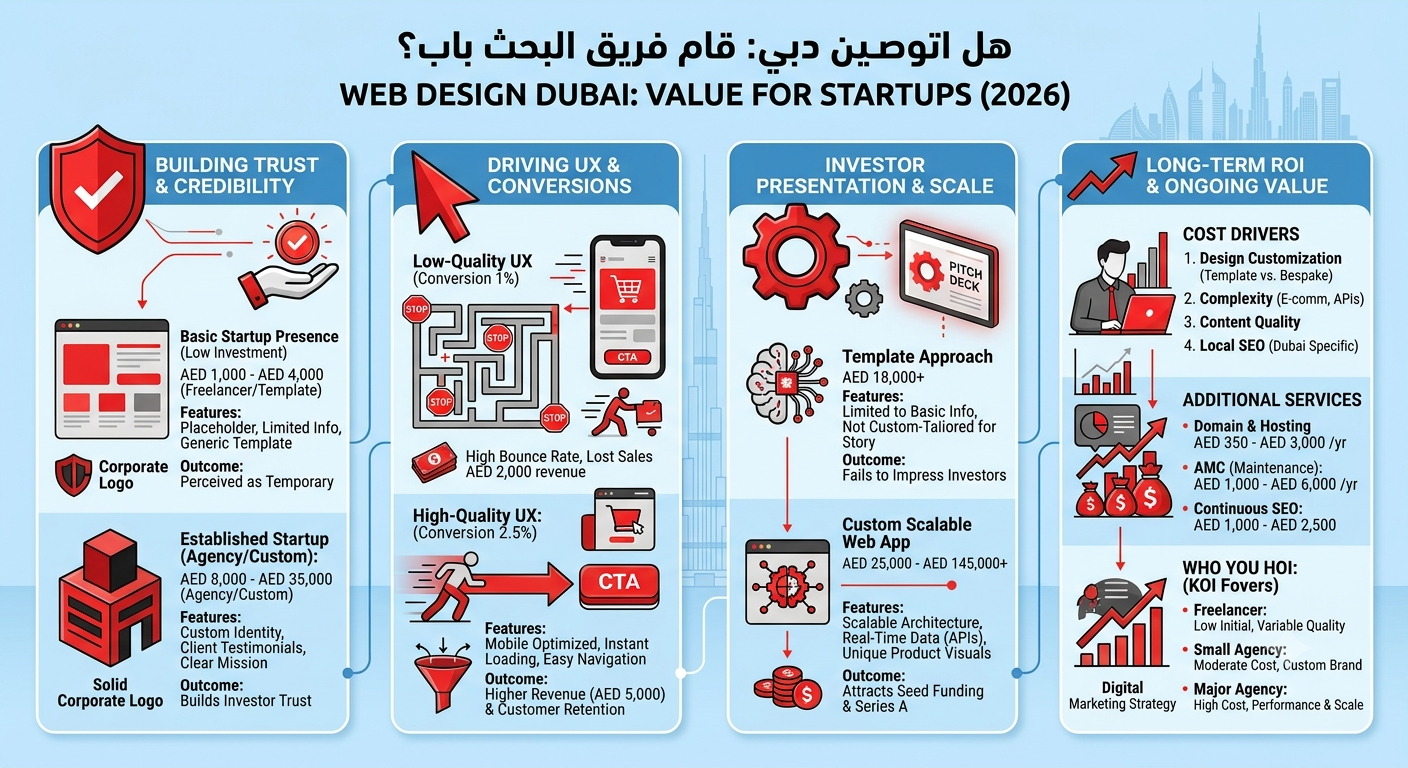
New businesses don't have years of reviews, a recognizable name, or an established reputation to lean on. A well-designed website does some of that work for you. It signals that you're a real, operating business, not a side project, and that signal matters enormously when someone is deciding whether to trust you with their money.
It Filters and Qualifies Leads
A good site doesn't just attract visitors, it does some of the sales conversation before you ever speak to the person. Clear pricing, service descriptions, and case studies mean the person contacting you already understands what you offer and roughly what it costs. That saves founders hours of unqualified calls and messages every week, which matters a lot when you're doing everything yourself.
It Supports Every Other Marketing Channel You'll Use
Startups in Dubai typically spend 15 to 20% of annual revenue on digital marketing, and a meaningful chunk of that goes toward paid ads and content. All of that spend is wasted if it funnels traffic to a site that looks unfinished or doesn't load properly on mobile. Your website is the landing point for every ad, every social post, and every referral link you'll ever run. If it's weak, you're paying to send people somewhere that won't convert them.
It's an Asset, Not a Recurring Expense
Unlike ad spend, which stops producing results the moment you stop paying, a well-built website keeps working. Organic search traffic, direct visits, and word-of-mouth referrals all route through the same asset, month after month, without an ongoing media budget behind them.
The Real Risk of Skipping It
Founders who delay proper web design usually do it for one of two reasons: they think it can wait until the business is more established, or they think a free template is good enough for now. Both come with hidden costs.
Delaying it means launching your marketing, your ads, and your first customer conversations around a placeholder that undersells the business. First impressions in a competitive market like Dubai are hard to walk back. A visitor who leaves unconvinced rarely comes back to check again later.
Relying on a generic free template long-term tends to cost more eventually, not less. Rebuilding a site from scratch after you've already built SEO rankings, backlinks, and brand recognition around a weak version is more expensive and slower than doing it properly the first time.
What "Worth It" Actually Looks Like in Numbers
For most Dubai startups, a solid, professionally designed brochure or small business website costs somewhere in the AED 8,000 to 30,000 range, depending on the number of pages and features required. Compare that to a single month of underperforming paid ads sending traffic to a weak site, and the website usually pays for itself quickly through better conversion alone.
Search visibility adds another layer to this. Businesses that rank on Google's first page capture the large majority of clicks in their category, and getting there requires a site that's technically sound from the start: fast loading, mobile-optimized, and structured properly for search engines. That's not something you bolt onto a free template later. It has to be built in from day one.
When It Makes Sense to Wait
To be fair, there are cases where investing heavily in web design too early doesn't make sense. If you're still validating your core business idea, testing pricing, or figuring out who your actual customer is, sinking a large budget into a polished custom site before that's settled can be premature. In that phase, a lean, functional site that gets you online quickly is the smarter move, with a fuller build coming once the business model is proven.
The distinction isn't "spend a lot" versus "spend nothing." It's matching the investment to where your business actually is.
How RedSpider Web & Art Design Approaches Startup Projects
We work with a lot of early-stage businesses, so we don't pitch every startup the most expensive package we offer. We start by understanding where you are: pre-launch and validating an idea, or ready to scale and needing a site that can carry serious marketing spend. From there, we build something that fits your stage, with a clear path to expand it as the business grows, rather than a full rebuild every time you outgrow the last version.
The Bottom Line
For most startups operating in Dubai's fast-moving, mobile-first, highly competitive market, a properly designed website isn't an optional extra. It's the foundation everything else, your ads, your SEO, your first impression with customers, gets built on. Skipping it or underinvesting in it doesn't save money in the long run. It usually just delays a bigger expense.




 English
 French
 Spanish
 Portuguese
 Deutsch
 Turkish
 Dutch
Dutch
 Italiano
 Russian
 Romaian
 Portuguese (Brazil)
 Greek
Greek