

Breast Cancer Drug Market to Achieve USD 12.4 Billion by 2036 as Rising Breast Cancer Incidence Accelerates Drug Innovation
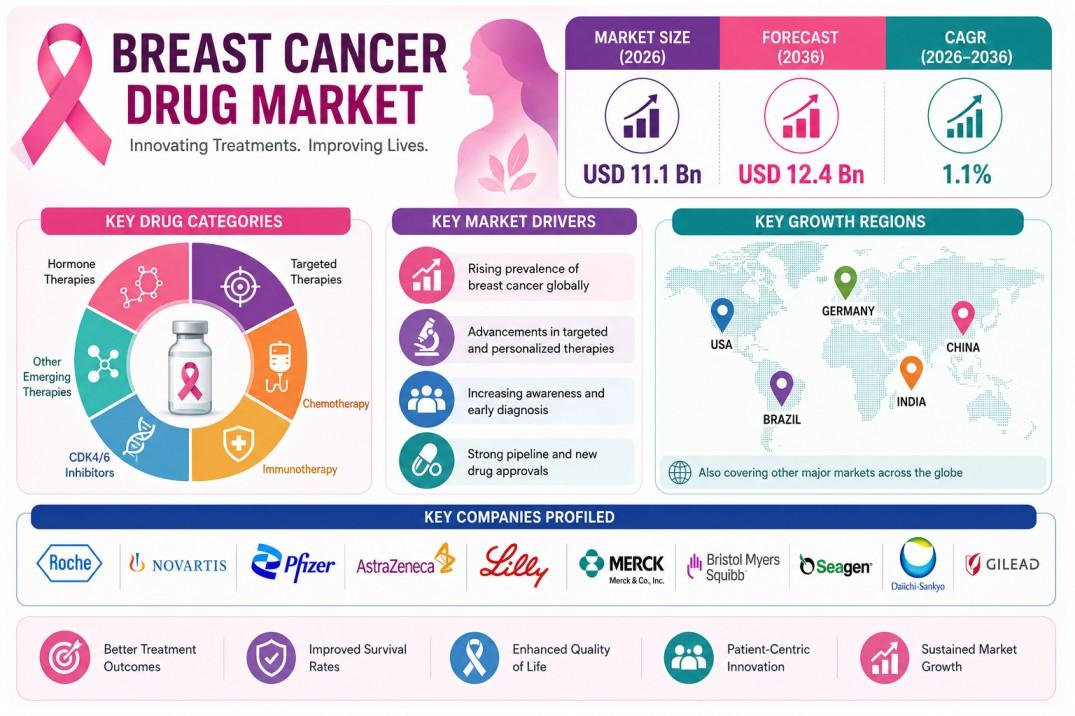
The Breast Cancer Drug Market is expected to maintain steady growth as the global healthcare industry continues to prioritize long-term treatment strategies for breast cancer, particularly hormone receptor-positive (HR+) and HER2-negative disease. According to Future Market Insights (FMI), the market is projected to grow from USD 11.1 billion in 2026 to USD 12.4 billion by 2036, registering a 1.1% CAGR during the forecast period. Increasing breast cancer prevalence, sustained use of endocrine therapies, expanding access to targeted oncology treatments, and improvements in cancer diagnosis are expected to support market demand, despite pricing pressures from generic and biosimilar competition.
👉 Get Detailed Market Forecasts, Competitive Benchmarking, and Pricing Trends:
https://www.futuremarketinsights.com/reports/sample/rep-gb-1246
The market is anticipated to generate an absolute dollar opportunity of USD 1.3 billion between 2026 and 2036. Continued reliance on long-term hormonal therapy, increasing adoption of targeted treatment regimens, and growing investment in precision oncology continue to support the global breast cancer therapeutics market.
Key Breast Cancer Drug Market Highlights at a Glance
· Market Size (2026): USD 11.1 Billion
· Forecast Market Size (2036): USD 12.4 Billion
· Forecast Period: 2026–2036
· CAGR (2026–2036): 1.1%
· Absolute Dollar Opportunity: USD 1.3 Billion
· Leading Drug Class: Aromatase Inhibitors-Based (36.0% Market Share in 2026)
· Leading Distribution Channel: Hospital Pharmacies (58.0% Market Share in 2026)
· Key Countries: USA, Germany, France, UK
· Key Segments Covered: Drug Class, Distribution Channel, Cancer Type, Region
· Report Pages: 327
· Last Updated: July 15, 2026
· Reviewed by: Anurag Sharma
Why Is the Breast Cancer Drug Market Growing?
The market continues to grow as breast cancer remains one of the most commonly diagnosed cancers globally. Long-term treatment requirements, especially for hormone receptor-positive, HER2-negative breast cancer, continue to drive sustained demand for endocrine therapies and targeted oncology drugs.
Although generic competition and reimbursement pressures are moderating market value growth, increasing diagnosis rates, improvements in personalized medicine, and broader access to advanced therapies continue to support steady expansion.
Key Growth Drivers
· Rising global prevalence of breast cancer.
· Growing demand for long-term hormonal therapy.
· Increasing adoption of targeted oncology treatments.
· Improvements in early cancer diagnosis and screening.
· Expansion of precision medicine approaches.
· Rising healthcare expenditure on oncology care.
· Growing use of combination treatment regimens.
· Increasing survival rates requiring extended maintenance therapy.
As healthcare systems continue emphasizing personalized cancer treatment and long-term disease management, demand for effective breast cancer therapeutics is expected to remain stable.
👉 Access the Complete Report in PDF Format:
https://www.futuremarketinsights.com/reports/brochure/rep-gb-1246
According to Anurag Sharma, Principal Consultant for Healthcare at Future Market Insights, "The breast cancer drug market remains driven by long-term treatment rather than rapid volume expansion. Manufacturers are increasingly focusing on targeted therapies, companion diagnostics, and value-based clinical outcomes as reimbursement agencies place greater emphasis on treatment effectiveness and cost efficiency."
Why Do Aromatase Inhibitors Lead the Breast Cancer Drug Market?
Aromatase Inhibitors-Based therapies account for 36.0% of global market demand in 2026, making them the leading drug class.
These therapies remain the standard of care for many postmenopausal women with hormone receptor-positive breast cancer, providing effective long-term suppression of estrogen production while reducing recurrence risk.
Drug Class Highlights
· Aromatase inhibitors dominate endocrine therapy.
· Widely used for hormone receptor-positive breast cancer.
· Long-term treatment supports recurring demand.
· Strong clinical evidence sustains physician preference.
Why Do Hospital Pharmacies Dominate Distribution?
Hospital Pharmacies account for 58.0% of market demand in 2026, supported by centralized oncology care, specialty drug handling requirements, and multidisciplinary cancer treatment programs.
Hospital-based dispensing also facilitates reimbursement management, patient monitoring, and coordinated treatment planning for complex oncology therapies.
Distribution Channel Highlights
· Hospital pharmacies remain the primary dispensing channel.
· Oncology specialists manage long-term treatment plans.
· Specialty medicines require controlled distribution.
· Integrated cancer centers improve patient outcomes.
👉 Explore the Latest Pharmaceutical Industry Analysis Now:
https://www.futuremarketinsights.com/industry-analysis/pharmaceuticals
How Is Long-Term Hormonal Therapy Driving Market Expansion?
Hormone receptor-positive breast cancer remains the largest therapeutic segment, with many patients receiving endocrine therapy for five to ten years following primary treatment.
The prolonged duration of therapy creates stable demand for aromatase inhibitors and other hormonal agents while supporting continued utilization across oncology care pathways.
Therapeutic Trends
· Long-term maintenance therapy drives recurring demand.
· Increasing use of targeted combination therapies.
· Precision oncology improves treatment selection.
· Better survival rates expand the treated patient population.
Market Dynamics
Market Drivers
Increasing breast cancer incidence, growing adoption of targeted therapies, expanding use of endocrine treatments, improvements in cancer diagnostics, rising healthcare investments, and advances in personalized medicine continue driving market growth.
Market Restraints
Generic entry across established hormonal therapies, biosimilar competition, reimbursement pressure, high costs of innovative biologics, and pricing constraints continue limiting overall market value expansion.
Market Trends
Innovation continues transforming the breast cancer therapeutics landscape.
Major trends include:
· Expansion of precision oncology.
· Growing adoption of targeted biologics.
· Increasing use of companion diagnostics.
· Development of next-generation endocrine therapies.
· Greater integration of biomarker-driven treatment.
· Rising investment in oncology research and clinical trials.
Regional and Country Outlook
The United States remains the largest market, supported by high healthcare expenditure, widespread adoption of innovative oncology therapies, and favorable reimbursement for advanced cancer treatments.
Germany, France, and the United Kingdom continue to represent major European markets owing to strong public healthcare systems, organized breast cancer screening programs, and increasing access to targeted therapies.
Emerging markets including India, China, and Brazil are expected to witness rising demand as cancer awareness, healthcare infrastructure, and access to oncology medicines continue improving.
Competitive Landscape
Competition remains centered on clinical efficacy, targeted therapy innovation, regulatory approvals, reimbursement access, and oncology pipeline development.
Leading pharmaceutical companies continue investing in precision medicine, antibody-drug conjugates (ADCs), immuno-oncology combinations, and biomarker-driven treatment strategies to strengthen their global oncology portfolios.
Key Companies
· Roche
· Novartis
· Pfizer
· AstraZeneca
· Eli Lilly
· Merck & Co.
· Bristol-Myers Squibb
· Seagen
· Daiichi Sankyo
· Gilead Sciences
👉 Read Full Report:
https://www.futuremarketinsights.com/reports/breast-cancer-drug-market
Frequently Asked Questions
1. What is the projected size of the Breast Cancer Drug Market by 2036?
The global Breast Cancer Drug Market is projected to reach USD 12.4 billion by 2036, growing from USD 11.1 billion in 2026.
2. What is the expected CAGR of the Breast Cancer Drug Market?
The market is forecast to expand at a 1.1% CAGR between 2026 and 2036.
3. Which drug class dominates the market?
Aromatase Inhibitors-Based therapies lead the market with a 36.0% share in 2026.
4. Which distribution channel holds the largest market share?
Hospital Pharmacies dominate the market, accounting for 58.0% of total distribution in 2026.
5. What factors are driving market growth?
Growing breast cancer prevalence, increasing use of long-term hormonal therapy, expanding adoption of targeted oncology drugs, improvements in precision medicine, rising cancer diagnosis rates, and continued investment in oncology research are driving global market growth.
Related Reports
· https://sites.google.com/view/healthcarewellnessinsights/medical-rehabilitation-robotics-market
· https://sites.google.com/view/healthcarewellnessinsights/oxytocic-pharmaceuticals-market
· https://sites.google.com/view/healthcarewellnessinsights/pharmaceutical-omega-3-api-market
About Future Market Insights (FMI)
Future Market Insights, Inc. (ESOMAR certified, recipient of the Stevie® Award, and a member of the Greater New York Chamber of Commerce) provides deep insights into governing factors elevating demand in global markets.
FMI delivers market intelligence, consulting services, and syndicated research reports across chemicals, materials, food ingredients, pharmaceuticals, industrial manufacturing, sustainability, and advanced materials sectors.
With global expertise and industry-focused research capabilities, FMI provides actionable insights that help organizations understand market dynamics and identify emerging opportunities.
Contact
Future Market Insights Inc.
Christiana Corporate, 200 Continental Drive, Suite 401, Newark, Delaware 19713, USA
Rahul Singh
AVP – Marketing and Growth Strategy
Future Market Insights, Inc.
+91 8600020075
For Media: Rahul.Singh@futuremarketinsights.com
Email: sales@futuremarketinsights.com
Website: www.futuremarketinsights.com

 English
 Arabic
 French
 Spanish
 Portuguese
 Deutsch
 Turkish
 Dutch
 Russian
 Romaian
 Portuguese (Brazil)
 Greek