


Why Do I Feel Emotionally Numb? Understanding the Difference Between Burnout, Depression, and Trauma
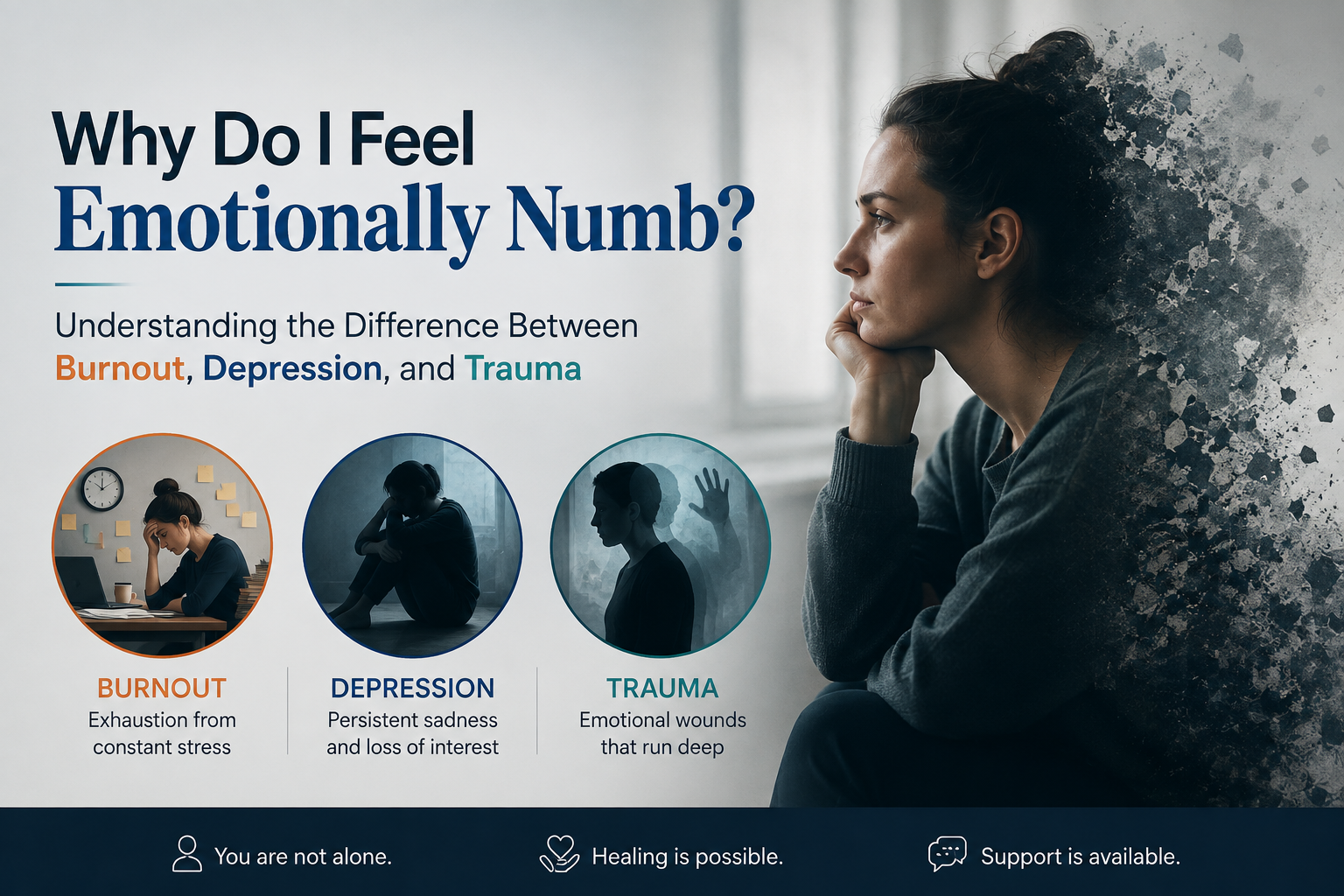
There's a particular kind of silence that happens inside a person before it ever shows up on the outside. You go through your day, answer emails, make dinner, smile when someone tells a joke — and yet nothing quite reaches you. Not joy, not sadness, not even irritation. Just a flat, gray stillness where feeling used to be.
If this sounds familiar, you are not broken, and you are not alone. Many individuals describe this experience as emotional numbness — a state where emotions feel muted, distant, or almost entirely absent. It can be confusing and even frightening, especially when you can't pinpoint why it's happening or how long it's been building.
This guide was written to help you make sense of what you're feeling, without judgment and without rushing you toward a label that may not fit. Emotional numbness can stem from several very different roots — burnout, depression, and trauma among them — and understanding which one (or combination) applies to you is an important first step toward feeling like yourself again.
In This Guide You'll Learn
-
What emotional numbness actually is and how it feels day to day
-
The key differences between burnout, depression, and trauma-related numbness
-
Early warning signs and red flags that suggest it's time to reach out for support
-
Evidence-based therapy approaches that can help you reconnect with your emotions
What Does Emotional Numbness Actually Feel Like?
People rarely describe it as "nothing." More often, it's described as watching your own life through glass — present, but not quite touching anything. Some common descriptions include:
-
Feeling disconnected from people you love, even while spending time with them
-
Difficulty crying, or crying without feeling the sadness behind it
-
Going through routines on autopilot
-
A sense that good news and bad news land the same way — flat
-
Physical fatigue paired with mental fog
Research suggests that emotional numbness often functions as a protective mechanism. When the mind is overwhelmed by stress, grief, or unresolved pain, it can temporarily reduce emotional intensity as a way of coping. The problem is that this protective response can outlast its usefulness, leaving a person stuck in a muted state long after the original stressor has passed.
Actionable Takeaway: Start noticing patterns rather than judging them. For one week, jot down a single word describing how you felt at three points in the day. This isn't about fixing anything yet — it's about building awareness of your emotional baseline.
Burnout, Depression, or Trauma? Untangling the Overlap
This is often the most confusing part for people trying to understand themselves. All three can produce a similar surface symptom — numbness — but the underlying cause, and often the path forward, looks different.
Burnout-Related Numbness
Burnout typically develops gradually, tied closely to chronic stress in work, caregiving, or relationships. It tends to improve, at least partially, with rest, boundaries, and reduced obligations — though it rarely resolves on its own if the underlying stressors stay the same.
Depression-Related Numbness
Clinical depression often brings numbness alongside other symptoms: changes in sleep or appetite, loss of interest in previously enjoyable activities, and persistent low mood. Unlike burnout, depression is less tied to a single external stressor and often requires more structured support to shift.
Trauma-Related Numbness
Trauma-related numbness, sometimes referred to as emotional or psychological "shutdown," frequently appears alongside hypervigilance, avoidance, or intrusive memories. It's the nervous system's way of protecting itself from re-experiencing pain, and it often responds well to trauma-focused therapeutic approaches.
It's worth saying clearly: this article cannot diagnose you, and self-diagnosis is rarely the full picture. A licensed mental health professional can help sort through which factors are contributing to what you're experiencing, and treatment often depends on individual needs and history.
Burnout vs. Depression: A Quick Comparison
|
Feature |
Burnout |
Depression |
|
Onset |
Gradual, tied to specific stressors (work, caregiving) |
Can develop with or without a clear external trigger |
|
Improves with rest/time off |
Often, at least partially |
Rarely improves with rest alone |
|
Core feeling |
Exhaustion, cynicism, detachment from tasks |
Persistent low mood, hopelessness, loss of interest |
|
Sleep/appetite changes |
Sometimes |
Common |
|
Typical first step |
Boundaries, workload changes, recovery time |
Professional evaluation and therapy |
Actionable Takeaway: Use this table as a conversation starter, not a diagnostic tool. If you recognize yourself in either column, consider bringing this comparison to a therapy intake session — it can help your provider understand your experience faster.
A Real-Life Example: Sarah's Story
Sarah, a 34-year-old marketing manager, came to therapy describing herself as "fine, just tired." She wasn't sleeping poorly, wasn't crying, wasn't in any obvious crisis. But she noticed she hadn't felt genuinely excited about anything — including her upcoming wedding — in nearly six months.
Through individual therapy, Sarah began to recognize that her numbness had started shortly after a period of intense work pressure combined with an unresolved conflict with her mother. Her nervous system had essentially "turned the volume down" on everything to cope with the overload.
Over several months of consistent therapy, Sarah didn't experience an overnight transformation — progress rarely works that way. But she gradually reconnected with small moments of feeling: a genuine laugh during a family dinner, tears during a difficult conversation she'd been avoiding for years. Her story is a reminder that healing is often incremental, and that reaching out for professional help doesn't require hitting a crisis point first.
Evidence-Based Therapy Approaches That Can Help
Cognitive Behavioral Therapy (CBT)
CBT helps individuals identify thought patterns that reinforce disconnection and gradually rebuild engagement with meaningful activities. It's often a strong starting point for burnout and mild-to-moderate depressive symptoms.
Trauma-Focused Therapy
Approaches such as EMDR or trauma-focused CBT are designed specifically to help the nervous system process distressing memories, which can reduce the need for emotional shutdown as a coping mechanism.
Psychodynamic Therapy
This approach explores how past experiences and relationship patterns shape present-day emotional responses, which can be particularly useful when numbness feels rooted in long-standing patterns rather than a recent event.
Couples or Family Therapy
When emotional numbness affects a relationship, couples or family therapy can help both partners understand what's happening and rebuild connection without placing blame.
Actionable Takeaway: You don't need to know which therapy type is "right" before starting. A licensed clinician can help match your needs to an approach during an initial consultation.
Warning Signs: When to Seek Support Sooner Rather Than Later
Early signs that numbness may be more than passing stress include:
-
Numbness lasting more than a few weeks without improvement
-
Withdrawing from relationships you previously valued
-
Using substances to feel "something"
-
Difficulty functioning at work, school, or home
Red flags requiring more immediate attention include thoughts of self-harm, feeling unsafe, or a sense of complete disconnection from reality. If you or someone you know is experiencing thoughts of suicide or self-harm, please contact the 988 Suicide & Crisis Lifeline (call or text 988) or go to your nearest emergency room immediately. This is a sensitive topic, and if you're personally struggling, reaching out to a crisis line or a trusted professional is a strong and appropriate step.
Daily Strategies That Support Emotional Reconnection
While professional support is often the most effective long-term path, several daily habits can support the process:
-
Sleep consistency — irregular sleep patterns intensify emotional flatness
-
Movement — even brief walks can help regulate the nervous system
-
Mindfulness practices — grounding exercises can gently reintroduce present-moment awareness
-
Journaling — writing without editing yourself can surface feelings before you're consciously aware of them
-
Nurturing one honest relationship — numbness thrives in isolation; connection, even small doses, can help interrupt it
Support Options in North Carolina and Beyond
If you're located in Charlotte, Raleigh, Ballantyne, Pineville, SouthPark, or elsewhere in North Carolina, in-person and telehealth counseling options are widely available and can be a practical starting point for exploring what's behind your emotional numbness. Telehealth in particular has made it easier for busy adults, parents, and caregivers to access consistent care without adding another obstacle to an already full schedule.
Common Myths About Emotional Numbness
Myth: Feeling numb means you don't care. In reality, numbness is often the mind's way of managing an overwhelming amount of caring, stress, or pain.
Myth: It will just go away with time. Sometimes it does ease naturally, but persistent numbness often benefits from active support rather than waiting it out.
Myth: Only people with severe trauma experience this. Burnout, grief, chronic stress, and everyday life pressures can all produce the same protective response.
Frequently Asked Questions
Is emotional numbness the same as depression?
Not always. Emotional numbness can occur with depression, but it can also result from burnout, trauma, or chronic stress without meeting the full criteria for a depressive disorder.
Can emotional numbness go away on its own?
For some people, especially those experiencing mild burnout, symptoms may ease with rest and reduced stress. For others, professional support leads to more consistent and lasting improvement.
How long does emotional numbness typically last?
This varies widely from person to person. What matters most is whether it's improving, staying the same, or getting worse over time.
Should I see a therapist or a psychiatrist first?
A therapist is often a good starting point for talk-based support, while a psychiatrist can evaluate whether medication may be a helpful part of treatment. Many people benefit from working with both.
Is it normal to feel numb after a stressful life event?
Yes, this is a common and understandable response. If it persists or significantly affects your daily life, reaching out to a mental health professional can help you understand what's happening and what support might help.
Final Thought
Feeling emotionally numb doesn't mean something is fundamentally wrong with you — it often means your mind has been working hard to protect you from something overwhelming. Whether that root cause is burnout, depression, trauma, or some combination of the three, understanding is the first real step toward reconnecting with yourself.
Healing isn't usually a straight line, and it rarely happens overnight. But with the right support — whether that's therapy, lifestyle changes, or simply naming what you're going through — it is possible to move from feeling disconnected to feeling present again, one small moment at a time.
If what you've read here resonates with you, consider reaching out to a licensed mental health professional in your area or through telehealth. You don't have to figure this out alone.

 English
 Arabic
 French
 Spanish
 Portuguese
 Deutsch
 Turkish
 Dutch
Dutch
 Italiano
 Russian
 Romaian
 Portuguese (Brazil)