


Longevity Wellness Pharmaceutical Market Growth, Global Outlook, Analysis, Trends and Forecast Analysis By Fact.MR
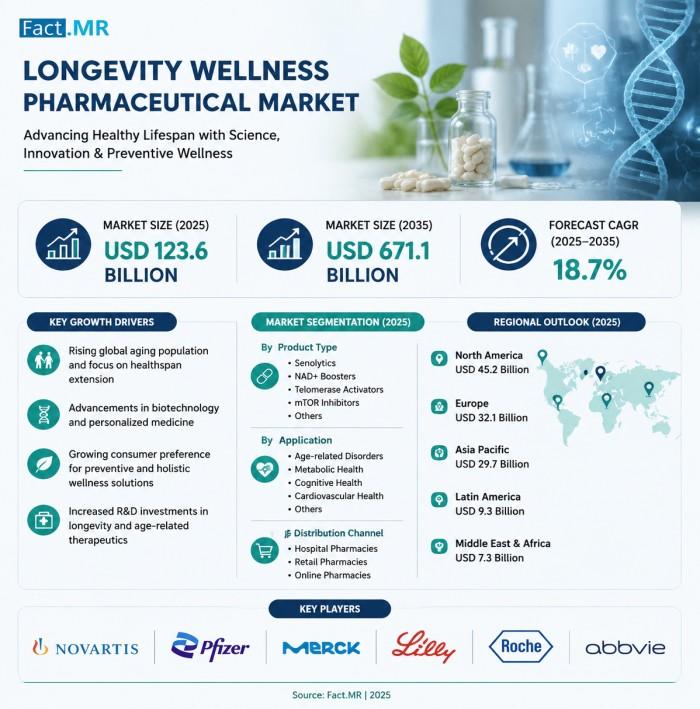
ROCKVILLE, MARYLAND , August 4, 2026 -- The global longevity wellness pharmaceutical market, valued at USD 29.1 billion in 2025, is projected to grow from USD 31.8 billion in 2026 to USD 76.0 billion by 2036, expanding at a Compound Annual Growth Rate (CAGR) of 9.1% during the forecast period. This expansion represents an absolute dollar opportunity of USD 46.9 billion between 2025 and 2036, according to a 170-page research report (Report Code: FACT15860MR) published by Fact.MR.
Get detailed market forecasts, competitive benchmarking, and pricing trends: https://www.factmr.com/connectus/sample?flag=S&rep_id=15860
Executive Summary & Key Market Findings
Growth across the longevity wellness pharmaceutical market is primarily driven by a pivot away from broad anti-aging marketing toward therapies evaluated through defined diseases, functional endpoints, and clinically governed treatment pathways.
Key quantitative findings from the Fact.MR study include:
- Base-Year Market Size (2025): USD 29.1 billion
- Forecast Starting Value (2026): USD 31.8 billion
- Forecast Terminal Value (2036): USD 76.0 billion
- Forecast Period CAGR (2026–2036): 9.1%
- Absolute Opportunity Growth: USD 46.9 billion
- Leading Product Segment: Senolytic Drugs (28.0% market share in 2026)
- Leading Application Segment: Healthy Aging (34.0% market share in 2026)
- Leading End-User Segment: Hospitals (32.0% market share in 2026)
"Longevity pharmaceutical demand will not be won by broad anti-aging language," states Shambhu Nath Jha, Principal Consultant at Fact.MR. "The commercial route begins with a defined disease or functional endpoint that regulators, clinicians, and payers can evaluate. Developers that pair validated biomarkers with chronic-use safety and reliable specialty distribution will have the clearest path to durable adoption."
Key Growth Drivers
The market is influenced by five primary qualitative and macroeconomic drivers:
1. Age-Linked Multimorbidity: Rising numbers of patients living with multiple age-related conditions drive demand for treatments that preserve organ function or alter disease progression over multi-year timelines.
2. Indication-Led Regulatory Pathways: Developers are organizing programs around specific clinical indications. For example, Eli Lilly's Kisunla received approval for early symptomatic Alzheimer's disease, establishing a blueprint for indication-specific commercialization.
3. Hospital and Specialty Pharmacy Capacity: Governed health settings offer infrastructure for specialist diagnosis, controlled administration, adverse-event monitoring, and biomarker evaluation.
4. Public Research Funding: Government programs in the United States and Japan are widening research pipelines around aging biology and lifespan extensions.
5. Biopharma Strategic Partnerships: Collaborations across North America and Europe are pooling resources to translate cellular senescence research into clinical drug candidates.
Market Segmentation Analysis
Product Type Breakdown
- Senolytic Drugs: Hold the largest product market share at 28.0% in 2026. These therapies convert senescent-cell clearance biology into measurable pharmaceutical interventions.
- Additional Product Types: The defined product universe comprises Dasatinib-Based Therapies, Fisetin-Based Therapies, and NAD+ Boosters, each facing distinct dosing protocols and chronic-use safety evaluations.
Application Breakdown
- Healthy Aging: Represents the dominant application segment with a 34.0% share in 2026, as it addresses functional decline before late-stage chronic diseases establish.
- Secondary Applications: Include Age-Related Functional Decline, Longevity Enhancement, and Cardiovascular Health.
End User & Distribution Channels
- Hospitals: Lead end-user demand with a 32.0% market share in 2026, categorized across Public Hospitals, Private Hospitals, and Specialty Clinics.
- Distribution Channels: Defined channels include Hospital Pharmacies, Inpatient Pharmacies, Outpatient Pharmacies, and Retail Pharmacies.
Drug Class Analysis
- Coverage encompasses Small Molecule Drugs, Senolytics, mTOR Inhibitors, and Biologics.
(Note on Source Data Consistency: The source report structures quantitative market share by Product Type, Application, End User, Distribution Channel, and Drug Class. While "technology" is referenced qualitatively in connection to gene therapy, stem cell technologies, and cell therapy CDMO/clinical trials, specific percentage share metrics for a dedicated "Technology" segment are omitted in the source data tables.)
Country-Level Growth Comparison
North America and East Asia lead the global acceleration, with the United States posting the highest country-level CAGR through 2036.
Summary Table of Country CAGRs (2026–2036)
|
Country |
CAGR (2026–2036) |
Primary Commercial Condition |
|
USA |
10.0% |
Commercial uptake remains tied to formal FDA indications and third-party payer coverage. |
|
Japan |
9.7% |
Adoption is driven by hospital-centered specialist care and nationally coordinated longevity research. |
|
Germany |
9.4% |
Purchasing is governed by statutory health insurance evaluation and formal benefit assessments. |
|
UK |
9.1% |
National Health Service (NHS) evaluation and service planning determine centralized market access. |
|
Canada |
8.8% |
Market entry depends on provincial formulary decisions and clinical cost-effectiveness reviews. |
|
Australia |
8.5% |
Specialized clinic administration and institutional procurement shape early adoption. |
|
Brazil |
8.2% |
Access expands through private specialist healthcare centers and emerging regional regulatory frameworks. |
Market Restraints & Conversion Barriers
Commercial conversion remains constrained by four key structural barriers:
- Strict Preventive Safety Thresholds: Enforcing high safety and duration thresholds for preventive use in healthy or mildly symptomatic patient populations within a short-term timeline (1 to 2 years).
- Payer & Regulatory Dependency: Heavy dependence on FDA, NHS, and provincial health system approvals over a medium-term horizon (2 to 4 years).
- Chronic-Use Safety Monitoring: Long-term administration requires ongoing monitoring of adverse events and long-term toxicity profiles over 4+ years.
- Biomarker Validation Delays: Slow consensus on accepted surrogate endpoints and biomarker validation protocols.
Buyer Decision Guide: How to Choose Longevity Pharmaceuticals
For procurement teams, clinical development units, and hospital pharmacy directors evaluating longevity wellness pharmaceuticals, Fact.MR recommends four core selection criteria:
1. Verify Indication-Led Approval: Require regulatory clearance linked to a defined disease state or measurable functional endpoint rather than broad preventive claims.
2. Validate Biomarker Compatibility: Confirm that the drug candidate incorporates validated diagnostic or functional biomarkers to measure efficacy across patient cohorts consistently.
3. Assess Chronic-Use Safety Records: Evaluate long-term safety data, tolerability metrics, and adverse-event management protocols suited for long durations of administration.
4. Confirm Specialty Cold-Chain and Pharmacy Infrastructure: Ensure the supply chain aligns with hospital pharmacy capabilities for controlled storage, specialty dispensing, and patient adherence tracking.
Report Scope & Availability
- Report Title: Longevity Wellness Pharmaceutical Market
- Report Code: FACT15860MR
- Publication Date: August 03, 2026
- Page Count: 170 Pages
- Coverage: Product Types, Applications, End Users, Distribution Channels, Drug Classes, and 7 Key Countries
Explore More Related Studies Published by Fact.MR Research
Viral Antigens Market https://www.openpr.com/news/4594324/merck-kgaa-anchors-u-s-viral-antigens-market-as-global-total
Vestibular Testing Systems Market https://www.openpr.com/news/4594329/interacoustics-helps-power-u-s-vestibular-testing-systems
Canine Separation Anxiety Treatment Market https://www.openpr.com/news/4594333/u-s-canine-separation-anxiety-market-climbs-from-usd-27-7
Home Diagnostics Market https://www.openpr.com/news/4594334/abbott-laboratories-powers-u-s-home-diagnostics-advance-as
Dental Consumables Market https://www.openpr.com/news/4594335/dentsply-sirona-anchors-u-s-growth-as-global-dental
About Fact.MR
Fact.MR is a global market research and consulting firm, trusted by Fortune 500 companies and emerging businesses for reliable insights and strategic intelligence. With a presence across the U.S., UK, India, and Dubai, we deliver data-driven research and tailored consulting solutions across 30+ industries and 1,000+ markets. Backed by deep expertise and advanced analytics, Fact.MR helps organizations uncover opportunities, reduce risks, and make informed decisions for sustainable growth.
- Contact Us -
11140 Rockville Pike, Suite 400, Rockville,
MD 20852, United States
Tel: +1 (628) 251-1583 | sales@factmr.com

 English
 Arabic
 French
 Spanish
 Portuguese
 Deutsch
 Turkish
 Italiano
 Russian
 Romaian
 Portuguese (Brazil)
 Greek
Greek