


Factors to Consider Before Leasing an Office
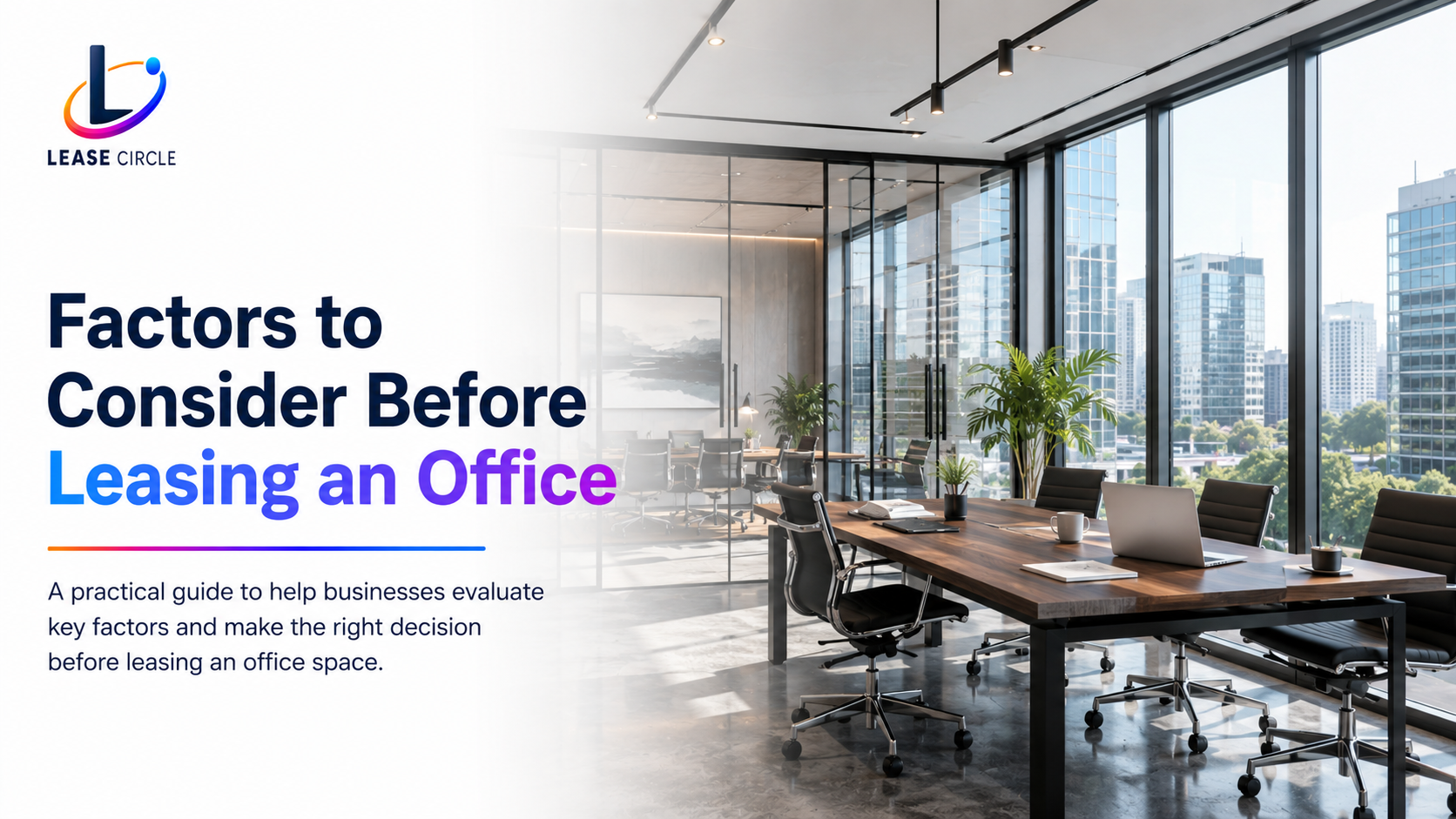
Choosing an office is an important business decision. The right workplace can support productivity, improve employee experience, create a professional environment for clients, and provide room for future growth. However, selecting a property simply because it looks attractive or falls within budget can lead to problems later.
Before committing to a lease, businesses need to evaluate several factors, including location, rent, lease terms, space requirements, accessibility, infrastructure, and future expansion plans. A careful evaluation becomes even more important when comparing different commercial properties across major business hubs.
For companies exploring Commercial Office Space in Gurgaon, factors such as connectivity, surrounding business activity, parking, and access to public transportation can significantly affect the suitability of a property. Similar considerations apply when evaluating office options in Noida, Delhi, or Greater Noida.
TheLeaseCircle helps businesses approach commercial real estate decisions with a practical perspective. Instead of focusing only on the appearance of an office, businesses should consider how the property will perform as a workplace over the entire lease period.
Understand Your Business Requirements
The first step in leasing an office is understanding what your business actually needs. A company with ten employees will have very different requirements from an organization with 100 or more employees.
Start by estimating the number of employees who will regularly use the workplace. Consider whether you need private cabins, meeting rooms, reception space, collaborative areas, storage, a pantry, or dedicated spaces for technical equipment.
Your working style also matters. Businesses with hybrid teams may require fewer permanent desks but more meeting and collaboration areas. On the other hand, companies with large operational teams may need a more traditional workstation-based layout.
It is also useful to consider your expected growth over the next few years. Leasing an office that is just large enough for your current team may create another relocation problem if your workforce expands quickly.
Choose the Right Location
Location is one of the most important factors when selecting commercial property. An office may have excellent interiors, but its value can be reduced if employees, clients, and business partners find it difficult to reach.
Look at the location from multiple perspectives. Check its distance from major roads, metro stations, bus routes, residential areas, and important business districts. The surrounding environment should also match the nature of your business.
For instance, a company that frequently meets clients may benefit from a prominent and easily accessible business location. A back-office operation may place greater importance on affordability and employee connectivity.
When comparing Commercial Office Space in Greater Noida, businesses should also examine how the location fits their workforce and operational needs rather than judging the property solely on its rental price.
Evaluate the Total Cost
Rent is only one part of the financial commitment involved in leasing an office. Businesses should calculate the complete occupancy cost before making a decision.
Additional expenses can include maintenance charges, electricity, parking fees, security deposits, fit-out costs, property taxes where applicable, internet infrastructure, and other building-related charges.
Ask the property representative for a clear explanation of all recurring and one-time expenses. This helps prevent unexpected costs after moving into the property.
It is also important to understand how rent may change during the lease period. Some agreements include escalation clauses that increase the rent after a specified period. Factoring these increases into your long-term budget can provide a more realistic picture of affordability.
Check the Size and Layout
The usable area of an office is often more important than its advertised size. Businesses should understand how much space can actually be used for workstations, meeting rooms, storage, and other functions.
A well-designed smaller office can sometimes be more practical than a larger property with inefficient space distribution.
Think about how employees will move through the workplace. Meeting rooms should be accessible without disrupting work areas. Reception and client-facing spaces should create a professional first impression, while employees should have enough room to work comfortably.
When considering Commercial Office Space in Noida, businesses should compare both the total area and the efficiency of the floor plan. Two properties with similar square footage can offer very different workplace experiences.
Understand the Lease Terms
Never evaluate an office only by looking at its monthly rent. The lease agreement contains important financial and operational conditions that can affect the business throughout the tenancy.
Pay attention to the lease duration, security deposit, rent escalation, lock-in period, renewal conditions, notice period, maintenance responsibilities, and termination clauses.
Businesses should also understand who is responsible for repairs, structural issues, fixtures, utilities, and alterations to the property.
Before signing, read the agreement carefully and seek professional legal advice when necessary. A clear understanding of the terms can help prevent disputes and unexpected liabilities later.
Assess Connectivity and Accessibility
A strategically located office can make everyday operations easier for both employees and visitors. Accessibility becomes particularly important for companies whose employees commute from different parts of a city.
Evaluate road connectivity as well as public transportation. Metro access, bus availability, nearby highways, and major roads can all influence the practicality of a location.
Client accessibility is another consideration. If customers or business partners regularly visit your office, a difficult-to-find or poorly connected location may create an unnecessary barrier.
For businesses comparing Commercial Office Space in Delhi, accessibility should be evaluated alongside rental costs because a well-connected location can have a meaningful impact on employee convenience and business interactions.
Examine Building Infrastructure
A professional office requires dependable infrastructure. Before signing a lease, inspect the building and determine whether its facilities can support your daily operations.
Check electricity supply, backup power, internet connectivity, elevators, air conditioning, water supply, fire safety systems, and common-area maintenance.
Technology-dependent businesses should pay particular attention to internet service availability and electrical capacity. If the office requires servers, specialized equipment, or extensive networking, confirm that the building can support those requirements.
The quality of common areas also matters. Clean corridors, functional elevators, maintained washrooms, and a well-managed reception area can influence both employee satisfaction and client impressions.
Consider Parking and Employee Convenience
Parking is easy to overlook during an initial property visit, especially when the office itself appears suitable. However, limited parking can become a daily inconvenience once employees begin using the workplace.
Ask whether parking is included in the lease, charged separately, or subject to availability. Understand the number of spaces allocated to your business and whether visitors can park conveniently.
Also examine nearby facilities such as restaurants, cafés, banks, pharmacies, convenience stores, and other useful services. Employees often value access to these facilities because they make the workday more convenient.
These seemingly small factors can influence how employees experience the workplace over the long term.
Evaluate Safety and Security
Security should be considered before leasing any commercial property. A safe office environment protects employees, visitors, equipment, and business information.
Check whether the building has controlled entry, security personnel, CCTV surveillance, visitor management, emergency exits, and appropriate fire safety arrangements.
Businesses should also understand the building's emergency procedures. Ask how incidents are handled and whether emergency exits are clearly marked and accessible.
If the business operates outside conventional working hours, confirm whether employees can access the building safely during evenings, weekends, or holidays.
Think About Future Business Growth
Leasing an office should not be based only on today's requirements. Businesses should consider where they expect to be during the next few years.
Rapidly growing companies may need additional workstations, meeting rooms, storage, or dedicated departments as their workforce expands. If the selected building cannot accommodate future requirements, another relocation may become necessary.
One practical approach is to estimate expected employee growth and determine whether the property can support additional capacity. Some businesses may also benefit from negotiating expansion options or flexibility within the lease agreement.
For organizations evaluating Commercial Office Space in Gurgaon, this forward-looking approach can be particularly useful because the right property should support business operations rather than become a limitation as the company develops.
Inspect the Property Before Signing
Photos, floor plans, and property descriptions cannot replace an actual inspection. Visit the property at different times when possible to understand how it functions throughout the day.
Pay attention to noise levels, traffic, parking availability, natural lighting, ventilation, common-area maintenance, and the general condition of the building.
Speak with the property manager about practical issues that may not be visible during a short visit. For example, ask about maintenance response times, power backup, internet providers, and building access policies.
If possible, visit during working hours. This provides a better understanding of the surrounding environment and daily activity.
A physical inspection can also help businesses identify potential fit-out or renovation costs before they commit to the lease.
Compare Multiple Properties Before Deciding
Businesses should avoid making a decision after visiting only one property. Comparing several options creates a clearer picture of market pricing, facilities, location advantages, and lease conditions.
Create a simple comparison based on factors such as monthly occupancy cost, usable area, connectivity, building quality, parking, lease flexibility, and future expansion potential.
For example, a slightly more expensive office could offer better connectivity, lower commuting difficulties, and stronger infrastructure. In another situation, a lower-cost property may provide better value because the business does not need premium facilities.
The objective should not simply be to find the cheapest office. It should be to identify the property that provides the best overall value for the business.
Frequently Asked Questions
1. What should I check before leasing an office?
Businesses should evaluate location, total cost, usable area, layout, lease terms, connectivity, infrastructure, parking, security, and future expansion possibilities before signing a lease.
2. Is office rent the only major leasing expense?
No. Businesses may also have to account for maintenance charges, security deposits, utilities, parking, fit-out expenses, internet services, and other property-related costs.
3. How important is office location?
Location can significantly affect employee commuting, client accessibility, operating convenience, and the overall practicality of the workplace. It should be evaluated according to the needs of the business.
4. Should I lease a larger office for future growth?
It can make sense if you expect significant growth, but leasing substantially more space than you currently need may increase unnecessary costs. The decision should be based on realistic growth expectations.
5. What lease terms require particular attention?
Lease duration, lock-in period, rent escalation, security deposit, renewal conditions, notice period, maintenance responsibilities, and termination clauses deserve careful review.
6. Why should businesses inspect an office before leasing?
A physical inspection can reveal issues related to noise, lighting, ventilation, parking, building maintenance, connectivity, and accessibility that may not be apparent in photographs or property listings.
7. How can I compare different office properties?
Compare properties using consistent criteria such as total occupancy cost, usable area, location, connectivity, infrastructure, parking, lease flexibility, and potential for future expansion.
8. Is a cheaper office always the better choice?
Not necessarily. A cheaper property may involve higher commuting difficulties, weaker infrastructure, limited parking, or additional expenses. Businesses should evaluate overall value rather than rent alone.
Conclusion
Leasing an office is a long-term business decision that requires more than comparing monthly rental prices. Location, accessibility, infrastructure, layout, lease conditions, operating expenses, employee convenience, security, and future growth should all be considered before making a commitment.
A property that looks attractive during the first visit may not necessarily be the right fit once everyday operational requirements are taken into account. Careful research and comparison can help businesses choose a workplace that supports productivity and long-term business objectives.
Whether a company is evaluating commercial properties in Greater Noida, Noida, Delhi, or Gurgaon, the best decision comes from balancing cost, convenience, functionality, and future requirements. TheLeaseCircle can help businesses approach commercial property decisions with greater clarity and focus on practical business requirements.

 English
 Arabic
 French
 Spanish
 Portuguese
 Turkish
 Dutch
Dutch
 Italiano
 Russian
 Romaian
 Portuguese (Brazil)
 Greek
Greek