


Patient Transfer & Nursing-Assist Robots Market Forecast 2026–2036: Innovation and Investment Trends
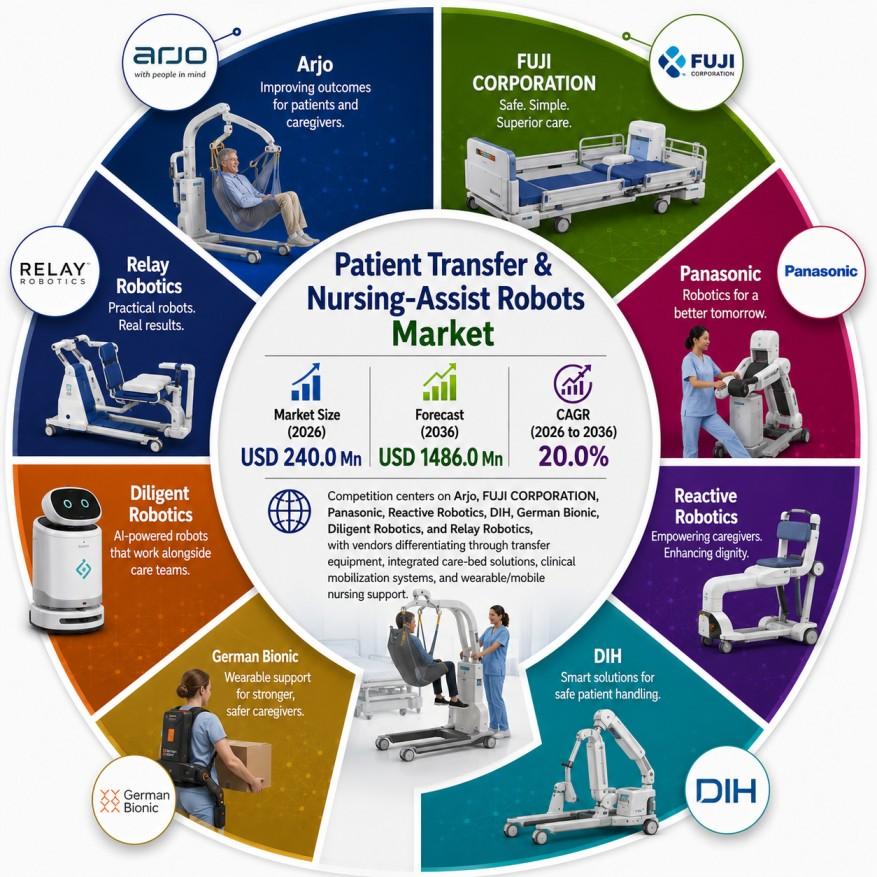
The global Patient Transfer & Nursing-Assist Robots Market is expanding as hospitals, long-term care facilities, and healthcare providers increasingly adopt robotic technologies to improve patient handling, reduce caregiver strain, and support safer routine mobility tasks. According to Future Market Insights (FMI), the market is projected to grow from USD 240.0 million in 2026 to USD 1,486.0 million by 2036, registering a 20.0% CAGR during the forecast period.
Demand is being supported by workforce shortages, increasing pressure on nursing teams, and the need to reduce physical strain associated with repeated patient movement. Hardware accounts for 66.0% of component demand in 2026, while lifting and transfer robots represent 42.0% of product demand. Bed-to-wheelchair transfer accounts for 38.0% of application demand, making it the leading application segment.
👉 Get Detailed Market Forecasts, Competitive Benchmarking, and Pricing Trends:
https://www.futuremarketinsights.com/reports/sample/rep-gb-34055
The market is progressing from limited pilot deployments toward more structured adoption as healthcare organizations evaluate robotic systems according to staff safety, workflow continuity, room compatibility, infection-control requirements, and long-term operating costs. Regulatory and deployment requirements are also encouraging manufacturers to demonstrate performance across real-world care environments.
China's Ministry of Industry and Information Technology reported in June 2025 that institutional care robots must be tested across 20 communities or facilities with 20 units, establishing a broader field-testing requirement that can provide manufacturers with evidence for subsequent commercial deployment.
Patient transfer and nursing-assist robots are increasingly being evaluated as workforce-support technologies rather than standalone automation systems. Hospitals and care providers are assessing whether robotic equipment can remove repetitive physical tasks from nursing workflows while maintaining patient comfort, safety, and continuity of care.
Key Patient Transfer & Nursing-Assist Robots Market Highlights at a Glance
· Market Size (2026): USD 240.0 Million
· Forecast Market Size (2036): USD 1,486.0 Million
· Forecast Period: 2026–2036
· CAGR (2026–2036): 20.0%
· Leading Component: Hardware, with 66.0% share in 2026
· Leading Product: Lifting and Transfer Robots, with 42.0% share in 2026
· Leading Application: Bed-to-Wheelchair Transfer, with 38.0% share in 2026
· Japan CAGR: 21.0% through 2036
· South Korea CAGR: 21.0% through 2036
· European Union CAGR: 19.0% through 2036
· Key Segments Covered: Component, Product, Application, End User, and Region
Analyst Viewpoint
“Patient transfer robots will earn wider acceptance only when they demonstrate measurable improvements in caregiver productivity and patient handling across routine hospital operations rather than controlled evaluations. Clinical teams assess these systems through workflow continuity, infection-control compatibility, and staff safety, while hospital administrators weigh utilization rates against long-term operating costs. Vendors that shorten implementation time, support multidisciplinary clinical adoption, and maintain high equipment availability through dependable service will hold a stronger position as healthcare providers expand automation investments.”
— Anurag Sharma, Principal Analyst, Future Market Insights
Why Is the Patient Transfer & Nursing-Assist Robots Market Growing?
The patient transfer and nursing-assist robots market is gaining momentum as healthcare organizations face increasing workforce pressure and seek technologies that can reduce the physical burden associated with repetitive patient handling.
Patient movement is a routine requirement across hospitals, rehabilitation centers, nursing facilities, and long-term care environments. Tasks such as lifting, repositioning, and transferring patients can require significant physical effort from caregivers, particularly when repeated throughout a shift.
Growing attention to worker safety is therefore supporting demand for robotic and automated assistance. A CDC-hosted study published in May 2024 reviewed 10,839 accepted nurse injury claims in Washington State exceeding USD 65 million, illustrating the economic impact associated with occupational injuries among nursing professionals.
Healthcare organizations are increasingly considering equipment investment as a way to address these costs while improving staff safety and maintaining care capacity.
Public policies and structured technology programs are also supporting market development. Deployment requirements that encourage manufacturers to demonstrate systems across multiple facilities can help move technologies beyond isolated demonstrations toward repeatable operational use.
👉 Access the Complete Report in PDF Format:
https://www.futuremarketinsights.com/reports/brochure/rep-gb-34055
Which Component Leads the Patient Transfer & Nursing-Assist Robots Market?
Hardware is projected to account for 66.0% of component demand in 2026, making it the leading component category.
Hardware represents the physical foundation of patient transfer and nursing-assist robotic platforms. Load-bearing frames, lifting mechanisms, mobility components, sensors, and integrated safety controls are essential for systems designed to assist with patient movement.
Because these systems operate in demanding healthcare environments, buyers increasingly evaluate hardware according to durability, reliability, cleaning requirements, patient safety, and maintenance needs.
Component Segment Highlights
· Hardware leads the component category with a 66.0% share.
· Load-bearing structures support routine patient transfer activities.
· Integrated safety controls are important for patient and caregiver protection.
· Equipment reliability influences hospital procurement decisions.
· Maintenance and service requirements affect long-term operating costs.
· Software and service revenue is expected to increase as the installed base expands.
Why Do Lifting and Transfer Robots Lead the Product Category?
Lifting and transfer robots are expected to account for 42.0% of product demand in 2026, making them the leading product segment.
These systems directly address frequent patient movement tasks across hospitals, rehabilitation facilities, and long-term care environments. Powered frames and automated assistance can help caregivers perform transfers while reducing the physical demands associated with lifting and repositioning.
The repeated nature of these activities provides a clear operational use case for automation, particularly in facilities experiencing staff shortages or high patient-handling workloads.
Product Segment Highlights
· Lifting and transfer robots lead the product category with a 42.0% share.
· Powered systems assist caregivers during repeated patient movements.
· Automated lifting can reduce physical strain on nursing staff.
· Transfer technologies can support mobility and rehabilitation workflows.
· Hospitals assess equipment according to patient safety and workflow continuity.
Why Does Bed-to-Wheelchair Transfer Lead Patient Transfer Robot Applications?
Bed-to-wheelchair transfer is projected to account for 38.0% of application demand in 2026, making it the leading application segment.
Bed-to-wheelchair movement represents a frequent transition in routine hospital and care workflows. Patients may require assistance during transfers following surgery, during rehabilitation, or when mobility limitations prevent independent movement.
Robotic assistance can support this process while helping caregivers manage physical workloads and maintain consistent handling procedures.
Application Segment Highlights
· Bed-to-wheelchair transfer leads applications with a 38.0% share.
· The procedure is common across hospitals and long-term care facilities.
· Robotic assistance can reduce the physical burden on caregivers.
· Transfer systems can support rehabilitation and mobility objectives.
· Standardized transfer workflows can improve operational consistency.
How Are Healthcare Providers Changing Patient Transfer Robot Procurement?
Healthcare providers are increasingly evaluating patient transfer robots as part of broader workforce-safety and nursing automation strategies.
Procurement teams are considering equipment utilization, room size, infection-control compatibility, staff training, patient comfort, maintenance requirements, and long-term operating costs.
The financial case for robotic patient handling can also be linked to workforce safety. Facilities experiencing repeated lifting-related injuries may evaluate automation as a means of reducing occupational risk and associated costs.
Procurement Trends
· Staff safety is becoming a central procurement consideration.
· Total cost of ownership influences purchasing decisions.
· Room size and maneuverability affect equipment selection.
· Training requirements can influence implementation timelines.
· Infection-control compatibility is important in hospital environments.
· Equipment availability and service support influence long-term value.
· Utilization rates increasingly shape the investment case.
👉 Explore the Latest Healthcare Industry Analysis Now:
https://www.futuremarketinsights.com/industry-analysis/healthcare
What Factors Are Driving Patient Transfer & Nursing-Assist Robots Market Growth?
Several factors are supporting expansion across patient transfer and nursing-assist robotics applications:
· Increasing healthcare workforce shortages.
· Growing focus on nursing staff safety.
· Rising frequency of patient lifting and transfer activities.
· Increasing awareness of occupational injury costs.
· Greater adoption of healthcare automation technologies.
· Expansion of rehabilitation and mobility-support services.
· Increasing demand for technologies that reduce caregiver workload.
· Public-sector support for healthcare and institutional care robotics.
· Greater emphasis on workflow efficiency and patient safety.
What Challenges Restrain the Patient Transfer & Nursing-Assist Robots Market?
High equipment costs remain a major constraint for healthcare organizations considering robotic patient handling systems. Hospitals and care facilities must evaluate capital expenditure against expected utilization, workforce savings, and long-term operational benefits.
Staff training can also affect adoption. Caregivers need to understand equipment operation, patient positioning, safety procedures, and emergency protocols before robotic systems can be incorporated into routine workflows.
Physical infrastructure represents another consideration. Some facilities may have limited room for maneuvering larger robotic systems, particularly in older hospital buildings or crowded patient-care environments.
Integration into established nursing workflows can also be challenging. Healthcare providers must ensure that robotic systems support care continuity rather than introduce additional steps or operational complexity.
Maintenance, infection-control requirements, equipment downtime, and service availability can further influence purchasing decisions.
What Are the Major Trends in the Patient Transfer & Nursing-Assist Robots Market?
The market is increasingly characterized by workforce-support automation, patient mobility assistance, and technologies designed to reduce physical strain among caregivers.
Major trends include:
· Growing adoption of lifting and transfer robots.
· Increasing focus on caregiver injury prevention.
· Expansion of robotic patient mobility systems.
· Greater integration of automation into nursing workflows.
· Increasing demand for safer patient handling technologies.
· Growing use of robotics in rehabilitation environments.
· Greater emphasis on equipment availability and service support.
· Increasing evaluation of robotic systems based on utilization rates.
· Expansion of public and institutional testing programs.
How Is the Patient Transfer & Nursing-Assist Robots Market Developing Across Key Countries?
Japan is projected to grow at a 21.0% CAGR through 2036, supported by national support programs and facility-level initiatives addressing care workforce requirements.
Japan's aging population and established focus on caregiving technology create opportunities for patient transfer and nursing-assist robotics. Facility grants and technology-support programs can reduce the initial financial burden associated with robotic equipment adoption.
South Korea is also expected to expand at a 21.0% CAGR, supported by increasing investment in healthcare automation, elderly care, rehabilitation, and assistive technologies.
The European Union is projected to grow at a 19.0% CAGR through 2036, with adoption influenced by healthcare workforce requirements, rehabilitation demand, technology support programs, and national procurement structures.
The United States remains an important market because hospitals increasingly evaluate patient handling technologies through workforce safety, occupational injury costs, capital equipment budgets, and operational efficiency.
Regional adoption will continue to depend on healthcare labor availability, public funding, capital expenditure budgets, facility infrastructure, staff training, regulatory requirements, and the availability of technical support.
Who Are the Leading Companies in the Patient Transfer & Nursing-Assist Robots Market?
Competition is centered on lifting technology, patient mobility, nursing assistance, clinical workflow integration, safety features, equipment reliability, and technical service.
Key companies profiled in the patient transfer and nursing-assist robots market include:
· Arjo AB
· FUJI CORPORATION
· Panasonic Holdings Corporation
· Reactive Robotics GmbH
· DIH Holding US Inc.
· German Bionic Systems GmbH
· Diligent Robotics Inc.
· Relay Robotics Inc.
Established and emerging companies are competing through transfer equipment, integrated care-bed technologies, clinical mobilization systems, wearable assistance, and mobile nursing support.
Vendors are increasingly differentiating through equipment versatility, patient safety, caregiver usability, workflow integration, and the ability to provide reliable service throughout the equipment lifecycle.
👉 Read the Full Patient Transfer & Nursing-Assist Robots Market Report: https://www.futuremarketinsights.com/reports/patient-transfer-and-nursing-assist-robots-market
What Is the Future Outlook for the Patient Transfer & Nursing-Assist Robots Market?
The patient transfer and nursing-assist robots market is expected to experience strong growth through 2036 as hospitals and care providers seek technologies that address workforce shortages, improve caregiver safety, and support routine patient mobility.
The market is projected to rise from USD 240.0 million in 2026 to USD 1,486.0 million by 2036, representing a 20.0% CAGR.
Hardware is expected to remain the dominant component category, while lifting and transfer robots will continue supporting product-level demand. Bed-to-wheelchair transfer is also likely to remain an important application because of its frequency across routine hospital and care workflows.
Japan and South Korea are projected to remain among the faster-growing markets, each recording a 21.0% CAGR, while the European Union is expected to expand at 19.0% CAGR through 2036.
Future purchasing decisions are likely to focus increasingly on patient safety, caregiver productivity, equipment utilization, infection-control compatibility, training requirements, and total cost of ownership. Suppliers that simplify implementation, provide dependable service, and demonstrate measurable improvements in routine patient handling may be better positioned to secure long-term relationships with hospitals, rehabilitation facilities, and institutional care providers.
Frequently Asked Questions
1. What is the projected size of the Patient Transfer & Nursing-Assist Robots Market by 2036?
The global Patient Transfer & Nursing-Assist Robots Market is projected to reach USD 1,486.0 million by 2036, increasing from USD 240.0 million in 2026.
2. What is the expected CAGR of the Patient Transfer & Nursing-Assist Robots Market?
The market is forecast to expand at a 20.0% CAGR between 2026 and 2036.
3. Which component leads the Patient Transfer & Nursing-Assist Robots Market?
Hardware is projected to lead the component category with a 66.0% share in 2026.
4. Which product holds the largest market share?
Lifting and transfer robots are expected to lead the product category with a 42.0% share in 2026.
5. Which application leads the Patient Transfer & Nursing-Assist Robots Market?
Bed-to-wheelchair transfer is projected to account for the largest application share at 38.0% in 2026.
6. Which countries are expected to grow fastest?
Japan and South Korea are projected to be among the fastest-growing markets, each registering a 21.0% CAGR through 2036.
7. Who are the leading companies in the Patient Transfer & Nursing-Assist Robots Market?
Arjo AB, FUJI CORPORATION, Panasonic Holdings Corporation, Reactive Robotics, DIH Holding, German Bionic, Diligent Robotics, and Relay Robotics are among the key companies profiled.
Related Reports:
· https://www.openpr.com/news/4599924/assistive-robots-for-disability-care-market-analysis-key
· https://www.openpr.com/news/4599927/tele-robotic-ultrasound-remote-diagnostics-market-to-reach
· https://www.openpr.com/news/4599929/united-states-dental-implant-robotics-report-robotic-systems
· https://www.openpr.com/news/4599930/united-states-elderly-care-companion-robots-report-social
· https://www.openpr.com/news/4599935/united-states-patient-transfer-nursing-assist-robots-report
About Future Market Insights (FMI)
Future Market Insights (FMI) is a global market intelligence and consulting firm providing comprehensive market research, competitive intelligence, and strategic business insights across industries. The firm delivers detailed forecasts, technology analysis, and data-driven recommendations that support informed decision-making for manufacturers, investors, distributors, and policymakers worldwide.
For Press & Corporate Inquiries
Rahul Singh
AVP – Marketing and Growth Strategy
Future Market Insights, Inc.
+91 8600020075
For Sales – sales@futuremarketinsights.com
For Media – Rahul.singh@futuremarketinsights.com
For Web – https://www.futuremarketinsights.com

 English
 Arabic
 French
 Spanish
 Portuguese
 Deutsch
 Turkish
 Dutch
Dutch
 Italiano
 Romaian
 Portuguese (Brazil)
 Greek
Greek