


The 2025 MEC Leaders Are Revealed—Is Your Vendor on the List?
Introduction
The rapid adoption of 5G, distributed applications, industrial IoT, autonomous systems, and real-time analytics is accelerating the demand for computing resources closer to where data is generated. For Communication Service Providers (CSPs), enterprises, and technology ecosystem participants, this shift is creating new opportunities to deliver low-latency digital experiences while reducing dependence on centralized cloud infrastructure.
Multi-Access Edge Computing (MEC) Solutions are emerging as a critical technology foundation for this transformation. By bringing compute, storage, networking, and application capabilities closer to users and connected devices, MEC enables organizations to process data with lower latency, improved responsiveness, and greater control over distributed workloads.
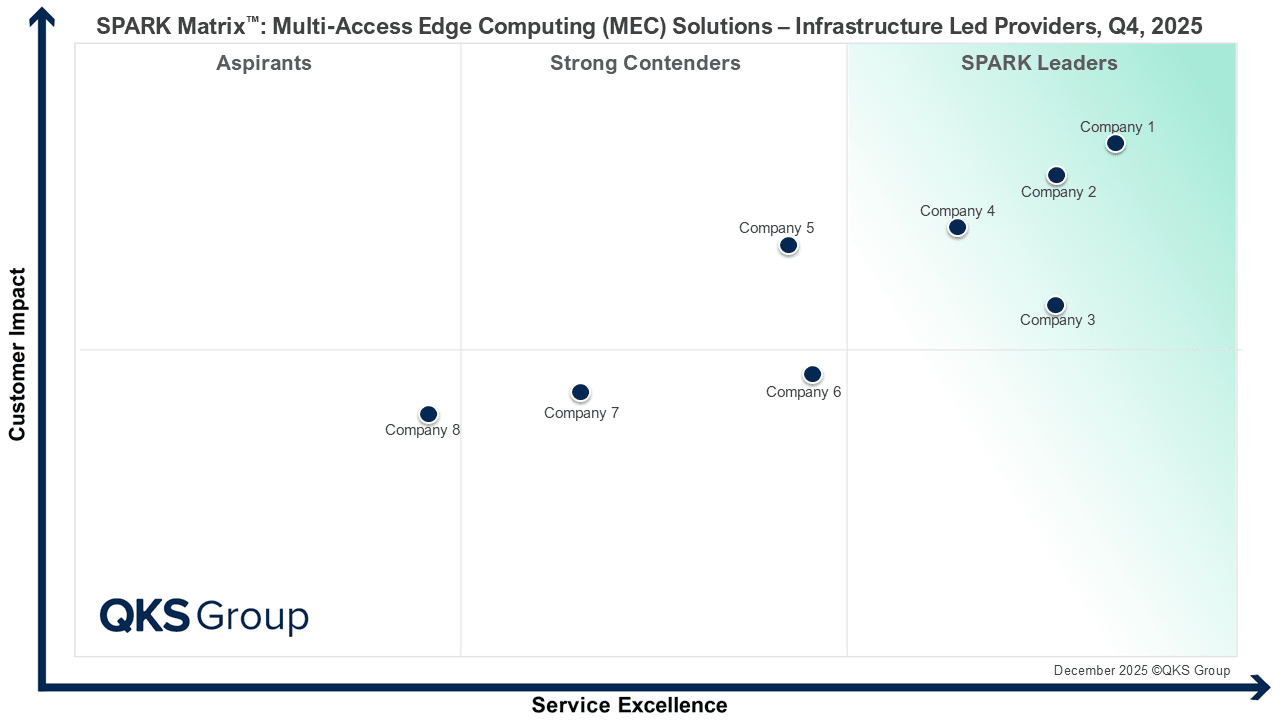
QKS Group's SPARK Matrix™: Multi-Access Edge Computing (MEC) Solutions – Infrastructure Led Providers, Q4 2025 provides an in-depth assessment of the global MEC infrastructure landscape. The research evaluates leading infrastructure-led providers based on their technology capabilities, competitive differentiation, market impact, and ability to support CSPs in deploying and monetizing edge computing environments.
Click Here For More Information: https://qksgroup.com/market-research/spark-matrix-multi-access-edge-computing-mec-solutions-infrastructure-led-providers-q4-2025-10340
Why MEC Is Becoming a Strategic Priority
Traditional cloud architectures often require data to travel to centralized data centers for processing. While effective for many workloads, this model can introduce latency, bandwidth costs, and connectivity challenges for applications requiring near-real-time responses.
MEC addresses these limitations by positioning computing capabilities at network-edge locations. This architecture is particularly important for applications such as industrial automation, connected vehicles, augmented reality, video analytics, smart infrastructure, and mission-critical enterprise workloads.
The evolution of 4G and 5G networks is further strengthening the MEC opportunity. 5G enables high bandwidth, low latency, network slicing, and massive device connectivity, creating an environment where edge computing can become tightly integrated with network infrastructure.
For CSPs, MEC is therefore moving beyond a technology deployment initiative and becoming a potential platform for developing new services, creating ecosystem partnerships, and generating additional revenue streams.
Infrastructure-Led MEC Providers: What Sets Them Apart?
The QKS Group study focuses specifically on infrastructure-led MEC providers, traditionally represented by Network Equipment Providers (NEPs). These vendors bring capabilities across network infrastructure, software platforms, edge orchestration, and telecommunications technologies.
Unlike standalone edge computing providers, infrastructure-led vendors can integrate MEC capabilities directly with the networking environment. Their solutions can combine Radio Access Network (RAN), transport, core network intelligence, compute, storage, and application hosting capabilities.
This integrated approach can help CSPs establish distributed edge environments that are optimized for telecommunications workloads while supporting enterprise applications.
The leading providers evaluated in the study include:
- Ericsson
- Fujitsu
- Huawei
- Mavenir
- NEC Corporation
- Nokia
- Samsung
- ZTE
These vendors are competing not only on infrastructure capabilities but also on orchestration, automation, interoperability, ecosystem support, application enablement, and the ability to support diverse edge deployment models.
Connect With Our Analyst: https://qksgroup.com/analyst-briefing?analystId=5&reportId=10340
Key Technology Trends Shaping the MEC Market
Several technology trends are influencing the evolution of the MEC market.
1. 5G and Edge Convergence
The combination of 5G and MEC enables CSPs to bring network and computing capabilities closer to end users. This convergence supports latency-sensitive applications while improving the overall performance of distributed workloads.
2. Edge Cloud Orchestration
As edge environments become increasingly distributed, centralized management becomes difficult. Advanced orchestration platforms help CSPs deploy, monitor, manage, and optimize workloads across multiple edge locations.
3. AI and Real-Time Analytics
AI workloads increasingly require rapid access to data. MEC enables organizations to process data closer to its source, supporting real-time analytics, computer vision, predictive operations, and intelligent automation.
4. Private 5G and Enterprise Edge
Private 5G networks are creating new opportunities for MEC adoption within enterprise environments. Manufacturing facilities, logistics operations, healthcare organizations, campuses, and other enterprises can deploy localized computing capabilities alongside private connectivity.
5. Edge Application Ecosystems
MEC is evolving from infrastructure deployment toward application enablement. CSPs increasingly need platforms that support developers, independent software vendors, hyperscalers, and enterprise application providers.
What QKS Group's SPARK Matrix Evaluates
The SPARK Matrix™: Multi-Access Edge Computing (MEC) Solutions – Infrastructure Led Providers, Q4 2025 provides a structured evaluation of vendors and their competitive positioning.
The assessment considers technology and market-related capabilities that can influence the success of MEC deployments, including platform capabilities, network integration, edge orchestration, scalability, application support, deployment flexibility, and overall market presence.
The analysis enables technology buyers to understand how different vendors approach the MEC opportunity and where their capabilities may provide a competitive advantage.
For vendors, the SPARK Matrix provides an objective view of the competitive landscape and helps identify opportunities for product differentiation, ecosystem development, and market expansion.
Business Benefits of MEC Adoption
Organizations adopting MEC can potentially achieve several business and operational benefits:
- Lower latency: Processing workloads closer to users and devices improves response times.
- Reduced network congestion: Local processing can reduce the amount of data transmitted to centralized cloud environments.
- Improved application performance: MEC supports real-time and latency-sensitive workloads.
- Enhanced data control: Organizations can process sensitive or operational data closer to its point of generation.
- Greater service innovation: CSPs can create new edge-enabled services for enterprise and consumer markets.
- Flexible deployment: MEC can support public, private, hybrid, and distributed network environments.
Strategic Implications for CSPs and Technology Buyers
The MEC market is becoming increasingly competitive, making vendor selection a strategic decision rather than simply an infrastructure procurement exercise.
CSPs need to evaluate whether a vendor can provide an integrated platform capable of supporting current requirements while scaling with future edge use cases. Factors such as interoperability, orchestration, automation, ecosystem maturity, network integration, and application enablement can significantly influence long-term value.
Enterprises should also assess how infrastructure-led MEC platforms align with their broader cloud, networking, cybersecurity, and digital transformation strategies.
Why This SPARK Matrix Matters
QKS Group's research provides stakeholders with a comprehensive perspective on the evolving Multi-Access Edge Computing (MEC) Solutions market and the competitive positioning of infrastructure-led providers.
The study helps technology decision-makers compare vendors, understand market differentiation, assess technology capabilities, and identify solutions aligned with their edge computing strategies. It also provides vendors with strategic insights into market dynamics, competitive strengths, growth opportunities, and evolving customer requirements.
For organizations planning their next-generation edge strategy, the SPARK Matrix™: Multi-Access Edge Computing (MEC) Solutions – Infrastructure Led Providers, Q4 2025 serves as a valuable decision-support resource for navigating an increasingly complex and rapidly evolving market.
Get the Competitive Edge with QKS Group
Are you evaluating MEC infrastructure providers or planning an edge computing strategy?
Get access to QKS Group's comprehensive research to assess Ericsson, Fujitsu, Huawei, Mavenir, NEC Corporation, Nokia, Samsung, and ZTE across key technology and market parameters.
Request the SPARK Matrix™ research today to benchmark vendors, evaluate competitive differentiation, identify market opportunities, and make more informed MEC investment decisions.
Custom Research & Consulting
QKS Group also provides customized research and consulting services designed to address specific strategic requirements. These services can help organizations gain deeper insights into industry structure, market participants, value chains, business opportunities, strategic planning, and go-to-market strategies.
Talk to QKS Group to understand how the MEC market is evolving and identify the right opportunities for your organization.
Download Sample Report Here: https://qksgroup.com/download-sample-form/spark-matrix-multi-access-edge-computing-mec-solutions-infrastructure-led-providers-q4-2025-10340
MEC Solutions SPARK Matrix™ – FAQs
1. What is the SPARK Matrix™ for MEC Solutions?
It evaluates leading infrastructure-led MEC providers based on technology capabilities, competitive differentiation, and market position.
2. Which vendors are included in the 2025 MEC SPARK Matrix™?
The report evaluates Ericsson, Fujitsu, Huawei, Mavenir, NEC Corporation, Nokia, Samsung, and ZTE.
3. Why are MEC Solutions important?
MEC enables low-latency computing closer to users and devices, supporting 5G, IoT, real-time analytics, and edge applications.
4. What does the MEC SPARK Matrix™ evaluate?
It assesses vendor capabilities across MEC platforms, network integration, edge orchestration, scalability, and market impact.
5. Who should use this MEC report?
CSPs, telecom operators, enterprises, technology buyers, and MEC vendors can use it for vendor comparison and strategic decision-making.

 Arabic
 French
 Spanish
 Portuguese
 Deutsch
 Turkish
 Dutch
Dutch
 Italiano
 Russian
 Romaian
 Portuguese (Brazil)
 Greek
Greek