


AI in Food Ingredient Innovation Market to Cross USD 45.1 Billion by 2036, Finds FMI Report
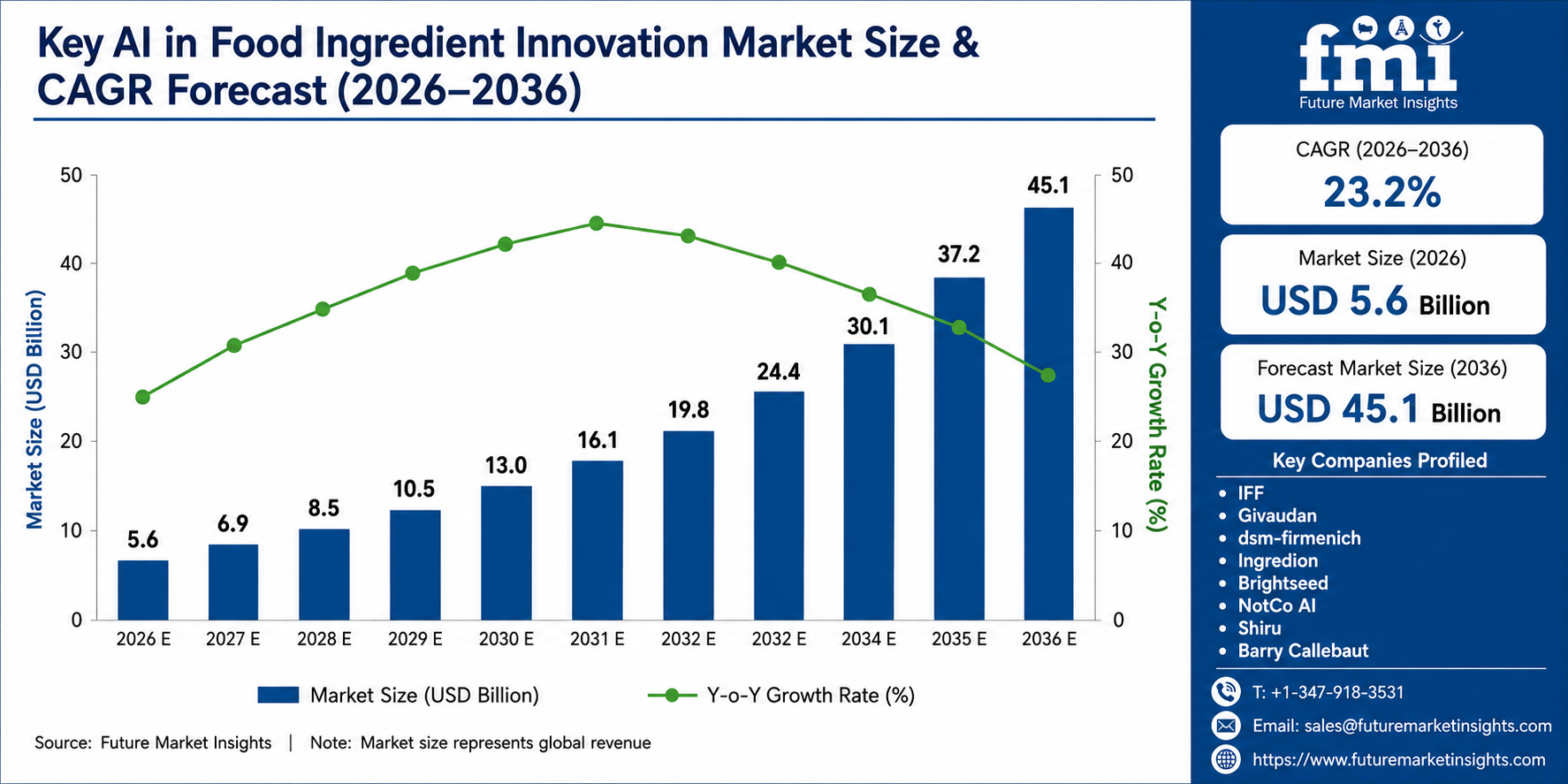
NEWARK, Del., August 13, 2026 — The global AI in Food Ingredient Innovation Market is entering a rapid growth phase as food manufacturers and ingredient companies increasingly adopt artificial intelligence to accelerate formulation, optimize ingredient combinations, improve product development, and support data-driven R&D decisions. According to Future Market Insights (FMI), the AI in Food Ingredient Innovation Market is valued at USD 5.6 billion in 2026 and is projected to reach USD 45.1 billion by 2036, expanding at a CAGR of 23.2% between 2026 and 2036.
The market is being shaped by the increasing use of AI across formulation, ingredient discovery, product optimization, sensory development, and food R&D workflows. Repeated use of AI tools across manufacturer portfolios can convert food technology investment into recurring formulation and product-development activity.
AI adoption is also gaining traction as companies seek to shorten development cycles and evaluate a larger number of ingredient and formulation combinations. dsm-firmenich reported in February 2026 that its AI tools assisted formulation development and generated provisional flavor formulas across operating business units, highlighting the growing role of AI in practical food innovation workflows.
The AI in Food Ingredient Innovation Market is expected to create significant opportunities between 2026 and 2036 as food manufacturers, ingredient suppliers, technology providers, and R&D organizations integrate AI into repeatable product-development processes.
👉 Get Detailed Market Forecasts, Competitive Benchmarking, and Pricing Trends:
Key AI in Food Ingredient Innovation Market Highlights
• Market Size (2026): USD 5.6 Billion
• Forecast Market Size (2036): USD 45.1 Billion
• Forecast Period: 2026–2036
• CAGR (2026–2036): 23.2%
• Leading Application Segment (2026): Formulation – 41.0% share
• Leading Technology Segment (2026): Machine Learning – 51.8% share
• Leading End User Segment (2026): Food Manufacturers – 38.0% share
Analyst Viewpoint
Nandini Roy Choudhury, Principal Consultant, Future Market Insights: “AI adoption in food ingredient innovation is likely to accelerate when manufacturers can connect validated food-specific data with repeatable physical testing and clear formulation outcomes. Technology providers that reduce integration complexity while supporting regulatory and quality requirements can strengthen enterprise adoption as AI moves from experimentation into routine product-development workflows.”
Why Is the AI in Food Ingredient Innovation Market Growing?
The AI in Food Ingredient Innovation Market is gaining momentum as food companies increasingly use artificial intelligence to improve formulation efficiency, evaluate ingredient combinations, and support recurring product-development activities.
The market is projected to increase from USD 5.6 billion in 2026 to USD 45.1 billion by 2036, representing a CAGR of 23.2% during the forecast period.
Formulation represents a significant application area, accounting for an estimated 41.0% share in 2026. AI-supported formulation enables manufacturers and ingredient developers to assess multiple combinations and identify potential product configurations more efficiently than conventional trial-and-error approaches.
Machine learning is projected to account for 51.8% of the market in 2026, reflecting the importance of data-driven models in identifying relationships between ingredients, formulations, sensory characteristics, and product-development outcomes.
Food manufacturers represent an estimated 38.0% share in 2026, highlighting the importance of AI within commercial product-development pipelines. As companies manage multiple product briefs and formulation requirements, repeated AI use can support recurring R&D workflows rather than isolated technology experiments.
The adoption of AI in food ingredient innovation also depends on access to validated, food-specific datasets. Models must produce useful outputs that can be tested and reproduced under real-world food-processing conditions. This connection between digital prediction and physical validation is expected to remain important as enterprise adoption expands.
Key Growth Drivers
• Growing adoption of AI across food formulation and R&D
• Increasing demand for faster product-development cycles
• Rising use of machine learning for ingredient and formulation analysis
• Growing need to evaluate complex ingredient combinations
• Increasing investment in food technology and digital R&D
• Expansion of AI-assisted formulation workflows
• Rising adoption among food manufacturers
• Growing importance of validated food-specific datasets
• Increasing demand for repeatable product-development processes
• Expanding use of AI across ingredient innovation and sensory development
Market Opportunity
The 23.2% CAGR projected for the AI in Food Ingredient Innovation Market between 2026 and 2036 indicates substantial opportunities for AI technology providers, food manufacturers, ingredient companies, formulation specialists, and food R&D organizations.
The market is expected to expand from USD 5.6 billion in 2026 to USD 45.1 billion by 2036. This rapid expansion creates opportunities for companies to develop AI platforms capable of supporting formulation optimization, ingredient selection, product development, and data-driven innovation.
Technology providers may increasingly focus on building systems trained on validated food-specific data and connecting AI recommendations with laboratory and physical testing workflows. Companies that demonstrate repeatable formulation outcomes may be better positioned to move customers from pilot projects to broader enterprise deployment.
👉 Access the Complete Report in PDF Format - AI in Food Ingredient Innovation Market Report:
Market Dynamics
Market Drivers
The AI in Food Ingredient Innovation Market is supported by the increasing need to improve the speed, scale, and efficiency of food product development. AI and machine learning can help companies analyze large datasets, evaluate ingredient relationships, and generate formulation possibilities across multiple product-development briefs.
Repeated R&D use is another important factor supporting market growth. When AI tools become integrated into recurring formulation workflows, technology investment can become connected to ongoing product-development decisions rather than remaining limited to individual experiments.
The growing participation of food manufacturers is also expected to support market expansion. With manufacturers accounting for an estimated 38.0% share in 2026, enterprise food companies represent a significant user base for AI-driven formulation and ingredient innovation technologies.
Market Restraints
Market adoption may be influenced by integration costs, regulatory requirements, data quality, validation needs, and the ability of AI-generated recommendations to perform consistently under physical food-processing conditions.
Food companies may also require substantial evidence before integrating AI outputs into commercial formulation processes. Regulatory proof, product safety requirements, quality standards, and the need for repeatable physical testing can extend enterprise conversion timelines.
Limited access to high-quality food-specific datasets can further affect model performance. AI systems that are not adequately trained on relevant ingredient, formulation, processing, and sensory data may deliver outputs that require extensive human validation before commercial application.
Market Trends
Major trends influencing the AI in Food Ingredient Innovation Market include:
• Rapid adoption of AI-assisted formulation
• Increasing use of machine learning in food R&D
• Growing demand for automated ingredient analysis
• Rising focus on formulation optimization
• Increasing integration of AI with physical food testing
• Growing importance of food-specific training datasets
• Expansion of AI use among food manufacturers
• Increasing investment in food technology platforms
• Growing emphasis on repeatable R&D workflows
• Increasing focus on regulatory and quality validation
• Expansion of AI-supported ingredient discovery
• Growing use of AI across multiple product-development briefs
Competitive Landscape
The AI in Food Ingredient Innovation Market is influenced by technology capabilities, food-specific datasets, formulation accuracy, integration flexibility, machine learning performance, regulatory support, validation capabilities, and the ability of technology providers to demonstrate measurable improvements in food R&D.
Companies operating in this market are expected to focus on AI-powered formulation platforms, ingredient intelligence, predictive analytics, machine learning models, sensory optimization, and tools that connect digital recommendations with physical testing.
Key AI In Food Ingredient Innovation Market Companies Profiled: Key IFF, Givaudan, dsm-firmenich, Ingredion, Brightseed, NotCo AI, Shiru and Barry Callebaut.
👉 Read the Complete Report: https://www.futuremarketinsights.com/reports/ai-in-food-ingredient-innovation-market
Frequently Asked Questions
What is the projected size of the AI in Food Ingredient Innovation Market by 2036?
The AI in Food Ingredient Innovation Market is projected to reach USD 45.1 billion by 2036, increasing from USD 5.6 billion in 2026.
What will be the value of the AI in Food Ingredient Innovation Market in 2026?
The market is projected to reach USD 5.6 billion in 2026.
What is the expected CAGR of the AI in Food Ingredient Innovation Market?
The market is forecast to expand at a 23.2% CAGR between 2026 and 2036.
What is the leading application segment in the AI in Food Ingredient Innovation Market?
Formulation is estimated to account for 41.0% of the market by application in 2026.
Which technology segment leads the AI in Food Ingredient Innovation Market?
Machine Learning (ML) is projected to account for 51.8% of the market in 2026.
Explore More Food and Beverage Industry Reports from FMI
About Future Market Insights (FMI)
Future Market Insights, Inc. provides actionable market intelligence and consulting services across global industries. FMI delivers market research, competitive intelligence, and strategic insights designed to help organizations identify emerging opportunities, evaluate market dynamics, and make informed business decisions.
For Press & Corporate Inquiries
Rahul Singh
AVP – Marketing and Growth Strategy
Future Market Insights, Inc.
+91 8600020075
For Sales: sales@futuremarketinsights.com
For Media: Rahul.singh@futuremarketinsights.com
For Web: www.futuremarketinsights.com

 English
 Arabic
 French
 Spanish
 Portuguese
 Deutsch
 Dutch
Dutch
 Italiano
 Russian
 Romaian
 Portuguese (Brazil)
 Greek
Greek