


Cocoa Supply Volatility to Push Alternative Chocolate Market to USD 1,460.2 Million by 2036: FMI
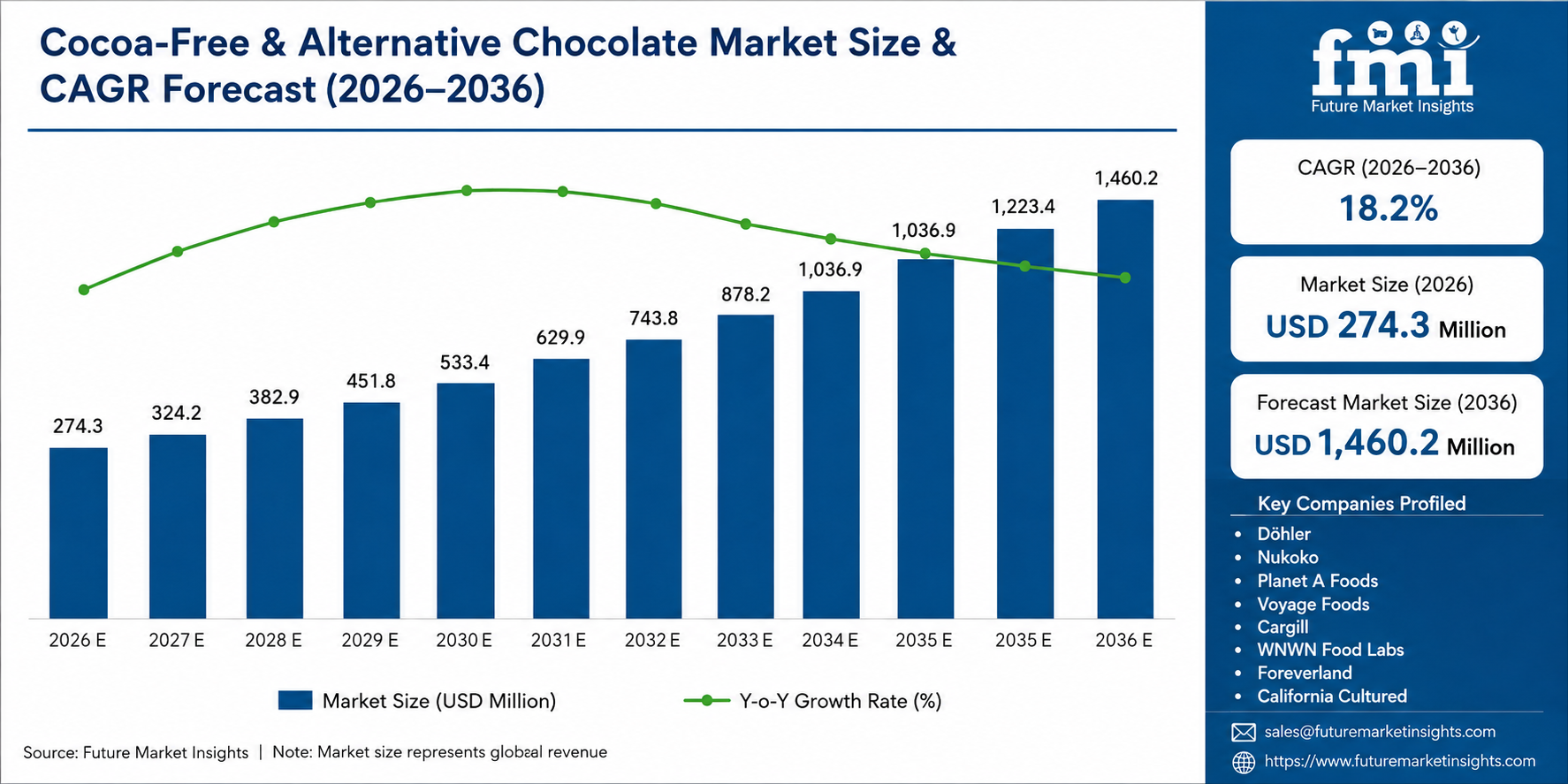
NEWARK, Del., August 13, 2026 — The global Cocoa-Free & Alternative Chocolate Market is expected to witness rapid growth as chocolate manufacturers increasingly explore alternatives to conventional cocoa ingredients amid supply uncertainty, cost pressures, and the need for more flexible ingredient sourcing. According to Future Market Insights (FMI), the Cocoa-Free & Alternative Chocolate Market is valued at USD 274.3 million in 2026 and is projected to reach USD 1,460.2 million by 2036, expanding at a CAGR of 18.2% between 2026 and 2036.
The market is being shaped by growing interest in cocoa-free formulations, alternative fats and masses, fermentation-based technologies, and ingredient systems that can reproduce key chocolate characteristics without relying entirely on traditional cocoa inputs.
Fermentation is estimated to account for 53.9% of technology demand in 2026, while cocoa-free chocolate represents 58.7% of product demand. Confectionery is expected to remain the leading application, accounting for 45.6% of application demand in 2026, as manufacturers increasingly evaluate alternative ingredients to manage cocoa supply exposure.
The Cocoa-Free & Alternative Chocolate Market is expected to create significant opportunities between 2026 and 2036 as manufacturers focus on sensory performance, ingredient qualification, formulation development, supply-chain resilience, and compliance with regional naming and labeling requirements.
👉 Get Detailed Market Forecasts, Competitive Benchmarking, and Pricing Trends:
Key Cocoa-Free & Alternative Chocolate Market Highlights
• Market Size (2026): USD 274.3 Million
• Forecast Market Size (2036): USD 1,460.2 Million
• Forecast Period: 2026–2036
• CAGR (2026–2036): 18.2%
• Leading Technology (2026): Fermentation – 53.9% share
• Leading Product (2026): Cocoa-Free Chocolate – 58.7% share
• Leading Application (2026): Confectionery – 45.6% share
• Report Published: August 12, 2026
• Report Length: 250 Pages
Analyst Viewpoint
Nandini Roy Choudhury, Principal Consultant, Future Market Insights: “Manufacturers evaluating cocoa-free and alternative chocolate solutions will need to balance supply-chain flexibility with sensory performance. Formulations that closely reproduce familiar melt, flavor, and texture characteristics while offering dependable ingredient sourcing are likely to have stronger potential for repeat purchasing as alternative chocolate categories develop.”
Why Is the Cocoa-Free & Alternative Chocolate Market Growing?
The Cocoa-Free & Alternative Chocolate Market is gaining momentum as chocolate manufacturers increasingly seek ways to reduce exposure to cocoa supply fluctuations while maintaining familiar product characteristics.
The market is projected to increase from USD 274.3 million in 2026 to USD 1,460.2 million by 2036, representing a CAGR of 18.2% during the forecast period.
Manufacturers are evaluating alternative fats, masses, and cocoa-replacement ingredients based on delivered cost, melt behavior, flavor, texture, and processing compatibility. This is encouraging broader ingredient trials across confectionery and other chocolate-related applications.
The cocoa supply environment is also contributing to the need for dual-source qualification. The International Cocoa Organization estimated a 48 thousand tonne cocoa surplus for 2024/25 in May 2026, although the reversal from the previous deficit continues to reinforce the importance of flexible sourcing strategies.
Formulators increasingly compare conventional cocoa butter inputs with alternative ingredients before approving recurring orders. This evaluation can help manufacturers manage procurement exposure while maintaining the functional and sensory properties expected from chocolate products.
Fermentation is emerging as an important technology within the market, accounting for an estimated 53.9% of technology demand in 2026. The technology's potential to support the development of cocoa-free or alternative chocolate ingredients is contributing to increased interest from manufacturers seeking scalable formulation solutions.
Key Growth Drivers
• Growing need to reduce exposure to cocoa supply volatility
• Rising interest in cocoa-free chocolate formulations
• Increasing adoption of alternative fats and chocolate masses
• Growing use of fermentation-based technologies
• Increasing ingredient trials among chocolate manufacturers
• Demand for improved supply-chain flexibility
• Rising focus on sensory performance and melt behavior
• Growing confectionery applications
• Increasing importance of dual-source ingredient qualification
• Continued innovation in alternative chocolate formulations
• Growing demand for cost-effective ingredient systems
• Increasing focus on supply-chain resilience
Market Opportunity
The 18.2% CAGR projected for the Cocoa-Free & Alternative Chocolate Market between 2026 and 2036 indicates substantial opportunities for ingredient manufacturers, chocolate producers, formulators, technology providers, and specialty food companies.
The market is expected to expand from USD 274.3 million in 2026 to USD 1,460.2 million by 2036. This rapid expansion creates opportunities for companies to develop cocoa-free chocolate products, alternative fat systems, fermentation-derived ingredients, and formulations designed to replicate familiar chocolate characteristics.
Manufacturers may increasingly focus on improving sensory performance, optimizing melt behavior, reducing ingredient costs, strengthening supply-chain flexibility, and developing formulations that can be integrated into existing chocolate production systems without extensive production-line reconstruction.
Market Dynamics
Market Drivers
The Cocoa-Free & Alternative Chocolate Market is supported by manufacturers' growing efforts to reduce cocoa supply exposure without rebuilding production lines.
Alternative ingredients are being assessed against cocoa-based inputs based on delivered cost, melt behavior, sensory performance, and processing characteristics. This creates opportunities for ingredient suppliers that can demonstrate consistent functionality and reliable supply.
The growing importance of dual-source qualification is another factor supporting market development. Manufacturers may increasingly seek alternative ingredients that can complement or partially replace conventional cocoa inputs when supply conditions or procurement economics change.
Fermentation-based technology is also contributing to market development. With fermentation estimated to account for 53.9% of technology demand in 2026, companies developing scalable approaches to cocoa-free and alternative chocolate production are positioned to address growing formulation requirements.
👉 Access the Complete Report in PDF Format - Cocoa-Free & Alternative Chocolate Market Report
Market Restraints
Market performance may be influenced by sensory challenges, consumer familiarity, regulatory naming requirements, labeling considerations, ingredient costs, and manufacturers' ability to reproduce the characteristics associated with conventional chocolate.
Sensory performance remains particularly important. Alternative chocolate products must deliver acceptable flavor, texture, melt behavior, and overall eating experience to encourage repeat purchasing.
Naming rules can also delay market adoption in some regions. Manufacturers may need to ensure that cocoa-free and alternative chocolate products comply with local requirements governing product descriptions, labeling, and consumer communication.
Higher formulation complexity and the need for ingredient qualification can further extend development cycles before alternative formulations achieve consistent commercial-scale adoption.
Market Trends
Major trends influencing the Cocoa-Free & Alternative Chocolate Market include:
• Growing interest in cocoa-free chocolate
• Rising adoption of fermentation-based technologies
• Increasing experimentation with alternative fats and masses
• Growing focus on cocoa supply-chain resilience
• Increasing importance of sensory performance
• Rising demand for familiar melt and texture characteristics
• Growing confectionery applications
• Increasing dual-source ingredient qualification
• Continued development of alternative chocolate formulations
• Growing focus on delivered ingredient costs
• Increasing attention to naming and labeling requirements
• Expansion of ingredient trials across chocolate manufacturing
Competitive Landscape
The Cocoa-Free & Alternative Chocolate Market is influenced by formulation performance, ingredient functionality, technology capabilities, supply reliability, cost competitiveness, sensory characteristics, processing compatibility, and manufacturers' ability to reduce cocoa exposure without compromising the consumer experience.
Companies operating in the market are expected to focus on improving alternative chocolate formulations, strengthening ingredient supply networks, optimizing sensory characteristics, and developing scalable technologies capable of supporting commercial production.
Key Cocoa-Free & Alternative Chocolate Market companies profiled: Döhler, Nukoko, Planet A Foods, Voyage Foods, Cargill, WNWN Food Labs, Foreverland, California Cultured.
👉 Read the Complete Report: https://www.futuremarketinsights.com/reports/cocoa-free-and-alternative-chocolate-market
Frequently Asked Questions
What is the projected size of the Cocoa-Free & Alternative Chocolate Market by 2036?
The Cocoa-Free & Alternative Chocolate Market is projected to reach USD 1,460.2 million by 2036, increasing from USD 274.3 million in 2026.
What will be the value of the Cocoa-Free & Alternative Chocolate Market in 2026?
The market is projected to reach USD 274.3 million in 2026.
What is the expected CAGR of the Cocoa-Free & Alternative Chocolate Market?
The market is forecast to expand at an 18.2% CAGR between 2026 and 2036.
What is the leading technology in the Cocoa-Free & Alternative Chocolate Market?
Fermentation is estimated to account for 53.9% of technology demand in 2026.
What is the leading product in the Cocoa-Free & Alternative Chocolate Market?
Cocoa-free chocolate is estimated to account for 58.7% of product demand in 2026.
Which application leads the Cocoa-Free & Alternative Chocolate Market?
Confectionery is expected to account for 45.6% of application demand in 2026.
What is driving growth in the Cocoa-Free & Alternative Chocolate Market?
Growing cocoa supply exposure, demand for ingredient diversification, increasing alternative ingredient trials, fermentation-based technology development, supply-chain resilience, and the need to maintain sensory performance are key factors supporting market growth.
Why are manufacturers exploring cocoa-free and alternative chocolate?
Manufacturers are exploring cocoa-free and alternative chocolate solutions to reduce exposure to cocoa supply fluctuations while maintaining acceptable flavor, texture, melt behavior, and processing characteristics.
What is the role of fermentation in the market?
Fermentation is estimated to account for 53.9% of technology demand in 2026, making it an important technology area for the development of cocoa-free and alternative chocolate solutions.
What challenge could affect repeat purchasing?
Sensory performance remains a major consideration. Alternative products need to deliver familiar flavor, texture, and melt characteristics, while naming and labeling requirements may also influence consumer acceptance and market adoption.
Explore More Food and Beverage Industry Reports from FMI
About Future Market Insights (FMI)
Future Market Insights, Inc. provides actionable market intelligence and consulting services across global industries. FMI delivers market research, competitive intelligence, and strategic insights designed to help organizations identify emerging opportunities, evaluate market dynamics, and make informed business decisions.
For Press & Corporate Inquiries
Rahul Singh
AVP – Marketing and Growth Strategy
Future Market Insights, Inc.
+91 8600020075
For Sales: sales@futuremarketinsights.com
For Media: Rahul.singh@futuremarketinsights.com
For Web: Future Market Insights

 English
 Arabic
 Spanish
 Portuguese
 Deutsch
 Turkish
 Dutch
Dutch
 Italiano
 Russian
 Romaian
 Portuguese (Brazil)
 Greek
Greek