


Targeting EZH2: Market Opportunities in Lymphoma and Solid Tumor Treatment
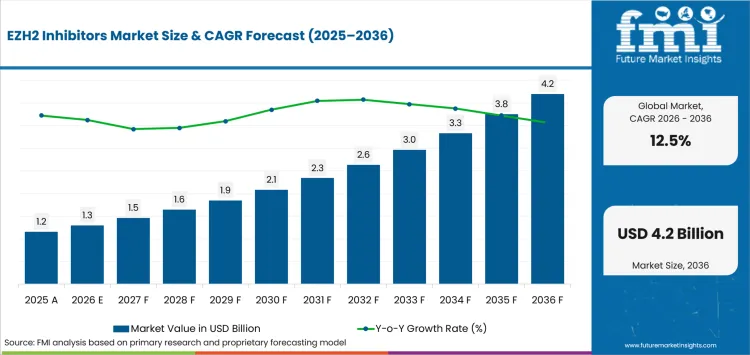
NEWARK, Del., Aug. 14, 2026 — The global EZH2 Inhibitors Market is entering a significant development phase as pharmaceutical and biotechnology companies advance epigenetic therapies for hematologic malignancies and other oncology indications. According to Future Market Insights (FMI), the market is projected to grow from USD 1.3 billion in 2026 to USD 4.2 billion by 2036, registering a 12.5% CAGR during the forecast period.
Growth is being supported by continued clinical research into EZH pathway biology, increasing interest in targeted oncology therapies, biomarker-defined patient selection, and the development of next-generation EZH2 inhibitors. EZH2, a component of the Polycomb Repressive Complex 2, plays an important role in regulating gene expression, making the pathway an important target for cancer drug development.
👉 Get Detailed Market Forecasts, Competitive Benchmarking, and Pricing Trends: https://www.futuremarketinsights.com/reports/sample/rep-gb-34533
The market is expected to create an absolute dollar opportunity of approximately USD 2.9 billion between 2026 and 2036. However, future commercial expansion will depend heavily on long-term safety evidence, durable efficacy, regulatory confidence, patient selection, and the ability of replacement assets to demonstrate differentiated clinical value.
Key EZH2 Inhibitors Market Highlights at a Glance
- Market Size (2026): USD 1.3 Billion
- Forecast Market Size (2036): USD 4.2 Billion
- Forecast Period: 2026–2036
- CAGR (2026–2036): 12.5%
- Absolute Dollar Opportunity: Approximately USD 2.9 Billion
- Leading Product: Tazemetostat (68.0% Market Share in 2026)
- Leading Indication: Follicular Lymphoma (36.0% Market Share in 2026)
- Leading Mechanism: Selective EZH2 Inhibition (62.0% Market Share in 2026)
- Key Growth Areas: Hematologic Malignancies, Lymphoma and Emerging Solid-Tumor Applications
- Key Companies: Ipsen, Pfizer, Novartis, Daiichi Sankyo, Haihe Biopharma, Jiangsu Hengrui Pharmaceuticals, Treeline Biosciences, and Axter Therapeutics
Analyst Viewpoint
"The future trajectory of the EZH2 inhibitors market depends increasingly on replacement programs capable of establishing a clear separation between therapeutic efficacy and long-term safety concerns. Biomarker-defined patient selection, prospective surveillance, and extended follow-up will become important factors in restoring confidence in EZH-targeted therapies. Developers that demonstrate durable clinical benefit while addressing safety considerations could strengthen the next phase of market development across lymphoma and other oncology indications."
Why Is the EZH2 Inhibitors Market Growing?
Increasing investment in epigenetic cancer therapies is creating new opportunities for EZH2-targeted treatments.
EZH2 regulates chromatin structure and gene expression and can contribute to abnormal cellular proliferation when dysregulated. Its involvement in cancer biology has encouraged researchers to investigate EZH2 inhibition across hematologic malignancies and selected solid tumors.
The growing emphasis on precision oncology is also supporting development. Researchers increasingly use molecular and genetic characteristics to identify patient populations that may benefit from targeted therapies.
Clinical development of dual EZH1/EZH2 inhibitors and selective EZH2 inhibitors is further expanding the therapeutic landscape.
Daiichi Sankyo's Japanese approval of valemetostat for relapsed or refractory peripheral T-cell lymphoma in June 2024 demonstrated continued regulatory interest in EZH-targeted approaches and represented an important milestone for dual EZH1/EZH2 inhibition.
Key Growth Drivers
- Increasing investment in epigenetic oncology therapies.
- Growing prevalence of hematologic malignancies.
- Expansion of biomarker-defined cancer treatment.
- Increasing research into EZH pathway biology.
- Development of selective EZH2 inhibitors.
- Clinical advancement of dual EZH1/EZH2 inhibitors.
- Growing interest in targeted lymphoma therapies.
- Expansion of oncology clinical trials.
- Increasing focus on precision medicine.
The development pipeline is increasingly moving toward therapies designed to achieve targeted pathway inhibition while maintaining an acceptable long-term safety profile.
👉 Access the Complete Report in PDF Format: https://www.futuremarketinsights.com/reports/brochure/rep-gb-34533
Why Does Tazemetostat Lead Product Demand?
Tazemetostat is estimated to account for 68.0% of product demand in 2026, making it the leading product within the defined market.
Its established clinical and regulatory history provides an important reference point for the EZH2 inhibitor landscape. The product has helped validate EZH2 as a therapeutic target in selected oncology indications.
However, subsequent safety findings have increased scrutiny around long-term treatment and created opportunities for next-generation assets to demonstrate differentiated safety and efficacy.
Replacement therapies are therefore being evaluated not only on their ability to inhibit EZH2 but also on their capacity to provide durable clinical benefit with prospective safety monitoring.
Why Does Follicular Lymphoma Lead Indication Demand?
Follicular lymphoma is projected to account for 36.0% of indication demand in 2026.
The disease represents an important application for EZH2-targeted therapy because molecular characteristics can help identify patients potentially responsive to pathway inhibition.
The increasing use of precision oncology approaches is supporting interest in genetically defined patient populations.
Future market expansion will depend on clinical evidence demonstrating meaningful outcomes across both mutation-positive and broader patient populations where appropriate.
👉 Explore the Latest Healthcare Industry Analysis Now:
https://www.futuremarketinsights.com/industry-analysis/healthcare
Why Does Selective EZH2 Inhibition Dominate Mechanism Demand?
Selective EZH2 inhibition is forecast to capture 62.0% of market share in 2026.
Selective inhibition has an established target-validation record and remains central to the development of EZH2-directed therapies.
At the same time, researchers are investigating whether alternative approaches, including dual EZH1/EZH2 inhibition, can expand therapeutic applications or overcome limitations associated with selective pathway targeting.
The competitive landscape is therefore evolving around target selectivity, pharmacological characteristics, efficacy, safety, and patient selection.
How Are Safety Considerations Reshaping the Market?
Long-term safety has become a central consideration for the EZH2 inhibitors market.
In May 2026, the United States FDA reported hematologic second primary malignancies in 18 of 318 SYMPHONY-1 participants, representing approximately 5.7% of participants in the reported population.
Such findings increase the importance of prospective safety surveillance and may influence regulatory, clinical, and commercial strategies surrounding replacement assets.
Future developers are expected to place greater emphasis on long-term follow-up, risk monitoring, biomarker-defined enrollment, and evidence generation throughout clinical development.
What Are the Latest EZH2 Inhibitor Development Trends?
Innovation continues to reshape the EZH2 inhibitors industry.
Major trends include:
- Development of next-generation selective EZH2 inhibitors.
- Increasing investigation of dual EZH1/EZH2 inhibition.
- Expansion of biomarker-driven clinical trials.
- Greater emphasis on long-term safety surveillance.
- Increasing research into solid-tumor applications.
- Development of companion diagnostic strategies.
- Greater focus on mutation-defined patient populations.
- Expansion of precision oncology approaches.
- Increasing competition among global and regional pharmaceutical developers.
These trends are shifting market competition from target validation alone toward differentiated clinical outcomes and demonstrable long-term safety.
What Are the Key Market Challenges and Restraints?
Safety concerns, regulatory uncertainty, clinical-development complexity, and the requirement for long-term evidence remain important market constraints.
The withdrawal of the former global commercial reference has also increased the importance of replacement programs demonstrating a clear benefit-risk profile.
EZH2 inhibitors must compete within increasingly crowded oncology pipelines, where physicians and healthcare systems evaluate therapies based on efficacy, safety, durability, patient selection, and overall treatment value.
What Is the Competitive Landscape?
Competition is centered on selective EZH2 inhibition, dual EZH1/EZH2 approaches, clinical differentiation, biomarker strategies, safety monitoring, and expansion into additional oncology indications.
Companies are investing in clinical trials and drug-development programs designed to establish differentiated positions within hematologic malignancies and potentially solid tumors.
Key Companies
- Ipsen
- Pfizer
- Novartis
- Daiichi Sankyo
- Haihe Biopharma
- Jiangsu Hengrui Pharmaceuticals
- Treeline Biosciences
- Axter Therapeutics
These companies maintain commercial or clinical positions across the defined EZH2 inhibitor landscape, competing through targeted therapies, clinical development programs, biomarker strategies, and expansion into new oncology indications.
👉 Read Full Report: https://www.futuremarketinsights.com/reports/ezh2-inhibitors-market
Frequently Asked Questions
1. What is the projected size of the EZH2 Inhibitors Market by 2036? The global EZH2 Inhibitors Market is projected to reach USD 4.2 billion by 2036, increasing from USD 1.3 billion in 2026.
2. What is the expected CAGR of the EZH2 Inhibitors Market? The market is forecast to expand at a 12.5% CAGR between 2026 and 2036.
3. Which product dominates the EZH2 Inhibitors Market? Tazemetostat is estimated to lead product demand with 68.0% market share in 2026.
4. Which indication holds the largest market share? Follicular lymphoma is projected to lead indication demand with 36.0% market share in 2026.
5. Which mechanism dominates the market? Selective EZH2 inhibition is forecast to account for 62.0% market share in 2026.
6. What is driving EZH2 inhibitor development? Growing interest in epigenetic oncology, biomarker-defined treatment, hematologic malignancy therapies, precision medicine, and next-generation EZH-targeted drugs is supporting market development.
7. What is the key challenge facing the EZH2 Inhibitors Market? Long-term safety evidence and regulatory scrutiny remain key challenges, increasing the importance of prospective surveillance and differentiated clinical evidence for replacement therapies.
Related Reports:
· Fc Fusion Protein Market - https://www.futuremarketinsights.com/reports/fc-fusion-protein-market
· Gene Switch Market - https://www.futuremarketinsights.com/reports/gene-switch-market
· Viral Clearance Market - https://www.futuremarketinsights.com/reports/viral-clearance-market
· NLP in Healthcare and Life Sciences Market - https://www.futuremarketinsights.com/reports/nlp-in-healthcare-and-life-sciences-market
· Non-Muscle Invasive Bladder Cancer Market - https://www.futuremarketinsights.com/reports/non-muscle-invasive-bladder-cancer-market
About Future Market Insights (FMI)
Future Market Insights (FMI) is a global market intelligence and consulting firm providing comprehensive market research, competitive intelligence, and strategic business insights across industries. The firm delivers detailed forecasts, technology analysis, and data-driven recommendations that support informed decision-making for manufacturers, investors, distributors, and policymakers worldwide.
For Press & Corporate Inquiries
Rahul Singh
AVP – Marketing and Growth Strategy
Future Market Insights, Inc.
+91 8600020075
For Sales – sales@futuremarketinsights.com
For Media – Rahul.singh@futuremarketinsights.com
For Web – https://www.futuremarketinsights.com

 English
 Arabic
 French
 Spanish
 Portuguese
 Deutsch
 Dutch
Dutch
 Italiano
 Russian
 Romaian
 Portuguese (Brazil)
 Greek
Greek