


24/7 Managed SOC Services: Critical Protection for Indian Healthcare
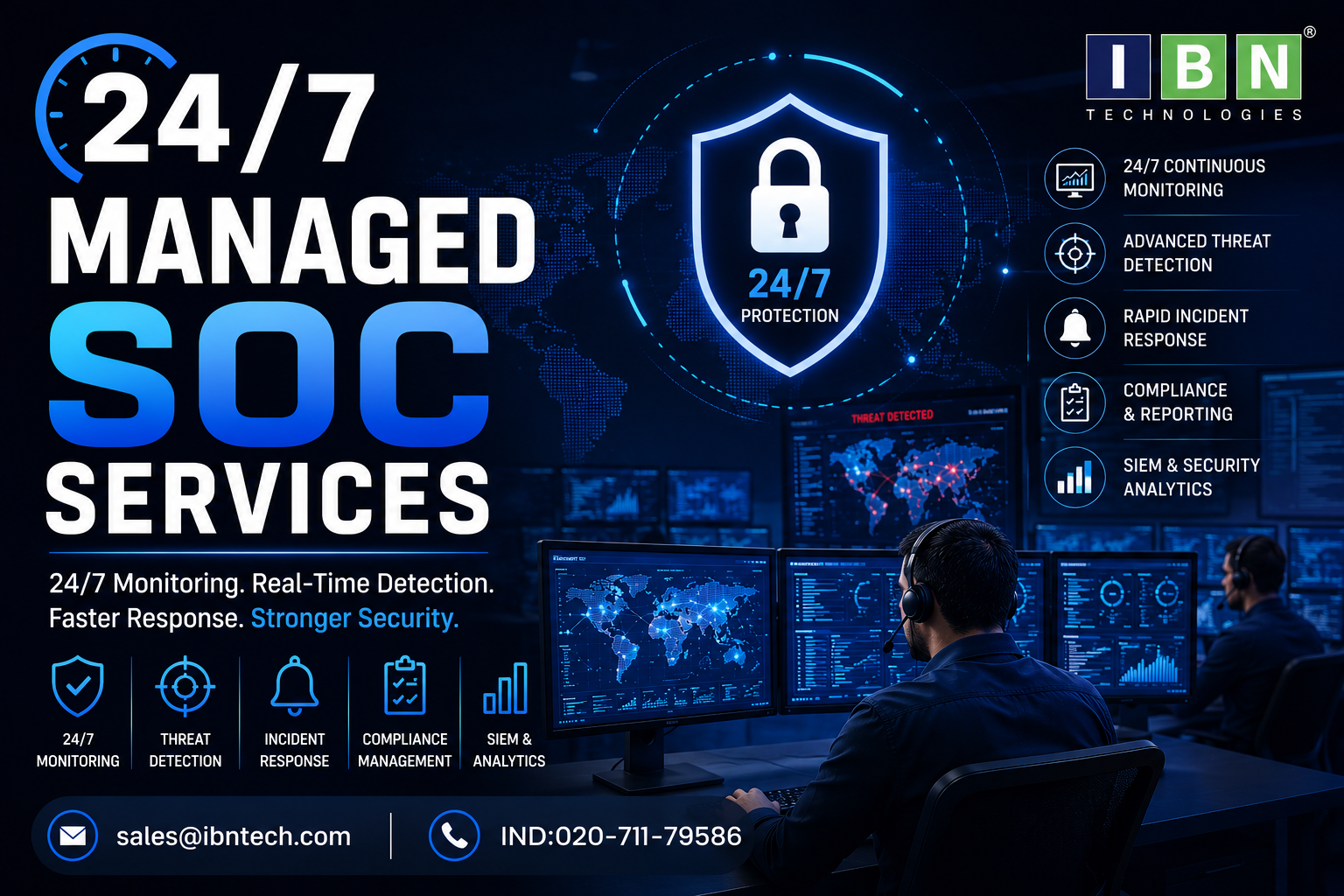
Why 24/7 managed SOC services matter for healthcare security
Healthcare organizations cannot treat cybersecurity as an issue limited to the IT department. Hospitals, diagnostic providers, clinics, healthtech companies, and other digital health organizations depend on systems that support patient records, clinical workflows, billing, communication, and connected services.
24/7 managed SOC services provide continuous security monitoring and response so suspicious activity can be investigated even when an internal IT team is focused on clinical operations or working outside normal office hours.
In simple terms, a managed SOC continuously watches security events, identifies potentially harmful activity, and coordinates an appropriate response.
This is particularly important as Indian healthcare becomes more digitally connected.
The healthcare attack surface is different
Healthcare environments combine sensitive information with operational dependency. An incident affecting an administrative application is concerning; an incident that disrupts access to systems supporting patient care can become considerably more serious.
Electronic health records, patient portals, cloud applications, remote access, diagnostic systems, connected devices, and third-party integrations can all create security monitoring requirements.
Healthcare providers also have to consider privacy, access control, auditability, and the responsibilities that come with exchanging health information digitally.
This means healthcare cybersecurity requires more than protecting individual devices. Security teams need a view of how identities, applications, infrastructure, and sensitive data interact.
Why basic security tools are not enough
Antivirus software, firewalls, identity controls, backups, and vulnerability management remain important. They do not, however, eliminate the need for continuous security operations.
A suspicious login may look harmless in isolation. A privileged account accessing unusual resources after a series of authentication failures may tell a different story.
Similarly, a healthcare organization may receive large volumes of alerts from multiple systems without having enough analysts available to investigate every meaningful event.
This is where healthcare SOC monitoring becomes operationally valuable. The objective is not simply to collect alerts but to provide context, prioritize risk, investigate activity, and escalate incidents according to defined procedures.
What a healthcare SOC should actually monitor
A healthcare organization evaluating a managed SOC should begin with its critical systems and data flows rather than selecting a generic monitoring package.
The provider should understand which systems contain sensitive information, which identities have elevated privileges, which applications support patient-facing services, and which third parties connect to the environment.
Monitoring should then be aligned with the organization's risk priorities.
IBN Technologies' healthcare cybersecurity services include 24/7 SOC and SIEM monitoring, vulnerability assessment and penetration testing, virtual CISO services, and managed detection and response capabilities. Its healthcare security approach also addresses environments involving electronic health records and practice-management systems.
A practical monitoring-to-response model
A mature managed SOC can support healthcare security through several connected activities.
Security events from relevant systems are collected and analyzed. Detection logic identifies suspicious patterns, while analysts investigate higher-risk alerts. Confirmed or credible incidents are escalated using agreed response procedures.
The process should not end when an incident is contained. Post-incident analysis can identify control gaps, recurring attack patterns, access issues, or areas requiring additional security investment.
Managed Detection and Response can extend this model through threat hunting, human-led response, forensic analysis, reporting, and security-roadmap support.
For healthcare organizations, this combination is valuable because an isolated alert rarely provides enough context to understand the actual business risk.
The healthcare business case
For healthcare leadership, the value of continuous security operations extends beyond preventing a breach.
A well-run SOC can help protect service availability, reduce the burden on internal IT teams, provide stronger visibility into security events, and create a more consistent incident-management process.
It can also support organizations that cannot justify a large internal security operations team but still require continuous monitoring.
A managed model allows internal technology and clinical leadership to retain decision-making authority while specialist security personnel handle continuous monitoring and investigation.
Healthcare scenario: a multi-location provider
Imagine an Indian healthcare provider operating several facilities with centralized applications, cloud services, remote users, and shared patient-data systems.
A security event occurs outside normal working hours. Without continuous monitoring, the event may wait for an employee to notice it or for the next shift to investigate.
With a managed SOC, the event can enter the monitoring workflow immediately. Analysts can assess its context, determine whether escalation is necessary, and coordinate with the organization's designated response team.
The objective is not to remove healthcare staff from the response process. It is to ensure that a potentially serious event does not remain unseen simply because the right security specialist is unavailable.
Compliance needs to be designed into monitoring
Healthcare security leaders should evaluate compliance as part of the operating model, not as a separate documentation exercise.
Indian healthcare organizations need to consider applicable privacy, cybersecurity, and digital-health requirements alongside contractual obligations and the sensitivity of health information.
Where healthcare organizations serve international patients, customers, or partners, additional frameworks may apply. IBN Technologies supports healthcare cybersecurity requirements involving frameworks such as HIPAA and ISO 27001, alongside other compliance-focused security capabilities.
The important principle is simple: a SOC should help produce security evidence and operational discipline, but it should not be presented as a substitute for an organization's broader legal or compliance program.
Healthcare SOC readiness checklist
Before selecting a managed SOC, healthcare leaders should confirm:
- Critical clinical and administrative systems are clearly identified.
- Sensitive health-data repositories and access paths are mapped.
- Monitoring covers the organization's relevant cloud, endpoint, network, and identity environments.
- Escalation procedures distinguish clinical-impacting incidents from routine security alerts.
- Privileged-account activity receives appropriate attention.
- Log retention aligns with applicable Indian requirements.
- Incident evidence can be produced for investigations and audits.
- Responsibilities between the healthcare organization and SOC provider are documented.
- Security reporting is understandable to both technical and executive stakeholders.
- The service can integrate with the organization's existing technology environment.
Healthcare security should ultimately be treated as part of operational resilience and patient-data stewardship, not simply as an IT control. For Indian healthcare organizations, 24/7 managed SOC services can provide continuous security visibility, stronger incident readiness, and specialist monitoring without requiring every provider to build a full internal security operations center. IBN Technologies combines SOC and SIEM monitoring with MDR, threat detection, incident response, vulnerability management, and compliance-oriented security capabilities to support organizations seeking a more structured approach to continuous cyber defense.
Contact Us:
IND- 02067680404
IBN Technologies Ltd.
E-mail: - sales@ibntech.com

 English
 Arabic
 French
 Spanish
 Portuguese
 Deutsch
 Turkish
 Dutch
Dutch
 Italiano
 Romaian
 Portuguese (Brazil)
 Greek
Greek