


Managed SOC Service Providers in India: A Critical Shield
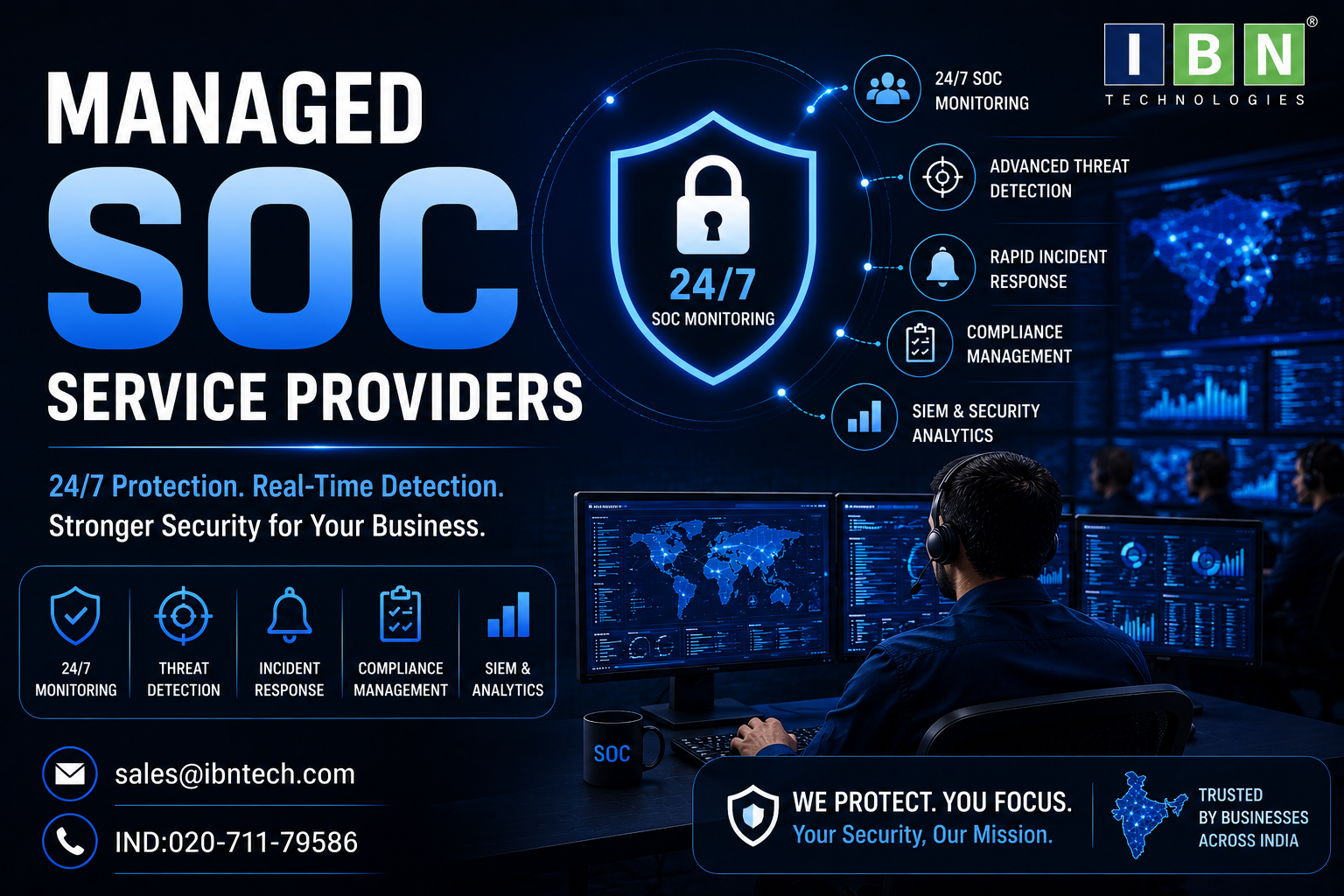
Building Stronger Healthcare Security With Managed SOC Service Providers
Healthcare organizations have a difficult cybersecurity responsibility: protect sensitive information while keeping critical digital systems available to the people who depend on them.
Hospitals, diagnostic centers, pharmaceutical organizations, healthcare technology companies, clinics, and other providers increasingly rely on connected applications, cloud platforms, endpoints, networks, patient portals, and digital workflows.
This creates a security environment where an incident can affect both information and operations. For healthcare leaders, managed soc service providers can provide continuous security monitoring and specialized threat-response capabilities without requiring the organization to build every security operation internally.
The right model should help healthcare organizations identify suspicious activity, investigate incidents, support containment, and maintain security visibility while internal teams remain focused on technology availability and organizational priorities.
What Are Managed SOC Service Providers?
Managed SOC service providers deliver outsourced security operations that monitor an organization's technology environment, analyze security events, investigate suspicious activity, and support incident response.
For healthcare organizations, healthcare SOC services apply these capabilities to an environment where confidentiality, availability, access control, and operational continuity are closely connected.
A managed SOC can monitor security events from relevant infrastructure and help security teams determine whether unusual behavior represents a genuine threat.
The objective is not to replace healthcare IT teams. It is to provide an additional security operations capability that can work alongside them.
Why Healthcare Needs Continuous Security Monitoring
Healthcare environments are different from many conventional business environments because technology is closely connected to daily operations.
A hospital may depend on digital systems for patient administration, scheduling, communication, documentation, billing, laboratory processes, and other workflows.
A diagnostic organization may rely on connected systems across collection centers and laboratories.
A healthcare technology company may operate cloud applications that process or support sensitive information.
The security challenge is therefore twofold.
Organizations must protect sensitive information from unauthorized access while also maintaining availability for legitimate users.
A security event that affects a business application may be inconvenient. A technology disruption in a healthcare environment can create much more complex operational consequences.
This makes early detection and disciplined incident response important components of healthcare resilience.
Why Traditional Security Approaches Can Miss the Bigger Picture
Healthcare organizations may already have multiple security controls.
They may use endpoint protection, firewalls, access controls, vulnerability-management tools, email security, cloud security controls, and other technologies.
The problem is often not the absence of tools.
It is the absence of continuous correlation and investigation.
One failed login may be harmless. An unusual endpoint connection may also be legitimate. A security alert from a network device may not appear serious on its own.
But when these events occur together, they may reveal a compromised account or an active attack.
A SOC helps connect those signals.
Instead of asking only whether a particular security tool generated an alert, security professionals can examine the broader sequence of events and determine whether the behavior warrants investigation.
What Healthcare SOC Services Should Cover
Healthcare organizations should begin by mapping their critical technology environment.
The provider should understand which systems are most important, which assets generate security-relevant information, where sensitive data is handled, and which activities could create operational risk.
IBN Technologies describes its managed SOC and SIEM services as providing 24/7 monitoring, threat detection, incident response, threat hunting, security-device monitoring, vulnerability management, user behavior analytics, dark-web and insider-threat monitoring, compliance-driven monitoring, and customized dashboards and reporting.
The company's service information also describes monitoring across firewalls, endpoints, cloud assets, and network devices.
These capabilities should be evaluated according to the healthcare organization's actual environment.
Not every organization needs identical monitoring coverage. The important consideration is whether the SOC provides meaningful visibility into the systems that matter most.
How Healthcare SOC Services Support Incident Response
Detection is only the first stage.
When suspicious activity is identified, healthcare organizations need a defined response process.
The SOC should investigate the event, establish its potential severity, escalate it to the appropriate people, and support containment or remediation according to agreed procedures.
Healthcare organizations should pay particular attention to response authority.
Not every system can simply be disconnected without considering operational consequences. A device, application, account, or network segment may support an important business or healthcare workflow.
This means incident-response procedures should be agreed before an emergency.
Internal leadership should know who can authorize containment, which teams need to be informed, and how the organization will balance security requirements with operational continuity.
Protecting Sensitive Healthcare Information
Healthcare security is closely connected with data protection.
Organizations need to understand not only whether unauthorized access occurred but also how users interact with sensitive systems and whether activity is consistent with established policies.
User behavior analytics can help identify unusual activity associated with insider threats, compromised accounts, or other anomalies.
IBN Technologies lists user behavior analytics among its managed SOC capabilities and describes it as a method for identifying anomalous activity and potential insider or compromised-account risks.
This type of monitoring can be useful in environments where legitimate users have access to important systems but their activity still needs to be evaluated against expected behavior.
Security monitoring should always be implemented with appropriate privacy, access, and governance considerations.
A Healthcare Use Case
Imagine a growing diagnostic organization with multiple locations.
Employees use centralized applications for administration and reporting. Different teams access systems according to their responsibilities. Remote connectivity is required for selected operational functions, while cloud services support parts of the organization's digital infrastructure.
The organization already has security technologies but does not have a dedicated team available to continuously investigate alerts.
One evening, an account associated with a privileged user begins showing unusual access behavior. Around the same period, an endpoint generates suspicious network activity.
Individually, each event might appear manageable.
A managed SOC can correlate the activity, investigate the account behavior, examine the endpoint event, and determine whether the activity requires escalation.
If the incident is confirmed as suspicious, the SOC can support the organization's response process while internal teams handle the business and operational decisions.
The benefit is not merely faster alert notification.
It is having a defined security function responsible for examining the wider context.
What Healthcare Leaders Should Evaluate Before Choosing a Provider
Healthcare CIOs, CISOs, CTOs, security managers, and compliance officers should evaluate managed SOC services based on the organization's operational realities.
|
Healthcare evaluation area |
What leaders should understand |
|
Asset coverage |
Which healthcare applications, endpoints, networks, cloud resources, and security devices are monitored |
|
Data visibility |
What security information is collected and analyzed |
|
Threat detection |
How suspicious patterns and anomalous activity are identified |
|
Investigation |
Who analyzes important alerts and determines potential severity |
|
Incident response |
How escalation, containment, investigation, and remediation are coordinated |
|
User activity |
Whether unusual account and user behavior can be identified |
|
Vulnerability management |
How security weaknesses are incorporated into ongoing security operations |
|
Compliance reporting |
What monitoring and reporting information can support audits and governance |
|
Dashboards |
Whether technical and executive stakeholders receive useful information |
|
Integration |
Whether the service can work with the organization's existing security environment |
|
Scalability |
Whether monitoring can grow as facilities, applications, users, and workloads expand |
The provider should also be transparent about its responsibilities.
Healthcare organizations should never discover during an incident that a critical response action falls outside the service scope.
Best-Practices Checklist for Healthcare Organizations
Before onboarding a managed SOC, healthcare leaders should establish a clear operational baseline.
- Identify critical healthcare applications and infrastructure.
- Map systems that process or provide access to sensitive information.
- Determine which security events require immediate escalation.
- Establish contacts across IT, security, compliance, and leadership.
- Define response authority for high-risk incidents.
- Identify systems where containment requires additional operational coordination.
- Confirm what logs and security events will be monitored.
- Review procedures for investigating unusual user behavior.
- Establish expectations for threat hunting and vulnerability management.
- Define reporting requirements for technical and executive stakeholders.
- Confirm how incident evidence and investigation records are handled.
- Test escalation procedures before relying on them during an actual incident.
- Review monitoring coverage whenever the technology environment changes.
This preparation helps turn the SOC from an alert-management function into a practical part of the organization's security and resilience program.
Compliance Should Be Connected to Daily Security Activity
Healthcare compliance should not exist as a separate paperwork exercise.
Security monitoring, access management, incident response, reporting, evidence preservation, and policy enforcement should work together.
IBN Technologies states that its managed SOC and SIEM services support compliance-driven monitoring and audit-ready reporting. Its published service portfolio references compliance considerations including HIPAA, GDPR, PCI-DSS, ISO 27001, and Indian regulatory requirements such as CERT-In.
The applicability of any specific framework depends on the healthcare organization's services, data flows, contracts, locations, and regulatory responsibilities.
For Indian organizations, the key principle is to understand the obligations that apply to the business and then build security operations that support those obligations consistently.
A SOC can contribute useful monitoring and reporting evidence, but it does not transfer the organization's legal or regulatory responsibility to the service provider.
Security and Operational Continuity Must Work Together
One of the biggest mistakes in healthcare cybersecurity is treating security and availability as competing objectives.
A mature security operation should consider both.
If a suspicious endpoint is identified, the security team needs to determine how to contain the threat while considering the operational importance of that endpoint.
If a privileged account appears compromised, the organization needs to secure the account while ensuring that appropriate authorized users retain access.
If suspicious network traffic is identified, the response should consider both the security risk and the systems potentially affected by containment.
This is why incident-response planning should involve more than the SOC.
IT, security, compliance, business leadership, and relevant operational stakeholders should understand their responsibilities.
The Role of Threat Hunting
Traditional monitoring waits for security events to trigger detection mechanisms.
Threat hunting takes a more proactive approach.
IBN Technologies describes threat hunting and intelligence as part of its managed SOC offering, using behavioral analytics and threat intelligence to identify hidden or dormant threats.
For healthcare organizations, proactive investigation can add value because attackers do not always generate an obvious alert at the moment they gain access.
A mature SOC should therefore combine automated detection with expert investigation.
This does not mean investigating every event manually. It means having processes for identifying patterns that deserve deeper analysis.
How Healthcare Leaders Can Measure SOC Effectiveness
A managed SOC relationship should be measured against meaningful security outcomes.
Healthcare leaders should look at whether monitoring coverage is improving, whether security events are being investigated consistently, whether escalation responsibilities are clear, and whether incident reporting provides useful information for decision-makers.
Security teams can review investigation quality, recurring alerts, unresolved vulnerabilities, response processes, and monitoring gaps.
Executives can focus on broader questions:
Is the organization better prepared to detect suspicious activity?
Can leadership understand the security situation without relying on fragmented technical reports?
Are incident responsibilities clear?
Can security operations scale as the organization expands?
These questions help ensure that managed security services deliver operational value rather than simply increasing the volume of security notifications.
Building a Sustainable Healthcare Security Model
Healthcare organizations in India face a security environment where digital transformation, sensitive information, connected infrastructure, and operational continuity intersect.
That makes continuous security monitoring increasingly important.
IBN Technologies provides managed SOC and SIEM services alongside related cybersecurity capabilities such as Managed Detection and Response, VAPT, vCISO services, Managed Microsoft Security, Cyber Security Maturity Risk Assessment, and Compliance Management and Audit Services.
For healthcare organizations, the objective should be to create a security operation that fits the way the organization actually works.
The best managed soc service providers should bring together continuous monitoring, threat detection, investigation, threat hunting, incident-response support, vulnerability management, user behavior analysis, and compliance-aware reporting. For Indian healthcare organizations, that combination can help create a more resilient security posture while allowing internal teams to remain focused on reliable technology and the people who depend on it.
Contact Us:
IND- 02067680404
IBN Technologies Ltd.
E-mail: - sales@ibntech.com

 English
 Arabic
 French
 Portuguese
 Deutsch
 Turkish
 Dutch
Dutch
 Italiano
 Russian
 Romaian
 Portuguese (Brazil)
 Greek
Greek