


managed soc services: Essential Cybersecurity Guide for Indian Healthcare
Why managed soc services are important for healthcare
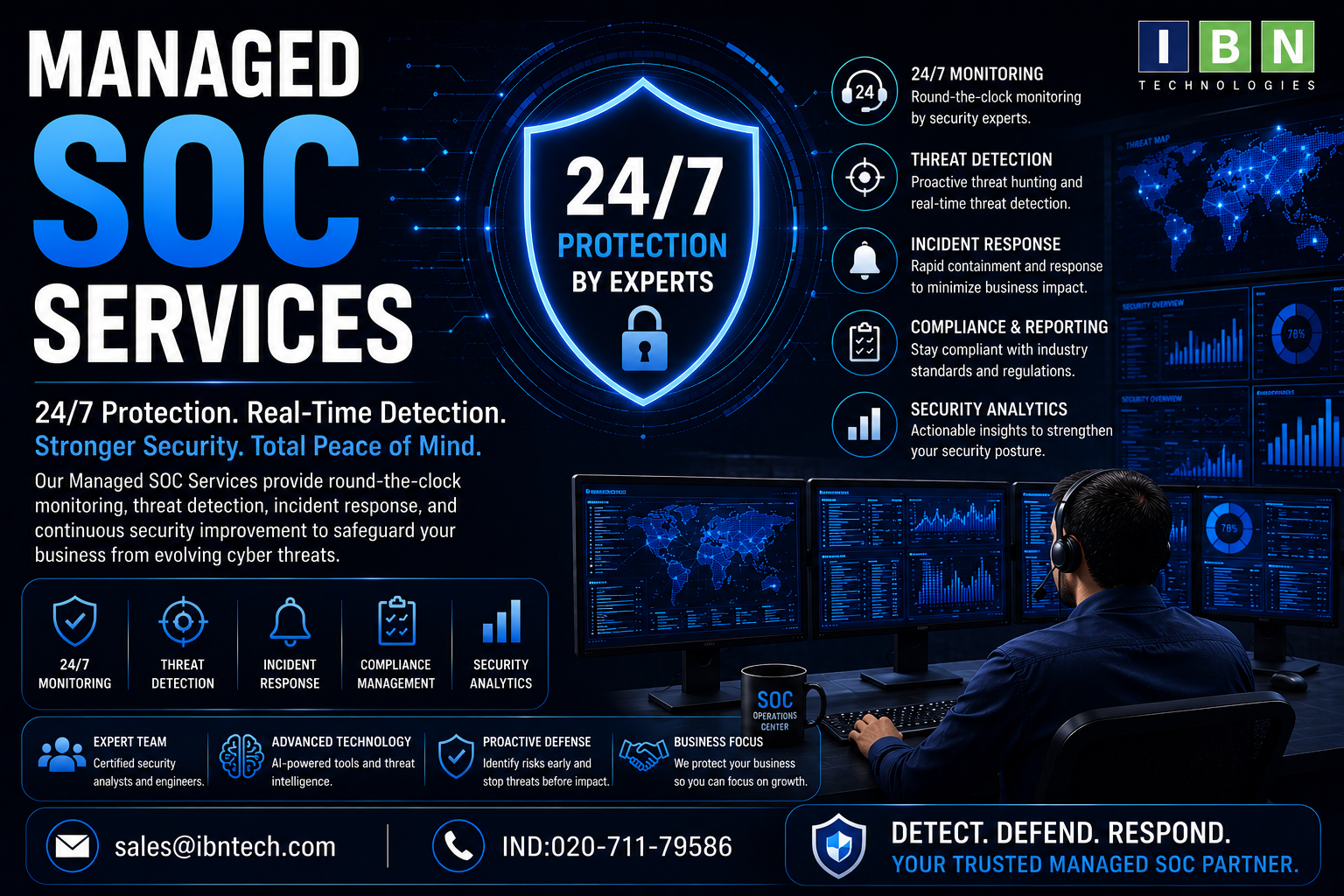
managed soc services provide continuous security monitoring, threat detection, investigation, and response through an outsourced security operations model. In healthcare, these services can help organisations maintain visibility across systems that handle patient information and support clinical, administrative, and financial workflows.
Indian healthcare organisations are increasingly dependent on digital infrastructure. Hospitals, clinics, healthtech businesses, and other providers may operate electronic health records, patient portals, diagnostic systems, billing applications, cloud services, endpoints, and external integrations.
A security operation must therefore consider both data protection and operational continuity.
Healthcare cannot treat security monitoring as an occasional task
A periodic security assessment can identify weaknesses at a particular point in time. Continuous monitoring addresses a different problem: what is happening across the environment between assessments.
Healthcare systems can generate large amounts of operational and security activity. An unusual login, unexpected privileged access, suspicious network behaviour, or abnormal application activity may need investigation even when the underlying systems appear to be functioning normally.
The difficulty increases when internal IT teams are already responsible for application support, infrastructure, user administration, vendor management, and clinical technology.
A managed operation can provide dedicated security monitoring while allowing healthcare technology teams to retain responsibility for systems and business decisions.
The threat driver is also an operational driver
Healthcare organisations face risks such as credential compromise, ransomware, phishing, exploitation of vulnerabilities, and unauthorised access to sensitive information.
The consequences can extend beyond privacy concerns. Depending on the systems involved, technology disruption can interfere with appointments, administrative processes, patient communications, diagnostics, billing, or other workflows.
This makes detection speed and response coordination important. A healthcare organisation needs to know not only that suspicious activity exists, but also which system is affected and who should take action.
What healthcare threat detection should cover
A healthcare monitoring strategy should begin with an inventory of important systems.
Clinical applications, patient-facing platforms, identity systems, endpoints, cloud environments, network infrastructure, and third-party connections may all contribute relevant security information.
Not every system requires identical monitoring. The organisation should prioritise assets based on the sensitivity of the information they handle and their importance to operations.
IBN Technologies' healthcare cybersecurity offering includes 24/7 SOC and SIEM monitoring, VAPT services, and security and compliance capabilities for hospitals, clinics, healthtech organisations, and healthcare providers.
How managed soc services support healthcare security
The operating process starts by connecting relevant security data sources to the monitoring environment.
Security events are analysed to identify suspicious behaviour. Analysts can investigate alerts and determine whether an event represents routine activity, a configuration issue, or a potential security incident.
When an incident requires escalation, the response process should already define who needs to be informed and what information they require.
For healthcare, that clarity matters because technical containment decisions may interact with operational requirements. The security provider and healthcare organisation should agree in advance on responsibilities and approval boundaries.
Why DIY monitoring can create gaps
Manual log reviews are difficult to sustain across a complex healthcare environment. Even when staff are highly capable, continuous security monitoring competes with daily operational responsibilities.
A healthcare organisation may also have fragmented visibility. Different departments can manage different applications, and third-party providers may operate systems that connect to the organisation's environment.
A centralised security operation can provide a consistent process for analysing events across those environments.
Building an internal SOC remains an option for larger organisations with the necessary security expertise and resources. However, it requires ongoing investment in personnel, technology, processes, and operational coverage.
What a healthcare organisation should expect from a managed service
The service scope should be specific.
Healthcare leaders should understand which systems are monitored, what telemetry is collected, how alerts are prioritised, how incidents are investigated, and what response activities are included.
Continuous monitoring is valuable only when it is connected to an effective response process. A large volume of alerts without appropriate prioritisation can create additional workload rather than reduce risk.
Reporting should also be designed for different audiences. Security teams may need technical information, while executives need a clearer view of significant incidents, recurring weaknesses, unresolved risks, and security trends.
Benefits for healthcare technology teams
A managed security operation can provide additional specialist capacity without requiring the organisation to create every security function internally.
This can help internal teams focus on system availability, application management, infrastructure, digital transformation, and remediation while security analysts handle monitoring and investigation activities.
It can also improve security consistency. Defined escalation processes reduce reliance on informal communication and make responsibilities clearer during an incident.
For healthcare organisations with multiple facilities or a growing digital footprint, the ability to extend monitoring as the environment changes can be particularly useful.
A realistic Indian healthcare scenario
Consider a healthcare provider operating several facilities and a mix of established clinical systems and newer cloud applications.
The organisation has endpoint protection and other security controls, but different technical teams manage different systems. Security events are reviewed when staff have time, which means there is no consistent process for continuous investigation.
The organisation begins by identifying its most important systems and determining what security information should be monitored continuously.
A managed SOC is then integrated with the relevant environment. An unusual privileged login is detected outside expected usage patterns and escalated to the appropriate internal team.
The internal technology team verifies the account activity and determines the necessary response. The managed service provides the monitoring and investigation capability, while the healthcare organisation retains authority over operational decisions.
This model creates a clearer relationship between security detection and business response.
Best-practice checklist for healthcare leaders
Map clinical and administrative systems
Identify systems containing sensitive patient information
Prioritise critical applications for continuous monitoring
Review privileged and third-party access
Centralise relevant security telemetry
Define incident severity levels
Establish escalation contacts before an incident
Clarify provider and internal response responsibilities
Test security incident communication procedures
Connect recurring alerts with vulnerability remediation
Review monitoring coverage whenever new technology is introduced
Compliance and security operations
Healthcare organisations may have to address multiple privacy, security, contractual, and regulatory requirements.
IBN Technologies' healthcare services reference HIPAA, HITECH, ISO 27001, SOC 2, GDPR, PCI-DSS, and Indian regulatory considerations including DPDPA.
The relevant requirements will depend on the organisation's activities, data flows, customers, and geographic relationships. A healthcare provider should therefore map its own obligations before defining the monitoring and reporting scope.
Security monitoring can support compliance by creating visibility and evidence around security events, access activity, incident response, and operational controls. It should nevertheless be treated as one component of the wider security and governance programme.
Evaluating a healthcare managed SOC provider
The provider selection process should start with the healthcare organisation's technology environment.
Ask whether the provider can monitor the systems that matter, integrate with existing security tools, and support the organisation's operating model.
Response procedures deserve particular attention. Healthcare leaders should establish who investigates incidents, how escalations are communicated, which containment actions are authorised, and how decisions affecting critical systems are coordinated.
It is also important to understand how the service handles changes. A new patient portal, cloud application, facility, or third-party connection may create additional monitoring requirements.
How healthcare threat detection should be measured
Healthcare threat detection should not be evaluated simply by counting alerts.
Useful measures can include the quality of prioritisation, investigation processes, escalation consistency, recurring incident patterns, and remediation follow-through.
The goal is to make security information actionable. A monitoring service should help the organisation understand what happened, why it matters, who needs to respond, and whether the underlying weakness has been addressed.
Making managed security part of healthcare resilience
Security operations should fit into the organisation's wider resilience strategy rather than functioning as an isolated technical service.
Incident response, vulnerability management, access governance, backup and recovery, compliance, and business continuity all influence how effectively an organisation can withstand a security event.
Managed SOC services can strengthen the monitoring and response component of that programme. The organisation still needs clear internal ownership, appropriate governance, and tested operational procedures.
For Indian healthcare providers, managed soc services can provide a practical way to maintain continuous security visibility without requiring every monitoring capability to be built internally. When the service is aligned with clinical systems, patient-data risks, response responsibilities, and compliance requirements, security operations become a more dependable part of healthcare resilience.
Contact Us:
IND- 02067680404
IBN Technologies Ltd.
E-mail: - sales@ibntech.com

 English
 Arabic
 French
 Portuguese
 Deutsch
 Turkish
 Dutch
Dutch
 Italiano
 Russian
 Romaian
 Portuguese (Brazil)
 Greek
Greek