


Acaricides Market Forecast to Reach $817.4M by 2036
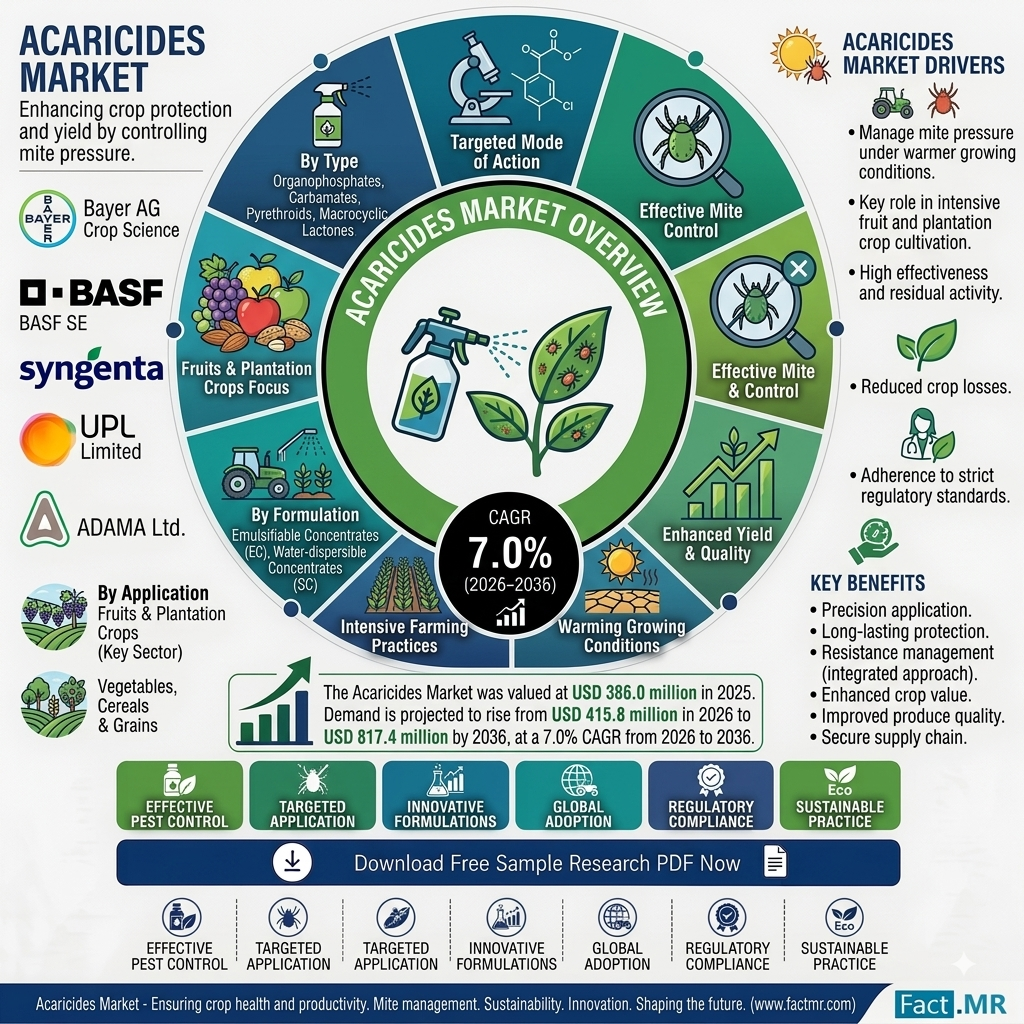
August 18, 2026 — The global acaricides market is projected to rise from USD 415.8 million in 2026 to USD 817.4 million by 2036, expanding at a 7.0% CAGR from 2026 to 2036, according to Fact.MR. The market was valued at USD 386.0 million in 2025.
The market is gaining as growers face stronger mite-management needs in high-value crops. Acaricides help reduce mite damage on leaves and fruit surfaces. Resistance control is also becoming more important. Crop advisors rotate products and modes of action to reduce pressure from repeated use of the same chemistry. Protected cultivation adds another demand factor because enclosed production can allow mite pressure to build.
External Market Proof
The wider crop-protection market also shows continued activity. The Food and Agriculture Organization of the United Nations (FAO) stated in 2025 that pesticides are important agricultural inputs used to protect seeds and crops from pests and diseases. BASF SE reported EUR 9,587 million in Agricultural Solutions sales for 2025, according to its 2025 report published in 2026. Syngenta Group reported USD 13.7 billion in 2025 sales for Syngenta Crop Protection in its 2026 full-year results. These figures provide context for the scale of crop-protection activity surrounding the acaricides market.
Get detailed market forecasts, competitive benchmarking, and pricing trends: https://www.factmr.com/connectus/sample?flag=S&rep_id=15107
Key Numbers
|
Market Metric |
Fact.MR Data |
|
Market value, 2025 |
USD 386.0 million |
|
Market value, 2026 |
USD 415.8 million |
|
Forecast value, 2036 |
USD 817.4 million |
|
CAGR, 2026–2036 |
7.0% |
|
Synthetic acaricides share, 2026 |
62.0% |
|
Contact acaricides share, 2026 |
36.0% |
|
Fruits and vegetables share, 2026 |
43.0% |
|
Suspension concentrates share, 2026 |
34.0% |
|
Agrochemical distributors share, 2026 |
41.0% |
|
India CAGR, 2026–2036 |
8.9% |
Source: Fact.MR. Each figure is reported by Fact.MR.
Segment Breakdown
Synthetic products lead. Synthetic acaricides are expected to hold 62.0% share in 2026. Established chemistries remain important because growers need quick mite knockdown. Bio-acaricides are gaining attention where residue pressure and beneficial-insect protection matter.
Contact products remain important. Contact acaricides are projected to account for 36.0% share in 2026. Foliar mite control often depends on reaching mite colonies on leaf surfaces and undersides. Translaminar products and other modes of action support rotation programs.
Fruits and vegetables drive crop demand. This segment is projected to hold 43.0% share in 2026. Visible mite damage can reduce crop quality and marketable value. Apples, cucurbits, and other high-value crops therefore need timely control.
Suspension concentrates lead formulations. Suspension concentrates are anticipated to capture 34.0% share in 2026 because growers need stable dispersion and easier spray handling.
Distributors remain the leading channel. Agrochemical distributors are expected to hold 41.0% share in 2026. Local product access and spray guidance remain important during mite outbreaks.
Country Growth Outlook
|
Country |
CAGR, 2026–2036 |
|
India |
8.9% |
|
China |
8.4% |
|
Brazil |
7.6% |
|
United States |
6.5% |
|
Germany |
5.8% |
Source: Fact.MR.
India records the fastest growth among the countries listed, with an 8.9% CAGR through 2036. China follows at 8.4%, supported by fruit and vegetable production. Brazil is projected at 7.6%, while the United States and Germany are forecast at 6.5% and 5.8%, respectively.
Competitive Landscape
Fact.MR identifies Bayer AG (Crop Science), BASF SE, Syngenta Group, UPL Limited, and ADAMA Ltd. as key companies. Bayer participates through products such as Oberon in selected markets, while BASF addresses mite-control demand through products such as Nealta. Syngenta competes through its broad crop-protection portfolio. UPL and ADAMA strengthen competition through regional registrations and distributor networks.
Important: The supplied Fact.MR page identifies the leading companies but does not publish individual company market-share percentages in the accessible text. No company share has therefore been added here.
Analyst View
Shambhu Nath Jha, Principal Consultant at Fact.MR, states: “Acaricides are becoming a bigger part of resistance management in crop protection. Growers need products that protect crop quality without repeated use of the same chemistry. Suppliers that offer effective mite control with clear rotation guidance will gain stronger farm-level acceptance.”
Frequently Asked Questions
What is the acaricides market forecast for 2036?
Fact.MR projects the market to reach USD 817.4 million by 2036.
What is the acaricides market CAGR?
The market is forecast to expand at 7.0% CAGR from 2026 to 2036.
Which product type leads the acaricides market?
Synthetic acaricides are expected to lead with 62.0% share in 2026.
Which country has the fastest projected growth?
India is projected to record the highest listed country CAGR at 8.9% from 2026 to 2036.
What is driving acaricide demand?
Mite pressure in high-value crops, crop-quality protection, resistance management, and protected cultivation are key demand drivers.
Top Reports:
https://kaamkaaziclub.com/read-blog/38270
https://1nigeria.radiobenue.be.gov.ng/read-blog/24976
https://bolworld.com/blogs/45402/Sound-Control-Sealants-Market-to-Reach-1-004B-by-2036
https://gulfsena.com/blogs/78783/Sound-Control-Sealants-Market-Poised-for-1-004B-by-2036
About Fact.MR
Fact.MR is a market research and consulting firm providing market intelligence, forecasts, and strategic analysis across industries. Its acaricides market study covers product type, mode of action, crop type, formulation, sales channel, regional markets, and key companies.

 English
 Arabic
 Spanish
 Portuguese
 Deutsch
 Turkish
 Dutch
Dutch
 Italiano
 Russian
 Romaian
 Portuguese (Brazil)
 Greek
Greek