


The Story of Hajar: A Woman Whose Journey Became an Act of Worship
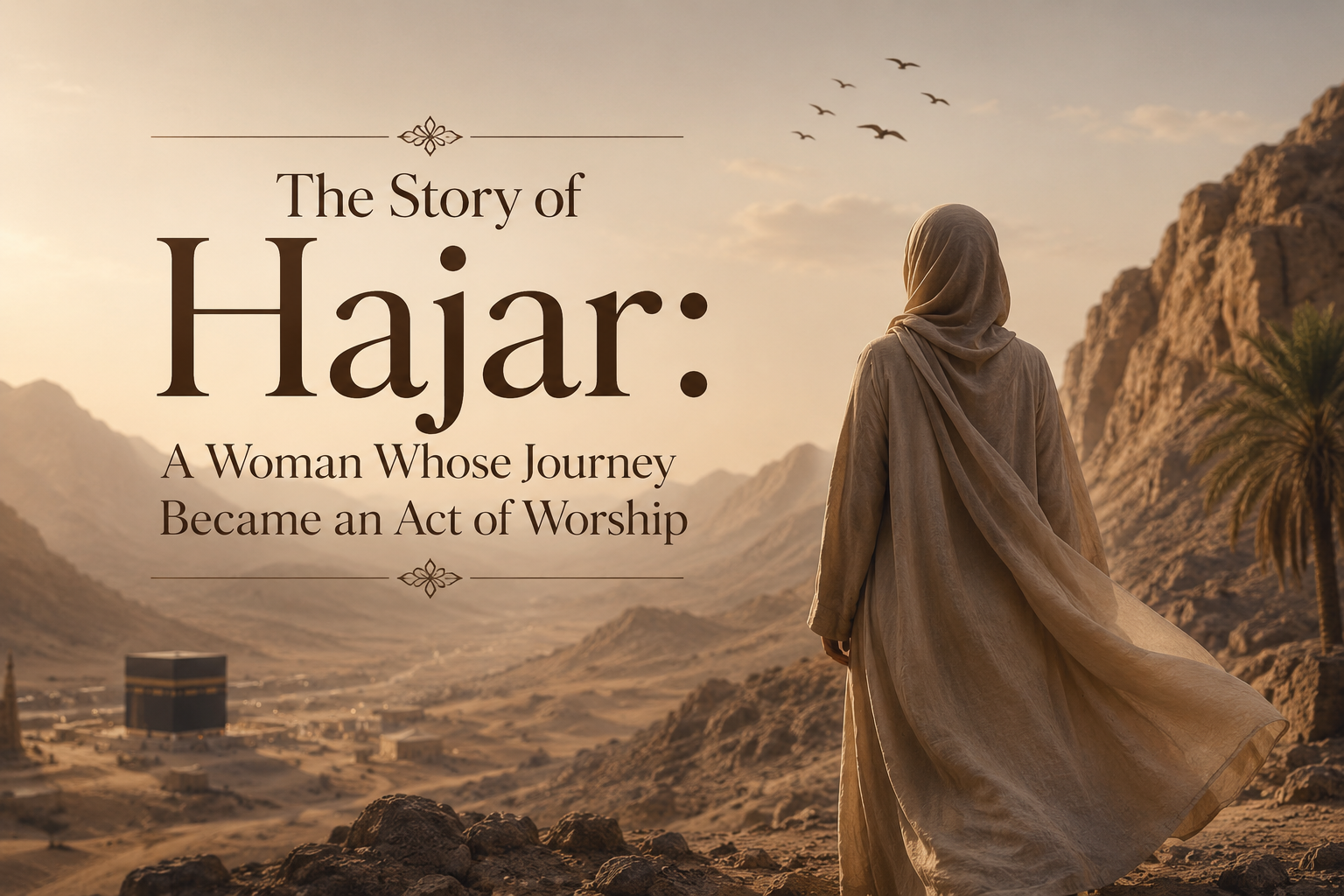
The story of Hajar is one of the most powerful stories connected to Makkah, Hajj and Umrah. Her experience was marked by hardship, trust in Allah, patience and determination. What began as a mother's desperate search for water eventually became part of the pilgrimage rituals performed by millions of Muslims.
For Muslims preparing for a pilgrimage, learning the story behind the rituals can make the experience much more meaningful. Whether someone is travelling alone or considering Group Umrah packages from UK, understanding Hajar's journey helps explain why pilgrims walk between Safa and Marwah during Sa'i.
But who was Hajar, what happened to her and Ismail A.S in the valley of Makkah, and how did her journey become an act of worship?
Who Was Hajar?
Hajar, known as Hajar in Islamic tradition, was the wife of Prophet Ibrahim A.S and the mother of Prophet Ismail A.S.
Her story is closely connected with the origins of Makkah, the Kaaba and the well of Zamzam. Although the Qur'an does not provide a detailed biography of Hajar, her story is preserved in an authentic narration from Ibn Abbas R.A in Sahih al-Bukhari.
The narration describes how Prophet Ibrahim A.S brought Hajar and her infant son Ismail to a barren valley where there was no cultivated land and no visible source of water. This valley would eventually become Makkah.
Why Did Ibrahim Leave Hajar and Ismail in Makkah?
According to the narration in Sahih al-Bukhari, Prophet Ibrahim A.S brought Hajar and Ismail to the valley by Allah's command.
At the time, the place was empty and lacked the resources needed for normal settlement. Ibrahim A.S left them with some dates and a container of water.
When he began walking away, Hajar followed him and asked why he was leaving them in such a place. She continued asking him, but Ibrahim A.S did not turn back. Eventually, Hajar understood that this was Allah's command. She asked whether Allah had instructed him to do this.
When Ibrahim A.S confirmed that He had, Hajar responded with remarkable trust:
“Then He will not neglect us.”
This statement captures one of the central lessons of her story: true trust in Allah can remain strong even when circumstances appear impossible.
Hajar's Water Runs Out
After Ibrahim A.S left, Hajar remained with her infant son. The water eventually ran out. Ismail became thirsty, and Hajar began searching for a way to help him.
She could not simply remain where she was. She needed to find water or someone who could provide assistance. She climbed the hill of Safa and looked across the valley.
Perhaps she would see a traveller, a caravan or someone who could help. But she saw nobody. She then descended from Safa and travelled across the valley toward Marwah. When she reached Marwah, she looked again. Still, there was no one.
She continued going between Safa and Marwah, searching for help. According to the authentic narration, she repeated this journey seven times. This is the origin of the Sa'i that Muslims perform during Hajj and Umrah today.
How Hajar's Struggle Became Sa'i
The journey between Safa and Marwah is now one of the recognised rituals of pilgrimage.
Allah says in the Qur'an:
“Indeed, as-Safa and al-Marwah are among the symbols of Allah.”
Qur'an 2:158
The verse establishes the religious significance of these two locations. For pilgrims, walking between Safa and Marwah is not simply a historical reenactment. It is an act of worship performed according to the teachings of Islam.
Every journey between the two hills reminds Muslims of Hajar's determination. She was not walking between the hills because she knew that water would eventually appear. She was searching because she had to do everything she could for her child.
Her actions demonstrate an important Islamic principle: trusting Allah does not mean abandoning effort.
The Miracle of Zamzam
After Hajar had completed her search between Safa and Marwah, relief came in a way she could not have expected.
According to the narration in Sahih al-Bukhari, the Angel Jibril A.S came to her. He struck or searched the ground near Ismail, and water began to flow. This was the beginning of the well of Zamzam.
Hajar immediately tried to contain the water, gathering it around the spring. The narration describes her effort to prevent the water from spreading away.
This moment is deeply significant because Zamzam continues to flow in Makkah to this day and remains one of the most recognised symbols associated with the Sacred Mosque.
A mother's search for water became connected with a source that millions of Muslims would benefit from throughout history.
Why Is Zamzam Important to Muslims?
Zamzam is closely associated with the story of Hajar and Ismail. For Muslims, it is a reminder of Allah's mercy and provision.
Hajar had reached a point where her available water was gone and no human help was visible. Yet Allah provided a source of water from an unexpected place.
This does not mean that Muslims should expect miracles without effort. Hajar herself demonstrated the opposite.
She searched. She moved. She persisted. She trusted Allah.
The story therefore combines Tawakkul with action.
What Does Hajar Teach Us About Tawakkul?
One of the greatest lessons from Hajar is the meaning of Tawakkul, or reliance upon Allah.
Tawakkul does not mean doing nothing and simply waiting for an outcome. Hajar trusted Allah, but she also searched for water. She climbed Safa. She crossed the valley. She climbed Marwah. She repeated the journey.
Her behaviour shows that a Muslim can have complete reliance upon Allah while still taking practical steps to overcome difficulty. This lesson remains relevant to Muslims in every generation.
Why Do Pilgrims Walk Seven Times?
Muslims perform Sa'i seven times because this is the established form of the ritual. The authentic narration about Hajar records that she travelled between Safa and Marwah seven times while searching for help.
Prophet Muhammad ﷺ also performed Sa'i during his pilgrimage and taught his companions how to perform the rituals of Hajj and Umrah.
Therefore, the number seven is not something pilgrims choose themselves. It is part of the established practice of pilgrimage. Sa'i begins at Safa and ends at Marwah after seven journeys.
Why Do Men Walk Faster Between the Green Markers?
During Sa'i, pilgrims will notice two green markers along the route. Men are encouraged to move at a faster pace between these markers, while women continue walking normally.
This section is connected with the part of Hajar's journey where she hurried through the valley while searching for her son.
The practice also follows the example of Prophet Muhammad ﷺ during Sa'i. It is another reminder that the pilgrimage rituals preserve important moments from Islamic history.
Hajar's Story and Muslim Families Today
The story of Hajar is particularly valuable for parents because it demonstrates courage, patience and trust in Allah.
Her journey was centred around her responsibility toward her child. She did everything she could to protect Ismail while maintaining confidence in Allah's plan.
Muslim parents can share her story with children as an example of how faith can shape a person's response to difficult situations.
Rather than presenting Hajar only as a historical figure, her story can be used to teach children about patience, courage, responsibility and reliance upon Allah.
A Lesson for Pilgrims During Ramadan
Many Muslims choose Ramadan for their pilgrimage because of the special spiritual atmosphere of the month. Those considering Ramadan Umrah Packages from UK may spend time learning about the history of Makkah and the rituals they will perform before travelling.
The story of Hajar provides an especially meaningful reflection during Umrah. While walking between Safa and Marwah, pilgrims can remember that the route represents the struggle of a mother who refused to give up.
Her story encourages Muslims to remain patient when life becomes difficult and to continue seeking Allah's help.
What Makes Hajar's Story So Powerful?
Hajar's story is powerful because it combines several qualities that Muslims are encouraged to develop.
Faith: She trusted Allah's command.
Patience: She endured an extremely difficult situation.
Action: She actively searched for water.
Courage: She continued despite uncertainty.
Hope: She did not give up.
These qualities eventually became connected to one of the central rituals of Hajj and Umrah. Every pilgrim who performs Sa'i walks through a physical reminder of Hajar's perseverance.
From One Mother's Journey to a Global Act of Worship
Perhaps the most remarkable aspect of Hajar's story is what happened to her personal struggle.
She was searching for water for her son. Today, millions of Muslims perform the same route as an act of worship. Her journey has become part of the rituals of Hajj and Umrah, connecting Muslims across generations and continents.
A Muslim from Britain, Pakistan, Nigeria, Indonesia or any other part of the world can arrive in Makkah and follow the footsteps of Hajar. The languages, cultures and backgrounds may be different, but the ritual remains the same.
Final Thoughts
The story of Hajar is not simply a story about a mother searching for water. It is a story about faith under pressure, patience during hardship and trusting Allah while taking action.
Her journey between Safa and Marwah became the basis of Sa'i, one of the important rituals performed during Hajj and Umrah. The emergence of Zamzam also remains a lasting reminder of Allah's mercy and provision.
For Muslims preparing for Umrah, understanding Hajar's story can transform the experience of Sa'i. Instead of seeing it simply as seven journeys between two hills, pilgrims can remember the woman whose determination, faith and trust became an enduring part of Islamic worship.
Hajar's story reminds every Muslim that difficult journeys can carry profound meaning, and that sincere trust in Allah can remain strong even when the path ahead is uncertain.

 English
 Arabic
 French
 Spanish
 Portuguese
 Deutsch
 Turkish
 Dutch
Dutch
 Italiano
 Russian
 Romaian
 Portuguese (Brazil)