Buying an existing business can provide investors with an established operation, customer base, employees, assets, and market presence. However, an attractive financial performance does not necessarily mean that the business is free from legal or regulatory risks.
A company may have outstanding contractual obligations, licensing issues, employment matters, ongoing disputes, ownership concerns, or compliance gaps that are not immediately visible from its financial statements.
This is why legal due diligence in UAE is an important part of evaluating a business before an acquisition.
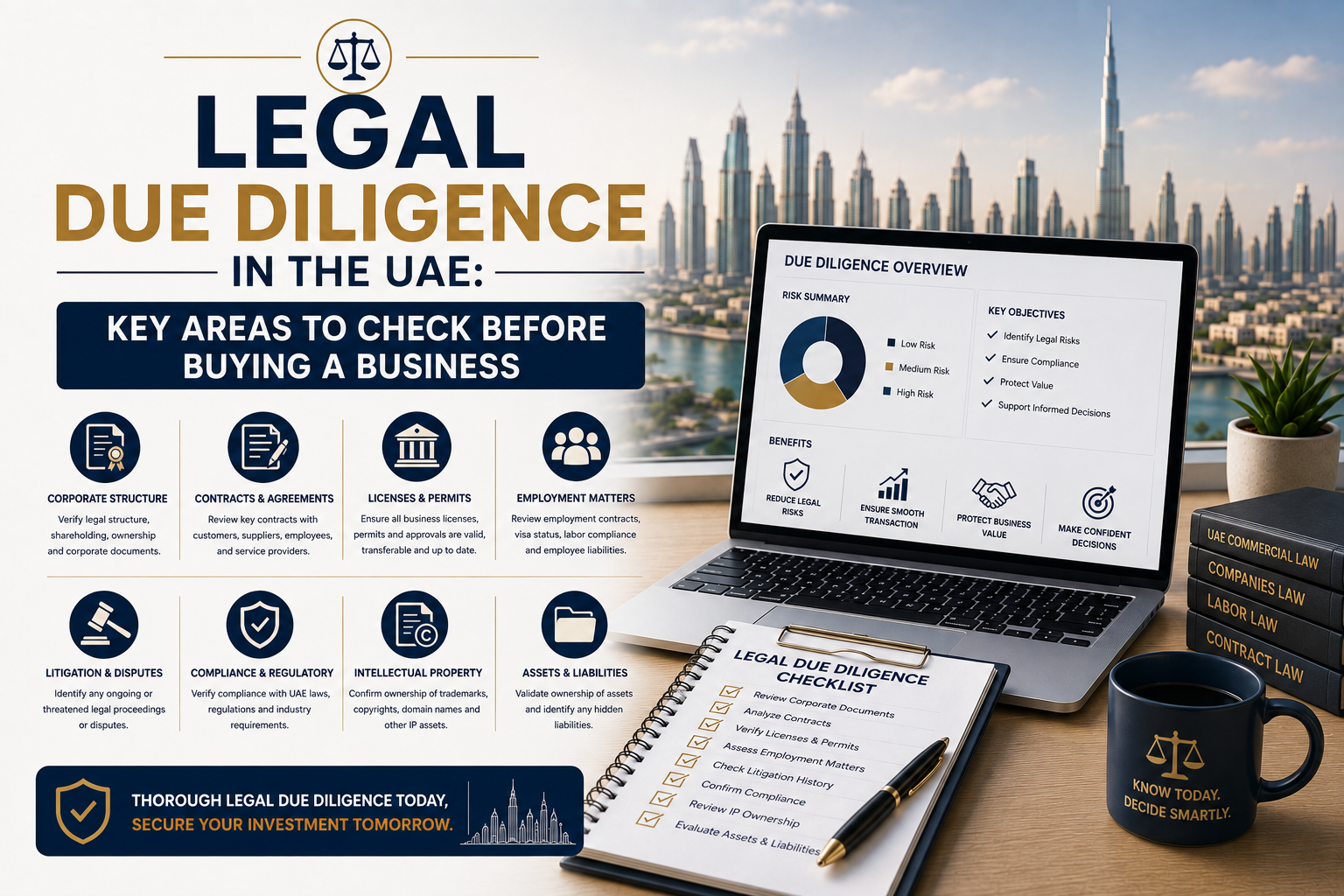
Legal due diligence involves reviewing the legal affairs and obligations of a target business to identify potential risks, liabilities, and issues that could affect the transaction or the company's future operations.
What Is Legal Due Diligence?
Legal due diligence is a structured review of a company's legal and regulatory position before an investment, acquisition, merger, partnership, or other significant transaction.
Depending on the nature of the business, the review may cover:
- Company ownership and structure
- Business licences
- Corporate documents
- Commercial contracts
- Employment agreements
- Intellectual property
- Real estate arrangements
- Regulatory compliance
- Litigation
- Disputes
- Loans and guarantees
- Legal obligations
The scope should be tailored to the company's industry, structure, activities, and the nature of the proposed transaction.
Why Is Legal Due Diligence Important Before Buying a UAE Business?
Purchasing a business means taking on more than its assets and revenue-generating activities.
An investor may also inherit or assume certain contractual, regulatory, employment, or legal obligations depending on the transaction structure.
Legal due diligence can help identify issues such as:
- Expired or inappropriate licences
- Restrictive contracts
- Pending disputes
- Unclear ownership
- Employment obligations
- Regulatory compliance concerns
- Undisclosed commitments
- Intellectual property issues
Identifying these matters before completing a transaction gives the buyer an opportunity to assess their potential impact.
1. Verify the Company's Legal Structure and Ownership
The first step is understanding who legally owns and controls the business.
Investors should review relevant corporate documents to confirm:
- Legal entity name
- Ownership structure
- Shareholders
- Directors or managers
- Shareholding percentages
- Corporate authority
- Relevant constitutional documents
The information should be consistent across the company's official records and transaction documentation.
Any uncertainty regarding ownership should be investigated before proceeding with an acquisition.
2. Review Business Licences and Registrations
A business needs appropriate licences and registrations to conduct its activities.
During legal due diligence in UAE, investors should verify:
- Current business licence
- Licensed activities
- Issuing authority
- Licence validity
- Relevant permits
- Regulatory approvals
It is important to determine whether the activities the company actually conducts correspond with its licensed activities.
An investor should also understand whether licences or approvals need to be renewed, amended, or transferred as part of the proposed transaction.
3. Examine Commercial Contracts
Contracts can represent significant obligations for a business.
Investors may review agreements with:
- Customers
- Suppliers
- Distributors
- Service providers
- Strategic partners
- Landlords
- Technology providers
Important contractual provisions may include:
- Contract duration
- Renewal terms
- Termination rights
- Payment obligations
- Exclusivity
- Liability
- Indemnities
- Change-of-control provisions
Some contracts may contain provisions that become relevant when ownership changes.
4. Check for Existing Litigation and Disputes
Potential buyers should determine whether the target company is involved in legal disputes.
The review may consider:
- Current litigation
- Pending claims
- Arbitration
- Regulatory proceedings
- Customer disputes
- Supplier disputes
- Employment disputes
The potential financial and operational impact of significant disputes should be assessed before completing the transaction.
A company with ongoing litigation may carry liabilities that are not immediately apparent from its financial statements.
5. Review Employment and Workforce Obligations
Employees are an important part of many businesses, and employment-related obligations should be reviewed during an acquisition.
Depending on the business, the review may include:
- Employment contracts
- Employee benefits
- Salary obligations
- End-of-service-related liabilities
- Workforce policies
- Employment disputes
- Relevant labour compliance
The specific requirements can vary depending on the business structure, employees, and applicable UAE regulations.
Professional legal advice should be obtained when assessing specific employment matters.
6. Examine Intellectual Property Rights
Intellectual property can be a significant asset for businesses operating in technology, consulting, creative, retail, and other sectors.
Investors should determine whether the company owns or has appropriate rights to use relevant:
- Trademarks
- Copyrights
- Trade names
- Software
- Patents
- Domain names
- Proprietary materials
The review should also identify whether any intellectual property is licensed from third parties.
If an important business asset is not properly owned or licensed, this could affect the value and future operation of the company.
7. Review Property and Lease Agreements
If the business operates from leased premises, property-related contracts should also be reviewed.
This may include:
- Office leases
- Retail leases
- Warehouse agreements
- Facility contracts
- Renewal terms
- Rental obligations
- Security deposits
- Termination provisions
Investors should understand whether the existing premises arrangements will continue after the transaction and whether any consent is required for a change in ownership or control.
8. Examine Loans, Guarantees, and Other Obligations
Legal due diligence should not focus only on obvious contracts.
Businesses may have obligations arising from:
- Bank financing
- Shareholder loans
- Guarantees
- Security arrangements
- Credit agreements
- Long-term commitments
These obligations should be identified and assessed to determine how they could affect the transaction.
Particular attention should be paid to provisions triggered by a change in ownership or control.
9. Assess Regulatory and Compliance Matters
Different industries may be subject to additional regulatory requirements.
Depending on the company's activities, investors may need to examine compliance relating to areas such as:
- Industry-specific licensing
- Data protection
- Consumer protection
- Employment requirements
- Financial regulations
- Anti-money laundering obligations
- Corporate requirements
The applicable requirements depend on the nature and structure of the business.
A compliance gap may result in additional costs, operational restrictions, or regulatory exposure.
10. Review Corporate Records and Approvals
Investors should also review the company's corporate records to determine whether important decisions have been properly documented and authorised.
Relevant documents may include:
- Shareholder resolutions
- Board resolutions
- Incorporation documents
- Share transfer records
- Amendments to constitutional documents
- Corporate registers
This can help confirm that the company's legal history and ownership records are properly documented.
Key Legal Red Flags to Watch For
Legal due diligence may uncover issues that require further investigation.
Some potential red flags include:
Expired Licences
A company may not have appropriate current licensing for its activities.
Unclear Ownership
Corporate records may not clearly establish ownership or control.
Restrictive Contracts
Important agreements may contain restrictions that affect the acquisition.
Pending Litigation
Ongoing disputes may create financial or operational risks.
Employment Claims
Unresolved employee matters can create additional liabilities.
Intellectual Property Gaps
Important business assets may not be properly owned or licensed.
Regulatory Non-Compliance
The business may have outstanding compliance issues.
Undisclosed Obligations
Previously unidentified contracts or commitments may affect the transaction.
Legal Due Diligence vs Financial Due Diligence
Legal and financial due diligence examine different aspects of a business.
| Legal Due Diligence |
Financial Due Diligence |
| Ownership structure |
Revenue |
| Business licences |
Profitability |
| Commercial contracts |
Cash flow |
| Litigation |
Assets |
| Employment matters |
Liabilities |
| Intellectual property |
Working capital |
| Regulatory compliance |
Financial obligations |
| Corporate records |
Financial performance |
For a major acquisition, investors may benefit from conducting both reviews.
Financial due diligence can show the company's financial position, while legal due diligence can reveal legal obligations and risks that may affect the transaction.
Legal Due Diligence for Business Acquisitions in the UAE
When buying a business in the UAE, the scope of legal due diligence should reflect the company's:
- Legal structure
- Industry
- Location
- Licensed activities
- Number of employees
- Contractual relationships
- Assets
- Regulatory environment
For example, a regulated business may require a more extensive compliance review than a company operating in a less regulated sector.
Similarly, a business with substantial intellectual property may require a more detailed IP review.
How Legal Due Diligence Can Protect Buyers
Legal due diligence cannot guarantee that an acquisition will be risk-free. However, it can help buyers identify issues before the transaction is completed.
The findings may influence:
- The purchase price
- Transaction structure
- Contract terms
- Representations and warranties
- Indemnities
- Conditions for completion
- Post-acquisition planning
For example, if a significant contractual or regulatory issue is identified, the buyer may request that it be resolved before closing or addressed through appropriate transaction protections.
Common Legal Due Diligence Mistakes
Buyers should avoid several common mistakes when assessing a target business.
Reviewing Only Corporate Documents
Important risks may exist in contracts, employment arrangements, or regulatory matters.
Ignoring Existing Disputes
Even relatively small disputes can reveal broader operational or contractual problems.
Failing to Review Licences
The company's actual activities should be consistent with its licensing requirements.
Overlooking Change-of-Control Clauses
Some contracts may contain provisions that become relevant following an acquisition.
Ignoring Intellectual Property
Unclear ownership can create problems after the transaction.
Relying Solely on Seller Representations
Information provided by the seller should be appropriately verified during the due diligence process.
What Documents Are Usually Reviewed?
The exact documentation depends on the transaction, but a legal due diligence review may include:
- Trade or business licences
- Incorporation documents
- Shareholder records
- Corporate resolutions
- Commercial contracts
- Employment agreements
- Lease agreements
- Loan agreements
- Intellectual property documents
- Regulatory approvals
- Litigation records
- Insurance documents
- Material supplier and customer agreements
Organising these documents in advance can help make the review more efficient.
When Should Legal Due Diligence Be Conducted?
Legal due diligence should generally take place before an acquisition or significant investment is finalised.
It can be particularly relevant when:
- Buying an existing UAE business
- Acquiring shares in a company
- Entering a joint venture
- Merging businesses
- Making a significant investment
- Purchasing business assets
The earlier potential issues are identified, the more opportunity the buyer has to investigate and address them.
How Professional Due Diligence Support Can Help
A legal due diligence process can involve reviewing a large volume of corporate, contractual, regulatory, and operational information.
Professional due diligence support can help investors:
- Organise documentation
- Identify potential legal risks
- Review corporate records
- Examine contracts
- Assess compliance matters
- Identify outstanding obligations
- Highlight areas requiring specialist legal advice
DBTA provides professional due diligence services covering financial, commercial, and legal aspects of business transactions in the UAE.
Where specific legal opinions or legal representation are required, businesses should also engage appropriately qualified legal professionals.
Conclusion
Legal due diligence in UAE is an important step for investors considering the purchase of an existing business. Reviewing ownership, licences, contracts, litigation, employment obligations, intellectual property, property arrangements, financing agreements, and regulatory compliance can help reveal potential risks before a transaction is completed.
A business may appear financially attractive while carrying legal obligations that could affect its value or future operations. Conducting a structured legal review allows buyers to better understand what they are acquiring and make more informed decisions about the transaction.
For investors evaluating a UAE business acquisition, Dubai Business and Tax Advisors (DBTA) can provide professional due diligence support across financial, commercial, and legal areas. A thorough due diligence process can help identify potential risks early and give investors a clearer basis for negotiating and planning their next steps.




 English
 French
 Spanish
 Portuguese
 Deutsch
 Turkish
 Dutch
Dutch
 Italiano
 Russian
 Romaian
 Portuguese (Brazil)
 Greek
Greek