


Global Adaptogenic Distillates Market to Reach $901.2M by 2036
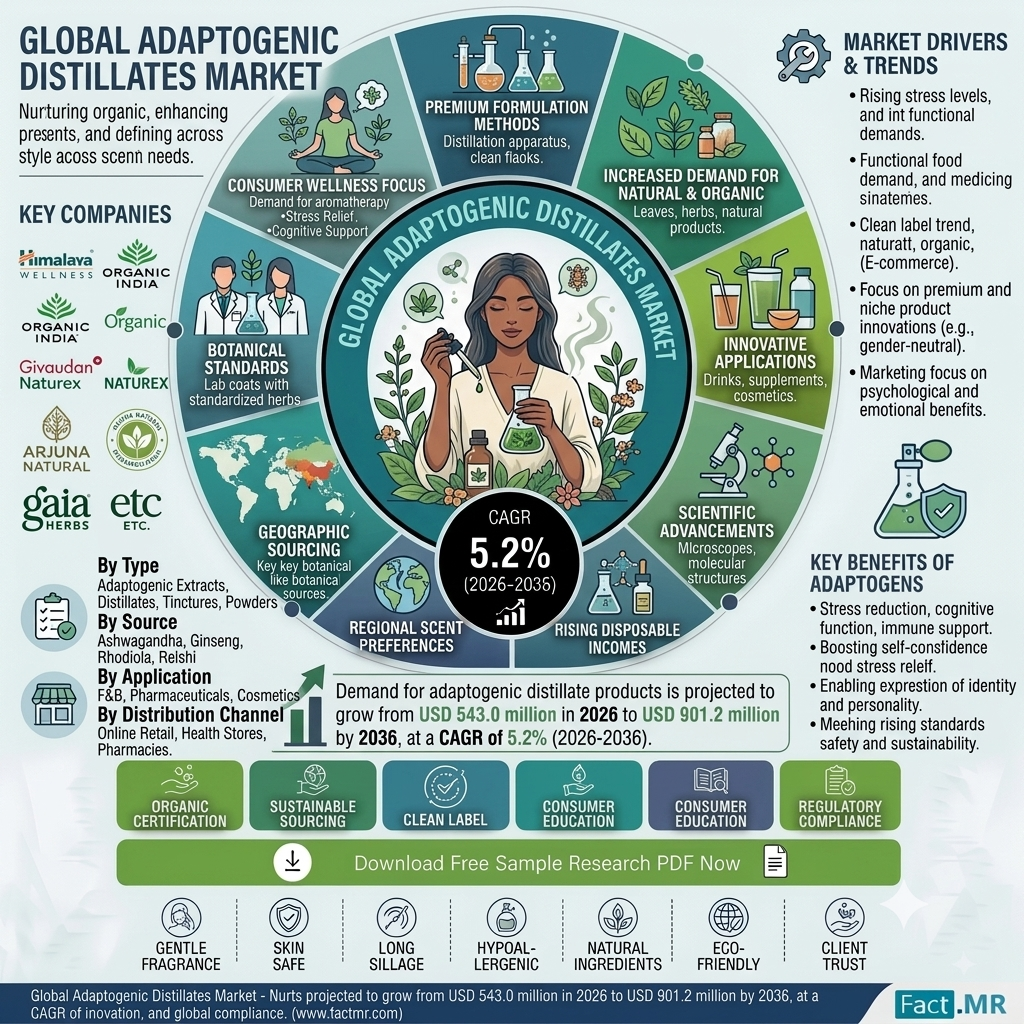
August 20, 2026 — The global adaptogenic distillates market is valued at USD 543.0 million in 2026 and is projected to reach USD 901.2 million by 2036, expanding at a 5.2% CAGR during the forecast period, according to Fact.MR. The market is expected to create an absolute dollar opportunity of USD 358.0 million between 2026 and 2036.
The market is gaining momentum as consumers seek functional wellness drinks, natural stress-management solutions, and plant-based products. Fact.MR identifies growing demand for clean-label botanical extracts, beverage-compatible ingredients, mushroom adaptogens, and herbal wellness products as key factors supporting expansion. The use of Ashwagandha, Panax Ginseng, Holy Basil, Rhodiola Rosea, Reishi, and Cordyceps is also expanding across beverages and nutraceuticals.
Get detailed market forecasts, competitive benchmarking, and pricing trends https://www.factmr.com/connectus/sample?flag=S&rep_id=15073
Industry Activity Supports Product Expansion
The Fact.MR page cites several dated industry developments. In October 2025, Arjuna Natural showcased botanical innovations at HI Japan 2025. In April 2025, Sabinsa Corporation introduced LactoBeet™ and showcased C3 Reduct® at Vitafoods Europe 2025. In February 2025, Four Sigmatic announced the launch of 11 new functional mushroom and adaptogen products. These developments point to continued product innovation in botanical ingredients, functional beverages, and wellness formulations.
Key Numbers
|
Market Indicator |
Fact.MR Data |
|
Market Value, 2025 |
USD 516.0 million |
|
Market Value, 2026 |
USD 543.0 million |
|
Market Value, 2036 |
USD 901.2 million |
|
CAGR, 2026–2036 |
5.2% |
|
Absolute Dollar Opportunity |
USD 358.0 million |
|
Total Growth |
65.90% |
|
Growth Multiple |
1.7x |
|
Leading Source Segment |
Herbal Adaptogenic Distillates |
|
Source Share, 2026 |
74.9% |
|
Leading Product Type |
Botanical Distillates |
|
Product Type Share, 2026 |
32.6% |
|
Leading Form |
Liquid Distillates |
|
Form Share, 2026 |
39.6% |
|
Leading Application |
Functional Beverages |
|
Application Share, 2026 |
33.8% |
|
Leading End User |
Beverage Manufacturers |
|
End User Share, 2026 |
35.4% |
Source: Fact.MR.
Segment Outlook
Herbal Adaptogenic Distillates lead the source segment. The segment is projected to hold 74.9% of source share in 2026. Fact.MR links this position to commercial adoption of Ashwagandha, Ginseng, Tulsi, and Rhodiola-based formulations across beverages and nutraceutical products.
Botanical Distillates lead by product type. They are projected to account for 32.6% of product type share in 2026. Demand is supported by the use of concentrated botanical extracts in functional beverages, liquid nutraceuticals, and clean-label wellness products.
Liquid Distillates lead by form. The segment is expected to hold a 39.6% share in 2026. Beverage-grade wellness ingredients, tinctures, wellness shots, and liquid nutraceuticals are supporting demand.
Functional Beverages lead by application. This segment holds 33.8% of application share in 2026. Wellness drinks, botanical mocktails, relaxation beverages, and clean-label formulations are key demand areas.
Beverage Manufacturers lead by end user. They are expected to account for 35.4% of the market in 2026, supported by growth in functional wellness beverages and adaptogenic drink innovation.
Country Growth Outlook
|
Country |
CAGR, 2026–2036 |
|
India |
8.4% |
|
Japan |
7.2% |
|
China |
6.9% |
|
Canada |
6.1% |
|
United States |
4.4% |
|
United Kingdom |
4.1% |
|
Germany |
3.5% |
Source: Fact.MR analysis, based on proprietary forecasting model and primary research.
South Asia & Pacific is identified as the fastest-growing region, supported by Ayurvedic heritage, expanding herbal supplement industries, higher wellness spending, and adoption of botanical stress-management products. India is projected to record an 8.4% CAGR through 2036. East Asia is also expected to remain a major market, with Japan projected at 7.2% CAGR and China at 6.9% CAGR.
Competitive Landscape
Fact.MR identifies Organic India, Himalaya Wellness Company, Natreon Inc., PLT Health Solutions, Ixoreal Biomed, Sabinsa Corporation, Gaia Herbs, Arjuna Natural, Bio-Botanica Inc., and Givaudan Naturex among prominent companies. The report says competition is based on extraction technology, ingredient standardization, beverage compatibility, clean-label positioning, and botanical source transparency.
The supplied Fact.MR page names these companies but does not provide individual company market-share percentages. Therefore, no company share figures are added here.
Analyst View
Shambhu Nath Jha, Principal Consultant at Fact.MR, says CXO leaders seeking competitive advantage will increasingly need to focus on high-bioavailability botanical extract systems, beverage-grade adaptogenic ingredients, clean-label and plant-based wellness trends, functional beverages, and direct-to-consumer marketing approaches.
Frequently Asked Questions
What is the adaptogenic distillates market size in 2026?
The market is valued at USD 543.0 million in 2026, according to Fact.MR.
What will the adaptogenic distillates market be worth in 2036?
Fact.MR forecasts the market to reach USD 901.2 million by 2036.
What is the CAGR of the adaptogenic distillates market?
The market is projected to expand at a 5.2% CAGR from 2026 to 2036.
Which segment leads the adaptogenic distillates market?
Herbal Adaptogenic Distillates lead the source segment with a 74.9% share in 2026.
Which country is growing fastest in the market?
India has the highest country CAGR listed by Fact.MR at 8.4% from 2026 to 2036.
Top Reports:
https://kaamkaaziclub.com/read-blog/39448
https://net-pals.com/blogs/22747/Global-Baby-Personal-Care-Market-to-Reach-9-8B-by
https://ikofficial.com/blogs/35922/Baby-Personal-Care-Industry-to-Reach-9-8B-by-2036
https://friends4ed.co.zw/read-blog/64410
About Fact.MR
Fact.MR is a market research and consulting company that provides market intelligence, forecasts, competitive analysis, and industry research across global markets. Its research combines primary interviews, company analysis, industry publications, and other research sources to develop market estimates and forecasts.

 English
 Arabic
 French
 Spanish
 Portuguese
 Deutsch
 Dutch
Dutch
 Italiano
 Russian
 Romaian
 Portuguese (Brazil)
 Greek
Greek