


Discovering the Intricate World of M.C. Escher Through His Drawings
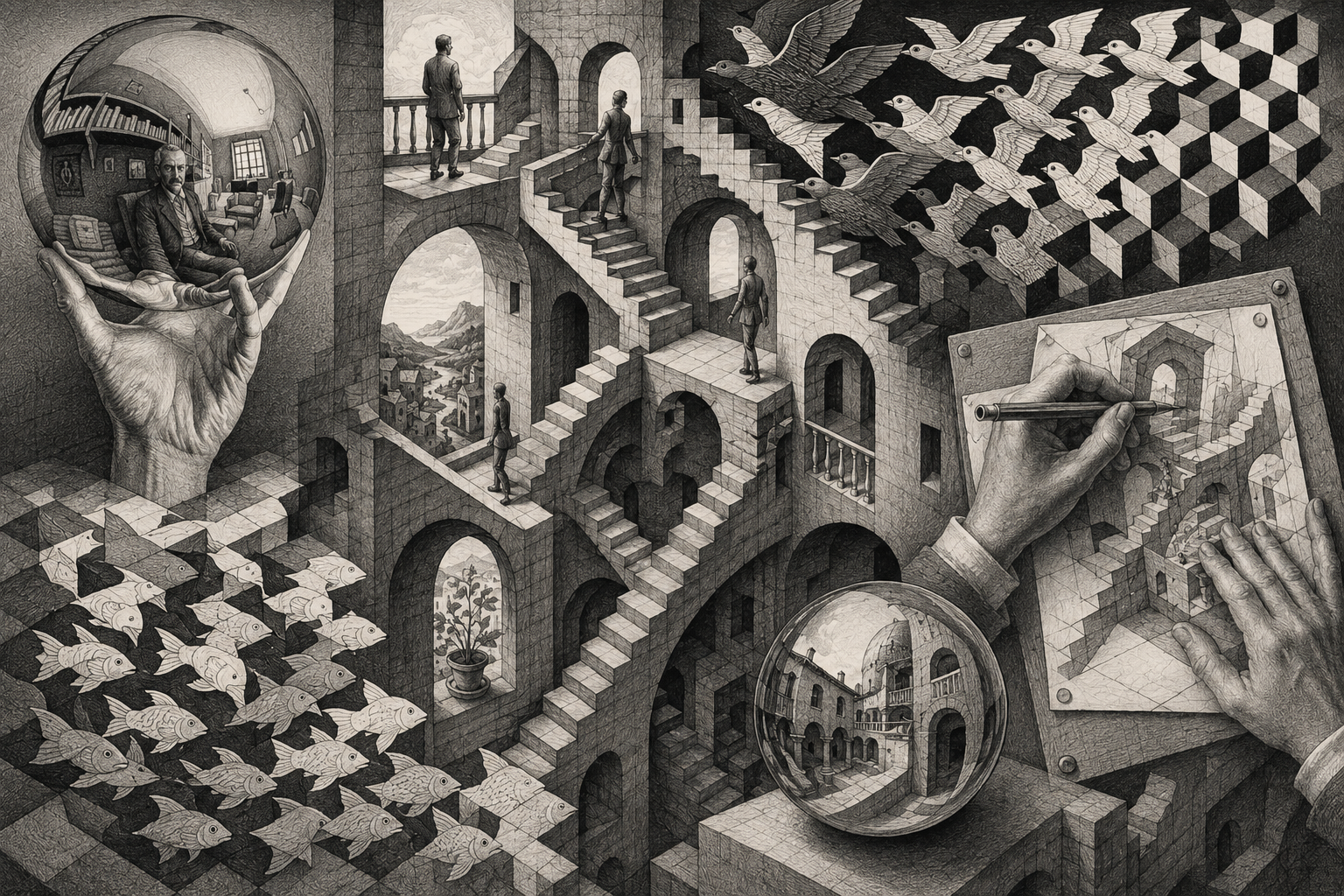
M.C. Escher is celebrated for creating artwork that challenges perception while maintaining an extraordinary level of technical precision. His compositions combine mathematics, nature, architecture, reflection, and imagination in ways that continue to fascinate art enthusiasts and collectors. While many of his finished prints are widely recognized, studying the drawings of Escher provides an opportunity to understand the careful observation and creative thinking behind his more elaborate compositions.
Escher's drawings demonstrate that his remarkable visual illusions were not accidental. They were the result of experimentation, detailed planning, and an enduring fascination with how the human eye interprets the world.
The Foundation of Escher's Artistic Vision
Long before an intricate composition became a finished print, Escher often explored ideas through sketches and drawings. These studies allowed him to investigate perspective, form, reflections, patterns, and spatial relationships.
The drawings of Escher reveal his exceptional control of line. Even seemingly simple subjects could contain remarkable detail, with carefully positioned marks creating texture, depth, and dimension. His attention to structure helped him transform ordinary landscapes, natural forms, and architectural elements into extraordinary visual experiences.
This technical foundation was essential to his later experiments with impossible spaces and mathematical concepts. Escher's work demonstrates how observation and imagination can work together rather than existing as separate creative processes.
From Observation to Imagination
Nature was an important source of inspiration for Escher. During his travels, he studied landscapes, buildings, plants, and other natural forms, often recording what he observed through detailed drawings. These observations later became part of his broader artistic vocabulary.
Rather than simply reproducing a landscape exactly as he saw it, Escher could extract shapes, textures, and structural ideas from the scene. He then transformed those elements into compositions that explored symmetry, repetition, and visual relationships.
This ability to move from observation to abstraction is one reason his work remains so interesting. A drawing could begin with something familiar and eventually contribute to an image that seemed to belong to an entirely different world.
Understanding the Idea Behind Three Worlds
Escher frequently explored the relationship between different visual realities. His work encourages viewers to consider how multiple perspectives can exist within a single image.
The concept often associated with three worlds escher is particularly intriguing because it demonstrates this interest in layered perception. In the well-known composition Three Worlds, Escher presents a calm pool of water containing reflections of trees while leaves float on the surface and a fish can be seen beneath it.
Rather than focusing on only one view, the composition brings several aspects of the environment together. The surface, reflection, and underwater world become part of a single visual experience.
This approach captures one of Escher's greatest artistic strengths: making viewers aware that what appears to be one simple scene can contain multiple layers of reality.
Why Reflections Fascinated Escher
Reflections offered Escher an effective way to explore questions about perception. A reflection can appear to duplicate the world while simultaneously changing it. Water can distort forms, mirrors can reverse them, and polished surfaces can create visual relationships that do not exist in ordinary space.
In Three Worlds, this fascination becomes especially apparent. The viewer sees water as both a surface and a window into another environment. The reflection of trees occupies the same composition as the fish below the surface, creating a subtle relationship between what is above, on, and beneath the water.
This layered construction encourages viewers to slow down and examine the image carefully.
The Importance of Line in Escher's Art
Line was central to Escher's artistic technique. Through changes in direction, density, and repetition, he could create the appearance of texture, movement, depth, and volume.
The drawings of Escher are especially valuable for appreciating this aspect of his work. Looking closely at his line work reveals the discipline required to construct complex imagery. Every mark contributes to the overall structure.
For collectors, this technical quality can add another dimension to the appreciation of Escher's art. Beyond the unusual subject matter, there is an extraordinary level of craftsmanship within each composition.
Exploring Escher With Walker Fine Art
For collectors and enthusiasts interested in discovering more about M.C. Escher, Walker Fine Art offers a specialized collection of his work. Exploring original pieces can provide a deeper understanding of the techniques and concepts that established Escher as one of the most distinctive artists of the twentieth century.
Viewing his work in greater detail can also reveal connections between seemingly different compositions. Themes such as reflection, transformation, symmetry, infinity, and impossible spaces repeatedly appear throughout his artistic career.
Whether someone is drawn to his mathematical imagery or his observational drawings, Escher's work offers numerous paths for exploration.
A Legacy Built on Looking More Closely
M.C. Escher's art rewards curiosity. His compositions encourage viewers to look beyond the obvious and consider how different visual elements can coexist.
The three worlds Escher concept demonstrates this beautifully by bringing reflection, surface, and underwater life together within one peaceful scene. Meanwhile, the drawings of Escher provide insight into the observational skill and technical discipline that supported his imaginative creations.
Through his ability to combine careful craftsmanship with unconventional ideas, Escher created a body of work that remains endlessly engaging. For today's collectors and art enthusiasts, exploring his work through Walker Fine Art offers an opportunity to discover not only remarkable images but also the inventive thinking behind them.

 Arabic
 French
 Spanish
 Portuguese
 Deutsch
 Turkish
 Dutch
Dutch
 Italiano
 Russian
 Romaian
 Portuguese (Brazil)
 Greek
Greek