


Global FMCG Logistics Market to Reach $190.5B by 2036
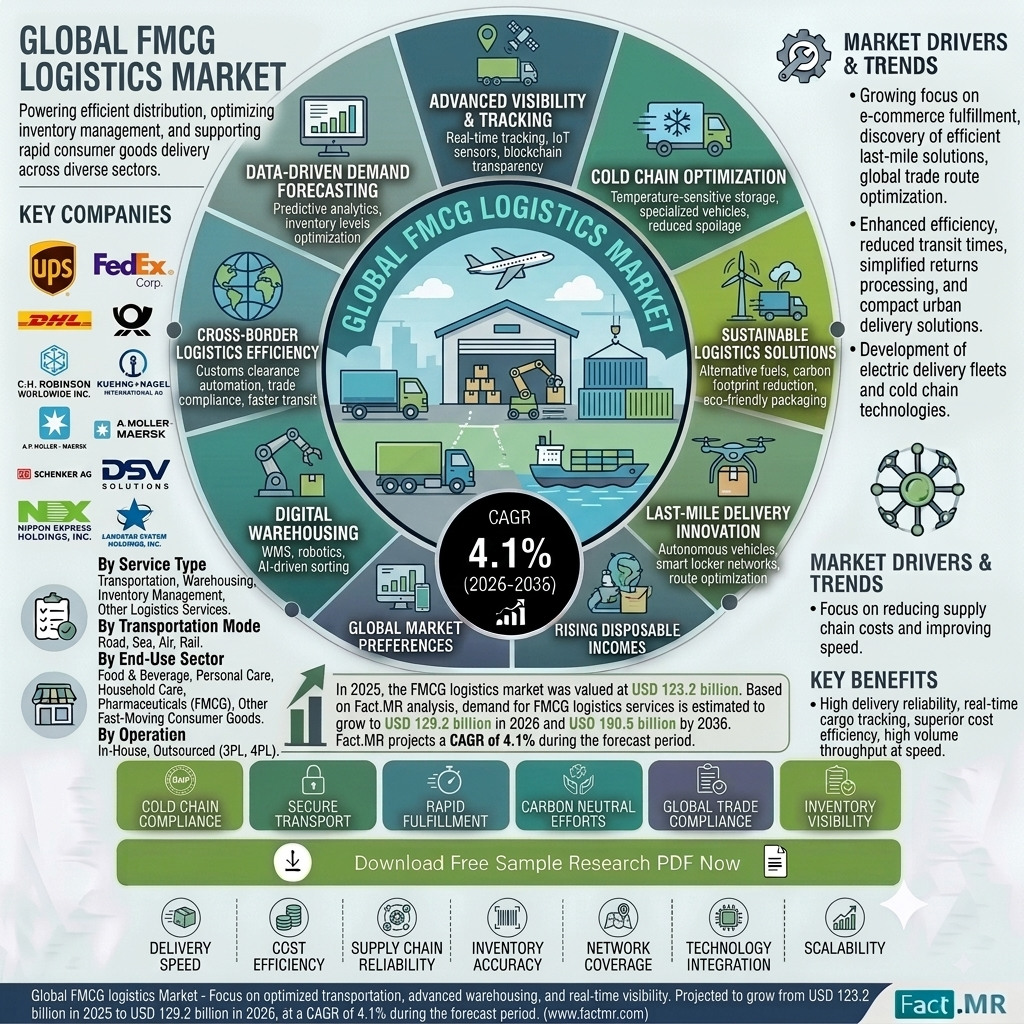
August 21, 2026 — The global FMCG logistics market is estimated at USD 129.2 billion in 2026 and is projected to reach USD 190.5 billion by 2036, expanding at a 4.1% CAGR during the forecast period, according to Fact.MR. The market was valued at USD 123.2 billion in 2025.
FMCG logistics covers transportation, warehousing, inventory management, cold chain services, and last-mile delivery for packaged foods, beverages, personal care products, and household essentials. The market is evolving as manufacturers and retailers respond to modern retail, e-commerce, and quick commerce demand.
Get detailed market forecasts, competitive benchmarking, and pricing trends: https://www.factmr.com/connectus/sample?flag=S&rep_id=14328
Quick Commerce Reshapes FMCG Distribution
The expansion of quick commerce platforms such as Blinkit, Zepto, Swiggy Instamart, Meituan, and JD Daojia is changing FMCG distribution models. Manufacturers increasingly require smaller and more frequent deliveries, dark-store fulfillment, and real-time inventory visibility. These requirements are increasing logistics complexity and supporting higher-value service contracts.
India's Pradhan Mantri Gati Shakti National Master Plan is also supporting multimodal infrastructure development, including freight corridors and logistics parks. These upgrades are helping reduce transit times and strengthen organized third-party logistics networks. In Europe, the Fit for 55 decarbonization framework is encouraging logistics providers to invest in electric and alternative-fuel trucks while supporting greater use of rail freight for medium- and long-haul FMCG transportation.
Key Numbers
|
Market Indicator |
Fact.MR Data |
|
Market Value, 2025 |
USD 123.2 billion |
|
Market Value, 2026 |
USD 129.2 billion |
|
Market Value, 2036 |
USD 190.5 billion |
|
CAGR, 2026–2036 |
4.1% |
|
Leading Transportation Mode |
Railways |
|
Transportation Share, 2026 |
43.1% |
|
Leading Product Type |
Food & Beverages |
|
Product Share, 2026 |
44.7% |
|
Asia Pacific Share of Incremental Growth |
42% |
|
Fastest-Growing Country |
India |
|
India CAGR, 2026–2036 |
9.1% |
Source: Fact.MR analysis.
Segment Outlook
Railways lead by transportation mode. Railways are expected to account for 43.1% of the market in 2026. Their cost efficiency and ability to transport large FMCG volumes across major markets such as China, India, and the United States support this position. Dedicated freight corridors and intermodal services also support reliable transit times.
Food and beverages lead by product type. This segment is projected to hold 44.7% share in 2026. High replenishment frequency and cold chain requirements create strong logistics demand for food and beverage products.
Quick commerce creates new logistics requirements. Smaller and more frequent deliveries, dark-store fulfillment, and real-time inventory management are changing traditional FMCG distribution networks.
Cold chain remains important for FMCG distribution. Temperature-controlled logistics supports food and beverage movement, while logistics providers are expanding cold chain capacity to serve changing FMCG requirements.
Country Growth Outlook
|
Country |
CAGR, 2026–2036 |
|
India |
9.1% |
|
China |
6.4% |
|
Brazil |
5.3% |
|
Germany |
5.2% |
|
United States |
4.5% |
Source: Fact.MR analysis, based on proprietary forecasting model and primary research.
India is forecast to record the fastest growth among the listed markets at 9.1% CAGR through 2036. Growth is supported by the Gati Shakti infrastructure plan, quick commerce expansion, tax reforms, and new freight corridors.
China follows at 6.4% CAGR, supported by rising FMCG demand in lower-tier cities, warehouse expansion, and logistics modernization. Brazil is projected to grow at 5.3%, while Germany and the United States are expected to record 5.2% and 4.5%, respectively.
Competitive Landscape
The global FMCG logistics market is moderately concentrated at the top tier. Deutsche Post DHL, UPS, FedEx, Kuehne+Nagel, Maersk, DSV, Schenker, C.H. Robinson, Nippon Express, and Geodis together account for roughly 35% to 40% of total market revenue, according to the supplied Fact.MR content.
Competition increasingly depends on network infrastructure, digital capabilities, temperature-controlled logistics, freight management platforms, and end-to-end transportation solutions. Large FMCG manufacturers such as Procter & Gamble, Unilever, and Nestlé allocate volumes across multiple logistics providers to maintain pricing discipline and limit supplier concentration.
Key Players
- United Parcel Service, Inc.
- FedEx Corp
- Deutsche Post AG
- C.H. Robinson Worldwide Inc.
- Kuehne+Nagel International AG
- A.P. Moller - Maersk
- Schenker AG
- DSV Solutions
- Nippon Express Holdings, Inc.
- Landstar System Holdings, Inc.
Analyst View
Shambhu Nath Jha, Principal Consultant at Fact.MR, says the shift from weekly retail replenishment toward daily and same-day e-commerce fulfillment is reshaping network design, contract pricing, and technology investment priorities for FMCG manufacturers and logistics providers.
Frequently Asked Questions
What is the FMCG logistics market size in 2026?
The FMCG logistics market is estimated at USD 129.2 billion in 2026, according to Fact.MR.
What will the FMCG logistics market be worth in 2036?
The market is projected to reach USD 190.5 billion by 2036.
What is the CAGR of the FMCG logistics market?
The market is forecast to grow at a 4.1% CAGR from 2026 to 2036.
Which transportation mode leads the FMCG logistics market?
Railways are expected to account for 43.1% of the market in 2026.
Which country has the highest FMCG logistics market CAGR?
India has the highest listed CAGR at 9.1% from 2026 to 2036.
Top Reports
https://friends4ed.co.zw/read-blog/64686
https://acmingle.com/blogs/13260/Hexacopter-Market-Expected-to-Reach-43-2B-by-2036
https://www.criconet.com/read-blog/21613
https://bolworld.com/blogs/46617/Hexacopter-Market-on-Track-to-Reach-43-2B-by-2036
About Fact.MR
Fact.MR provides market research, industry analysis, market forecasts, and competitive intelligence across global markets. Its research covers market trends, demand patterns, regional developments, competitive positioning, and long-term industry opportunities.

 English
 Arabic
 Spanish
 Portuguese
 Deutsch
 Turkish
 Dutch
Dutch
 Italiano
 Russian
 Romaian
 Portuguese (Brazil)
 Greek
Greek