


Radiation Hardened Electronics Market Set to Reach USD 2.9 Billion by 2036
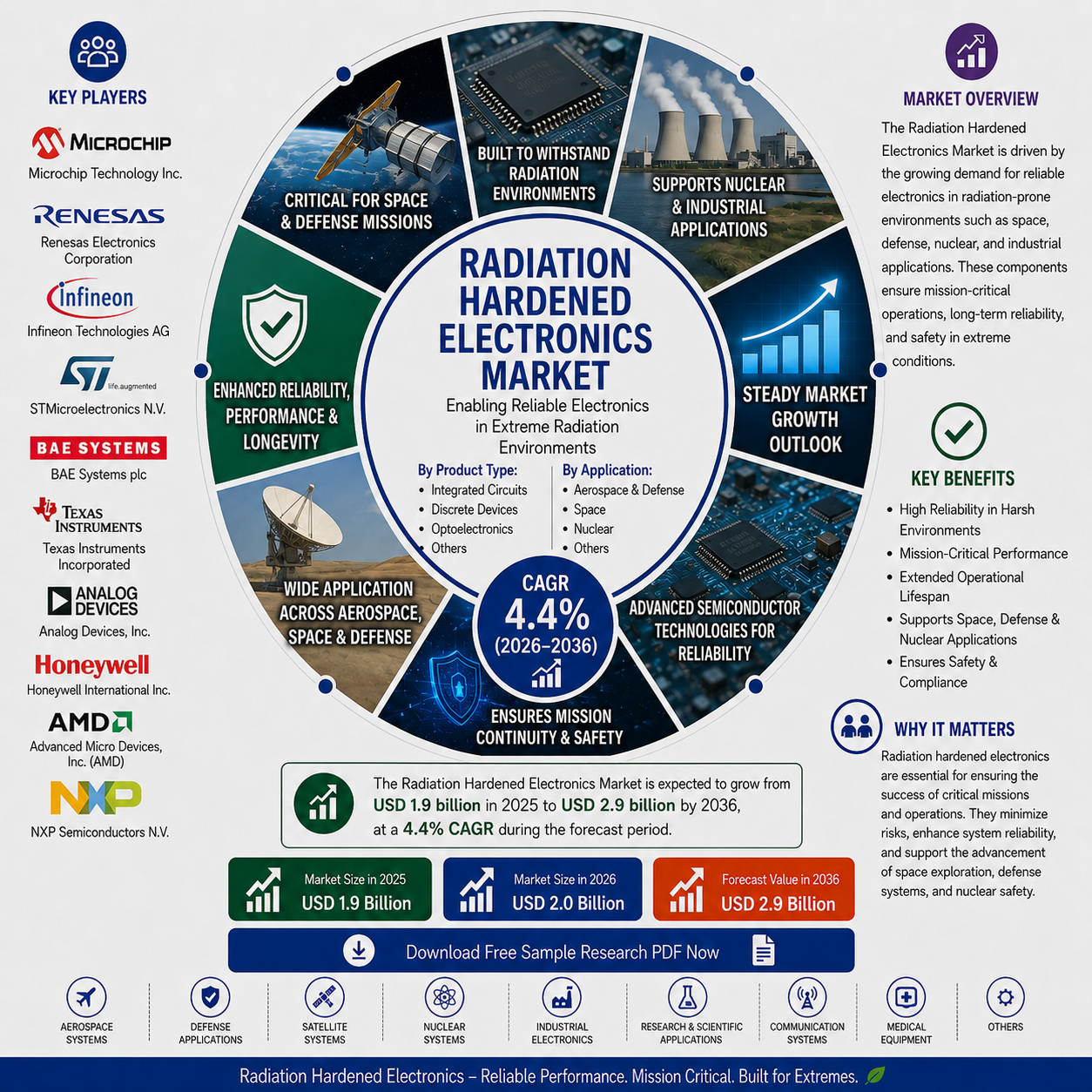
August 21, 2026 — The global radiation hardened electronics market is estimated at USD 2.0 billion in 2026 and is projected to reach USD 2.9 billion by 2036, expanding at a 4.4% CAGR, according to Fact.MR analysis. The market was valued at USD 1.9 billion in 2025.
Radiation hardened electronics are specialized semiconductor components built to operate in high-radiation environments. They serve space, nuclear, defence, and high-energy physics applications where standard commercial chips can fail from ionizing radiation. Fact.MR says growth is closely linked to long-cycle government space and defence programs. Commercial low Earth orbit constellations are also increasing demand for radiation-tolerant processors and memory.
The market is expected to add USD 0.9 billion between 2026 and 2036, based on Fact.MR's forecast. Growth is moderated by a concentrated buyer base of fewer than 50 major global space and defence program offices and qualification timelines of 18 to 36 months before a new device can become flight certified, according to Fact.MR.
Get detailed market forecasts, competitive benchmarking, and pricing trends: https://www.factmr.com/connectus/sample?flag=S&rep_id=14296
Third-Party Evidence Behind Demand
Fact.MR's research cites several dated external sources. Microchip Technology's June 2024 fiscal-year report highlighted development of a 65nm radiation-hardening-by-design FPGA for commercial LEO satellites, with a reported target price of USD 800 to USD 1,200 per unit. BAE Systems' March 2024 GOMAC Tech disclosure described its 28nm RHBD RAD5545 processor as delivering 12,000 MIPS at 15W. The FCC's December 2022 SpaceX filing disclosed plans for approximately 6,000 Starlink Gen 2 satellites through 2026, according to the bibliography and analysis published by Fact.MR.
Key Numbers
· Market value, 2025:USD 1.9 billion
· Market value, 2026:USD 2.0 billion
· Market value, 2036:USD 2.9 billion
· CAGR, 2026–2036:4%
· Absolute dollar growth, 2026–2036:USD 0.9 billion
· Processors & Controllers share, 2025:8%
· RHBD share, 2025:4%
*Source: Fact.MR analysis. *
Segment Breakdown
Processors & Controllers: This segment leads with a 32.8% share in 2025, according to Fact.MR. These devices provide the computing core for satellites, launch vehicles, nuclear control systems, and research platforms.
Radiation Hardening by Design: RHBD holds a 33.4% share in 2025. Fact.MR identifies the technique as important for advanced nodes because radiation tolerance is built into circuit architecture while retaining commercial CMOS cost structures.
Other Components: The market also covers mixed-signal ICs, memory, power management devices, sensors, and other components. The report further segments the industry by packaging, solution type, region, and manufacturing technique.
Regional Growth: Asia Pacific is identified by Fact.MR as the fastest-growing region. North America remains a leading market-share region because of NASA, Space Force, and LEO procurement activity.
Country Growth Outlook
· India:0% CAGR
· China:8% CAGR
· United States:9% CAGR
· France:3% CAGR
· Brazil:2% CAGR
*Source: Fact.MR proprietary forecasting model and primary research. *
India records the fastest country growth at 9.0% CAGR, while China follows at 6.8%. The United States is forecast at 4.9%, France at 4.3%, and Brazil at 3.2% through 2036.
Competitive Landscape
The market is concentrated among established space and defence semiconductor suppliers. Fact.MR estimates that Microchip Technology, BAE Systems Microelectronics, Honeywell Defense Electronics, and Texas Instruments together account for roughly 55% to 65% of global revenue for space-level qualified devices.
Key companies profiled by Fact.MR include Microchip Technology Inc., Renesas Electronics Corporation, Infineon Technologies AG, STMicroelectronics N.V., BAE Systems plc, Texas Instruments Incorporated, Analog Devices Inc., Honeywell International Inc., AMD, and NXP Semiconductors N.V.
Fact.MR notes that qualification investment, radiation testing, and Qualified Parts List coverage create major entry barriers. Proprietary radiation-hard foundries can also provide structural advantages.
Analyst View
Shambhu Nath Jha, Principal Consultant at Fact.MR, states that “CXOs will find this report essential” for understanding how commercial LEO constellation growth is changing rad-hard component qualification economics and which RHBD, RHBP, or RHBS manufacturing approach is capturing value from new-space procurement. This statement is reproduced from published commentary on the Fact.MR page.
Frequently Asked Questions
How large is the radiation hardened electronics market in 2025?
Fact.MR values the market at USD 1.9 billion in 2025.
What will the radiation hardened electronics market size be in 2036?
Fact.MR projects the market to reach USD 2.9 billion by 2036.
What is the CAGR of the radiation hardened electronics market?
The projected CAGR is 4.4% from 2026 to 2036, according to Fact.MR.
Which country has the fastest projected growth?
India leads the covered countries with a 9.0% CAGR through 2036.
Which segment leads the market?
Processors & Controllers hold the leading component position with a 32.8% share, while RHBD leads manufacturing techniques with a 33.4% share, based on Fact.MR's analysis.
Top Report
https://social.mytamam.com/blogs/32348/3D-CAD-Software-Market-to-Hit-USD-26-6-Billion
https://net-pals.com/blogs/23618/3D-CAD-Software-Market-Set-to-Reach-USD-26-6
https://knowlexaconnect.com/blogs/26717/3D-CAD-Software-Market-Poised-to-Reach-USD-26-6
https://uddokta64.com/blogs/5079/3D-CAD-Software-Market-Projected-to-Reach-USD-26-6
About Fact.MR
Fact.MR is a market research and consulting firm providing market intelligence, forecasts, competitive analysis, and strategic research across global industries. Its radiation hardened electronics study covers market size, component and manufacturing-technique segmentation, country forecasts, competitive analysis, and industry drivers for 2026 to 2036.

 Arabic
 French
 Spanish
 Portuguese
 Deutsch
 Turkish
 Dutch
Dutch
 Italiano
 Russian
 Romaian
 Portuguese (Brazil)
 Greek
Greek