


Vector Purification Market Opportunities: Improving Yield and Product Quality in Gene Therapy Manufacturing
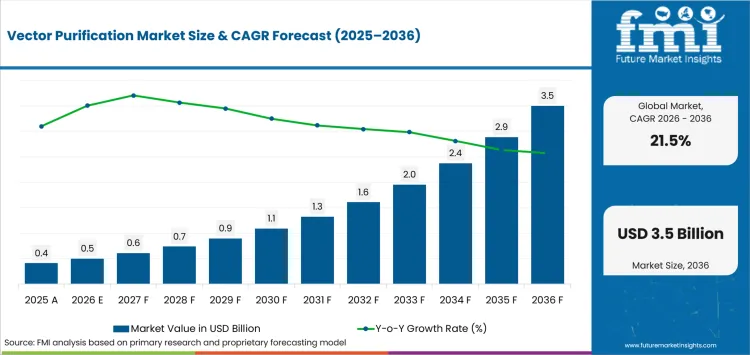
The global Vector Purification Market is expanding as cell and gene therapy manufacturers increase investment in downstream processes capable of recovering functional viral vectors while removing process-related and product-related impurities. According to Future Market Insights (FMI), the market is projected to grow from USD 0.5 billion in 2026 to USD 3.4 billion by 2036, registering a 21.5% CAGR during the forecast period.
Growth is being supported by the expansion of viral-vector-based therapies, increasing regulatory approvals, rising commercial manufacturing activity, and the need for consistent purification performance across development and production batches. As gene therapy pipelines move toward commercialization, manufacturers require scalable purification workflows that preserve vector integrity while achieving the impurity levels required for clinical and commercial release.
👉 Get Detailed Market Forecasts, Competitive Benchmarking, and Pricing Trends: https://www.futuremarketinsights.com/reports/sample/rep-gb-34492
The market is expected to create an absolute dollar opportunity of approximately USD 2.9 billion between 2026 and 2036. Adoption will increasingly depend on recovery yield, impurity clearance, vector integrity, serotype compatibility, process scalability, and the ability to transfer validated purification workflows across qualified manufacturing sites.
Key Vector Purification Market Highlights at a Glance
- Market Size (2026): USD 0.5 Billion
- Forecast Market Size (2036): USD 3.4 Billion
- Forecast Period: 2026–2036
- CAGR (2026–2036): 21.5%
- Absolute Dollar Opportunity: Approximately USD 2.9 Billion
- Leading Vector Type: AAV Vectors (46.0% Share in 2026)
- Leading Purification Technique: Chromatography (42.0% Share in 2026)
- Leading Therapy Type: Gene Therapy (57.0% Share in 2026)
- Key Growth Areas: North America, Europe, and Asia Pacific
- Key Growth Drivers: Gene Therapy Approvals, Commercial Vector Manufacturing, Process Scalability, and Impurity-Control Requirements
Analyst Viewpoint
"Manufacturing teams increasingly need to evaluate purification processes against the impurity profile and recovery requirements of individual vectors rather than focusing on equipment economics alone. Effective workflows must preserve functional particles while removing residual DNA, host-cell proteins, aggregates, and other contaminants across different serotypes and manufacturing scales. As commercial production expands, process consistency and successful technology transfer will become increasingly important factors in supplier selection."
Why Is the Vector Purification Market Growing?
The expansion of cell and gene therapy development is generating increasing demand for downstream purification technologies capable of producing high-quality viral vectors.
Vector manufacturing involves multiple stages in which impurities must be removed without compromising the functional particles required for therapeutic delivery. Purification therefore represents a critical component of manufacturing performance and product quality.
Regulatory approvals are also converting development programs into recurring manufacturing requirements. In January 2025, the FDA reported 10 rare-disease cell and gene therapy approvals, approximately twice the previous annual pace following its August 2023 reorganization.
Every approved therapy requires repeatable manufacturing and purification processes capable of meeting predefined quality specifications across commercial batches.
Key Growth Drivers
- Increasing approvals of cell and gene therapies.
- Expansion of AAV-based therapeutic programs.
- Rising demand for scalable vector manufacturing.
- Growing pharmaceutical investment in gene therapy.
- Increasing need for consistent impurity removal.
- Expansion of commercial viral-vector production.
- Growing adoption of chromatography-based purification.
- Increasing outsourcing of vector manufacturing.
- Rising requirements for validated downstream processes.
- Increasing focus on vector recovery and product quality.
As therapeutic programs progress from research to commercial manufacturing, purification processes must demonstrate reproducibility across larger production volumes and multiple manufacturing campaigns.
👉 Access the Complete Report in PDF Format: https://www.futuremarketinsights.com/reports/brochure/rep-gb-34492
Why Do AAV Vectors Lead Vector-Type Demand?
AAV vectors are estimated to account for 46.0% of vector-type demand in 2026, making them the leading vector category.
AAV platforms are widely evaluated for in vivo gene-delivery applications because different serotypes can provide distinct tissue-targeting characteristics.
However, differences between serotypes can influence purification performance, recovery, impurity profiles, and process conditions. Manufacturers therefore need purification strategies that can accommodate vector-specific characteristics without compromising product quality.
The increasing number of AAV-based development programs is expected to sustain demand for specialized purification technologies throughout the forecast period.
Why Does Chromatography Lead Purification Techniques?
Chromatography is projected to capture 42.0% of purification-technique demand in 2026.
Chromatography provides selective separation and can be incorporated into capture and polishing stages of vector purification.
Different chromatographic approaches can help manufacturers address impurities such as host-cell proteins, residual DNA, aggregates, and unwanted process components while retaining target vectors.
The technology's flexibility and compatibility with multi-stage purification workflows support its leading position.
However, chromatography conditions must be optimized carefully because additional polishing stages can contribute to recovery losses and affect overall manufacturing economics.
Why Does Gene Therapy Lead Therapy Demand?
Gene therapy is forecast to represent 57.0% of therapy demand in 2026.
Vector quality directly influences the ability of a gene therapy product to deliver its intended genetic payload. Consequently, purification performance becomes closely linked to therapeutic manufacturing requirements.
Manufacturers must balance impurity clearance with preservation of functional vector particles. Excessive processing can reduce yield, while insufficient purification can leave impurities that affect product quality and regulatory acceptance.
This balance is increasing demand for optimized downstream workflows.
How Is Vector Purification Supporting Commercial Manufacturing?
Vector purification is increasingly shifting from a development-stage laboratory function toward a standardized commercial manufacturing requirement.
Manufacturers need processes that can be transferred between facilities, scaled to commercial volumes, and reproduced across production campaigns.
Process development therefore increasingly considers chromatography capacity, filtration, buffer requirements, recovery rates, impurity clearance, analytical testing, and technology-transfer requirements together.
The ability to preserve full and functional capsids while consistently removing contaminants is becoming a central measure of purification performance.
What Are the Latest Technology and Innovation Trends?
Innovation continues reshaping the vector purification industry.
Major trends include:
- Expansion of AAV purification platforms.
- Advances in chromatography-based capture.
- Development of improved polishing technologies.
- Increasing focus on full-to-empty capsid separation.
- Greater emphasis on host-cell impurity clearance.
- Development of scalable downstream workflows.
- Increasing use of single-use bioprocessing technologies.
- Greater process automation and monitoring.
- Increasing focus on technology transfer.
- Integration of purification with broader viral-vector manufacturing platforms.
The industry is moving toward integrated workflows that combine purification, analytical characterization, process control, and scalable manufacturing.
What Are the Key Market Challenges and Restraints?
Recovery losses and vector heterogeneity remain major constraints.
Different vector serotypes can behave differently during purification, making it difficult to establish a single process that performs consistently across multiple products.
Additional purification and polishing stages can improve impurity clearance but may reduce overall particle recovery. Manufacturers therefore need to balance product purity against yield.
Scale transfer presents another challenge. A purification process that performs effectively at laboratory scale may require substantial optimization when transferred to pilot or commercial manufacturing.
High process complexity, specialized expertise, analytical requirements, and manufacturing costs can further restrict adoption.
What Is the Regional Outlook?
North America remains a major market because of its concentration of gene therapy developers, advanced biomanufacturing infrastructure, regulatory activity, and commercial cell and gene therapy programs.
Europe supports market expansion through established biopharmaceutical manufacturing capabilities and increasing investment in advanced therapies. Demand is also supported by the presence of specialized contract development and manufacturing organizations.
Asia Pacific represents an important growth opportunity as biotechnology investment, manufacturing capacity, and cell and gene therapy development expand across major markets.
Regional adoption will depend on regulatory frameworks, availability of qualified manufacturing facilities, technology-transfer capabilities, skilled personnel, and investment in advanced downstream processing.
What Is the Competitive Landscape?
Competition is centered on purification performance, chromatography capabilities, vector recovery, impurity clearance, scalability, process integration, and manufacturing support.
Leading companies are strengthening their positions through broad bioprocess portfolios, specialized purification technologies, contract manufacturing capabilities, strategic partnerships, and expanded viral-vector production services.
Key Companies
- Danaher Corporation
- Merck KGaA
- Thermo Fisher Scientific Inc.
- Sartorius AG
- Lonza Group AG
- FUJIFILM Biotechnologies
- Rose BioSolutions
- Repligen Corporation
These companies compete through chromatography systems, filtration technologies, bioprocessing platforms, vector manufacturing services, purification materials, and specialized downstream processing capabilities.
👉 Read Full Report: https://www.futuremarketinsights.com/reports/vector-purification-market
Frequently Asked Questions
1. What is the projected size of the Vector Purification Market by 2036? The global market is projected to reach USD 3.4 billion by 2036, increasing from USD 0.5 billion in 2026.
2. What is the expected CAGR of the Vector Purification Market? The market is forecast to expand at a 21.5% CAGR between 2026 and 2036.
3. Which vector type dominates the market? AAV vectors are estimated to lead the vector-type segment with a 46.0% share in 2026.
4. Which purification technique holds the largest market share? Chromatography is projected to lead purification techniques with a 42.0% share in 2026.
5. Which therapy type dominates the market? Gene therapy is forecast to account for 57.0% of therapy demand in 2026.
6. What factors are driving the Vector Purification Market? Increasing gene therapy approvals, AAV adoption, commercial vector manufacturing, demand for impurity clearance, and the need for scalable downstream processing are driving market growth.
7. What are the major challenges facing vector purification? Recovery losses, vector heterogeneity, serotype-specific purification behavior, scale-transfer challenges, and the need to balance purity with functional particle yield remain key restraints.
Related Reports
· https://www.linkedin.com/feed/update/urn:li:share:7496561494352949248/?actorCompanyId=131254190
· https://www.linkedin.com/feed/update/urn:li:share:7496561494352949248/?actorCompanyId=131254190
· https://www.linkedin.com/feed/update/urn:li:share:7495935690971439104/?actorCompanyId=131254190
· https://www.linkedin.com/feed/update/urn:li:share:7495826156680773632/?actorCompanyId=131254190
· https://www.linkedin.com/feed/update/urn:li:share:7495820914622734337/?actorCompanyId=131254190
About Future Market Insights (FMI)
Future Market Insights (FMI) is a global market intelligence and consulting firm providing comprehensive market research, competitive intelligence, and strategic business insights across industries. The firm delivers detailed forecasts, technology analysis, and data-driven recommendations that support informed decision-making for manufacturers, investors, distributors, and policymakers worldwide.
For Press & Corporate Inquiries
Rahul Singh
AVP – Marketing and Growth Strategy
Future Market Insights, Inc.
+91 8600020075
For Sales – sales@futuremarketinsights.com
For Media – Rahul.singh@futuremarketinsights.com
For Web – https://www.futuremarketinsights.com

 English
 Arabic
 French
 Portuguese
 Deutsch
 Turkish
 Dutch
Dutch
 Italiano
 Russian
 Romaian
 Portuguese (Brazil)
 Greek
Greek