


AR Navigation Windshield HUD Market Registers 19.4% CAGR as Advanced Driver Assistance Technologies Advance | Panasonic, Continental, Denso
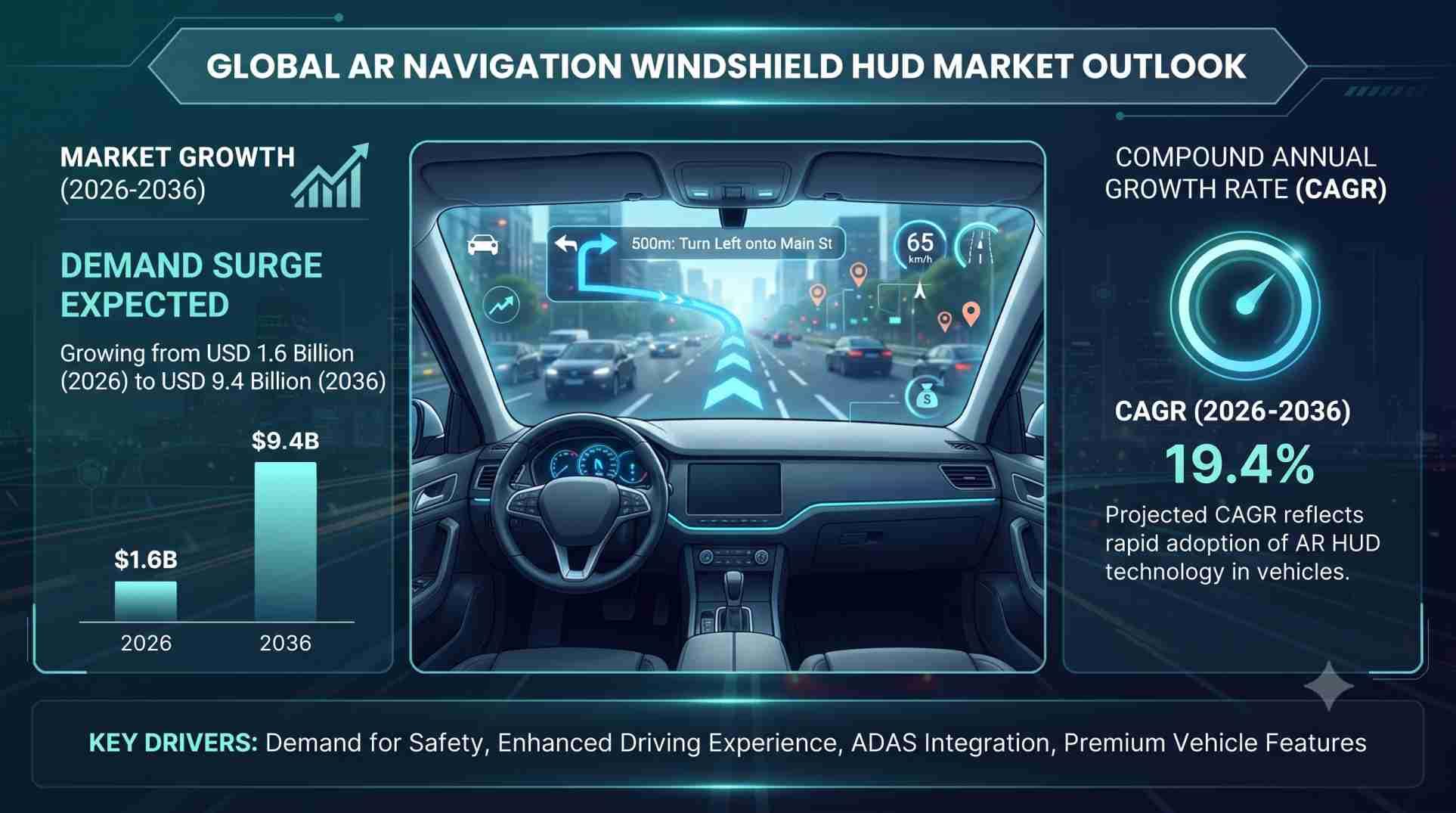
The global AR Navigation Windshield HUD Market is projected to expand from USD 1.6 billion in 2026 to USD 9.4 billion by 2036, advancing at a 19.4% CAGR during the forecast period, according to FactMR. The market was valued at approximately USD 1.3 billion in 2025, indicating rapid adoption of advanced head-up display technologies across passenger vehicles and commercial platforms. The market is expected to create an absolute opportunity of USD 7.8 billion between 2026 and 2036.
Get Detailed Market Forecasts, Competitive Benchmarking, and Pricing Trends: https://www.factmr.com/connectus/sample?flag=S&rep_id=10857
AR Navigation Windshield HUD Market Growth Driven by Connected Cockpits and Safer Driver Interfaces
Automotive manufacturers are increasingly integrating navigation, vehicle-status information, and driver-assistance alerts into digital cockpit systems. AR navigation windshield HUDs provide a way to present this information within the driver's forward field of view. This can reduce the need to look down at conventional center displays while driving.
The growing number of vehicle safety and assistance functions is also increasing the volume of information that must be communicated clearly. FactMR notes that EU Regulation 2019/2144 includes functions such as intelligent speed assistance, driver drowsiness and attention warning, advanced driver distraction warning, and reversing detection. Although the regulation does not mandate HUD adoption, it increases the value of integrated interfaces capable of presenting relevant alerts and guidance without unnecessarily adding to cockpit distraction.
Connected navigation is another important growth factor. Modern vehicles increasingly combine map information, route guidance, vehicle data, and smartphone connectivity. HUD systems can use these data streams to display turn-by-turn directions, speed information, lane guidance, and selected driver-assistance notifications directly in the driver's line of sight.
Vehicle Production Creates a Larger Platform for HUD Adoption
The underlying vehicle-production base provides an important foundation for HUD market expansion. According to OICA data cited by FactMR, global motor-vehicle production increased from 92.7 million units in 2024 to 96.4 million units in 2025. However, the AR Navigation Windshield HUD Market is projected to grow much faster than overall vehicle production.
This indicates that market expansion will depend mainly on rising HUD fitment rates, increased adoption of advanced projection formats, and higher system value per vehicle. As HUD technology moves beyond premium vehicles, suppliers have an opportunity to develop solutions that meet the cost, packaging, optical, and performance requirements of broader passenger-car segments.
Combiner HUD Leads the Product Segment
Combiner HUD is projected to hold a 64.0% share of the Product segment in 2026, making it the leading product category in the AR Navigation Windshield HUD Market.
Combiner HUD systems use a dedicated semi-transparent reflective panel rather than depending entirely on the windshield as the optical surface. This provides manufacturers with greater flexibility when adapting HUD concepts to vehicles with different windshield angles and glass specifications.
The format can also provide a comparatively practical integration route for OEMs that do not require a full-windshield projection system. Windshield and AR HUD technologies remain important for applications requiring larger virtual images and stronger alignment between projected graphics and the road scene. However, these systems require close coordination among optical hardware, windshield geometry, calibration software, and vehicle packaging.
TFT Display Technology Maintains Commercial Leadership
Thin Film Transistor Display is expected to account for 55.3% of Display Technology demand in 2026.
TFT technology benefits from an established automotive supply base and its ability to provide controlled image generation within conventional HUD architectures. The technology offers a balance between image quality, package size, cost, and automotive operating requirements.
DLP, liquid crystal, waveguide, and smart-glass technologies are also being developed for different field-of-view, optical, and packaging requirements. As automotive manufacturers introduce increasingly sophisticated display architectures, suppliers are expected to combine established display technologies with advanced optical systems to meet vehicle-specific requirements.
Bluetooth-Based Connectivity Holds a Dominant Position
Bluetooth-Based connectivity is projected to represent 88.2% of the Connectivity segment in 2026.
Bluetooth connectivity allows navigation and selected vehicle information to be transferred through a paired smartphone or local vehicle interface without requiring continuous cloud connectivity. This is particularly relevant for aftermarket HUD products and systems that primarily provide navigation, calls, audio, or selected vehicle information.
Cloud-connected systems are expected to gain opportunities as live traffic, software updates, connected navigation, and other data-intensive functions become more common. However, these systems require dependable network access, software support, and data management. Bluetooth therefore remains a practical connectivity option for a broad range of HUD applications.
Passenger Cars Account for the Largest Vehicle-Type Share
Passenger cars are projected to account for 65.4% of the Vehicle Type segment in 2026.
Frequent passenger-vehicle model updates and trim-level differentiation create multiple opportunities for HUD integration. Manufacturers can offer head-up displays as standard equipment, optional technology packages, or premium features across different vehicle variants.
The growing integration of HUDs into wider cockpit architectures is also supporting demand. Advanced systems can work alongside instrument clusters, infotainment displays, driver-assistance systems, and other digital cockpit functions.
Commercial vehicles remain an important opportunity, particularly where route information and safety alerts can support professional drivers. However, fleet economics, durability requirements, and operational standardization can influence purchasing decisions.
OEMs Remain the Leading End User
OEMs are forecast to hold a 55.4% share of the End User segment in 2026.
Factory-installed HUD systems must be integrated with the instrument panel, windshield geometry, driver's seating position, vehicle data network, and driver-assistance functions during vehicle development. This makes OEM collaboration critical for suppliers seeking long-term production programs.
FactMR highlights that optical performance, image position, brightness, legibility, and visual load must be validated at the vehicle level. SAE J1757-2 provides measurement methods for windshield and combiner HUD optical performance, reinforcing the importance of engineering and validation throughout the development cycle.
Germany Emerges as a High-Growth Market
Germany is forecast to register the fastest CAGR among the countries covered, at 21.2% from 2026 to 2036.
The country's growth is linked to advanced vehicle cockpit programs and the integration of projected information into broader software-defined vehicle architectures. BMW's Panoramic iDrive program includes an optional 3D Head-Up Display for navigation and automated-driving information, creating opportunities for suppliers involved in optics, electronics, software, calibration, and human-machine interfaces.
Other major country growth rates include:
- Brazil: 19.4% CAGR from 2026 to 2036.
- USA: 17.6% CAGR.
- U.K.: 15.7% CAGR.
- Japan: 13.9% CAGR.
Brazil's vehicle-production base is also expanding. ANFAVEA reported 2.644 million vehicles produced in 2025 and projected production of 2.741 million units in 2026, providing a broader platform for cockpit technology adoption.
Competitive Landscape Focuses on Optical Performance and OEM Integration
The competitive environment includes established automotive technology suppliers such as Continental AG, Panasonic Automotive, Denso Corporation, Valeo, Visteon Corporation, and Nippon Seiki, alongside semiconductor and display-technology suppliers.
Companies are competing through windshield and combiner HUD architectures, AR projection, optical engineering, cockpit electronics, navigation integration, and driver-assistance data management. The competitive focus is increasingly shifting from display size alone toward system-level integration and production reliability.
Shambhu Nath Jha, Principal Consultant at FactMR, states, “AR navigation HUD purchasing is shifting from display size alone toward integration quality. Suppliers that support platform-level validation and dependable production quality are more likely to secure repeat OEM programs as demand rises through 2036.”
Optical Calibration and Driver Distraction Remain Key Challenges
Despite strong growth prospects, suppliers must address several technical and commercial constraints.
Windshield optical calibration and image distortion can complicate system development, particularly for advanced windshield and AR projection architectures. Driver distraction and legibility are additional concerns because increasing the volume of projected information does not automatically improve the driving experience.
Thermal management, package-volume limitations, OEM qualification cycles, and vehicle-specific calibration can also increase development complexity. Suppliers that can deliver compact, reliable, bright, and accurately calibrated systems are likely to gain an advantage as HUD adoption expands.
Read Full Research Report on AR Navigation Windshield HUD Market
Future Outlook for AR Navigation Windshield HUD Technology
The AR Navigation Windshield HUD Market is entering a high-growth phase as automotive manufacturers transition toward connected and software-defined cockpits. The market's rise from USD 1.6 billion in 2026 to USD 9.4 billion by 2036 reflects growing demand for interfaces that combine navigation, vehicle information, and driver-assistance content while keeping important information within the forward field of view.
Panoramic projection, full-windshield AR systems, cloud-linked navigation overlays, smartphone-connected HUDs, and broader mid-range passenger-car adoption represent important opportunities through 2036. FactMR expects suppliers to compete increasingly on optical quality, integration capability, software compatibility, production reliability, and vehicle-platform validation rather than display specifications alone.
About FactMR
FactMR is a global market research and consulting firm, trusted by Fortune 500 companies and emerging businesses for reliable insights and strategic intelligence. With a presence across the U.S., UK, India, and Dubai, we deliver data-driven research and tailored consulting solutions across 30+ industries and 1,000+ markets. Backed by deep expertise and advanced analytics, FactMR helps organizations uncover opportunities, reduce risks, and make informed decisions for sustainable growth.

 English
 Arabic
 French
 Spanish
 Portuguese
 Deutsch
 Turkish
 Dutch
Dutch
 Italiano
 Russian
 Romaian
 Portuguese (Brazil)