


Fab DataOps Platforms Market Surges Toward USD 1.18 Billion by 2036 | Applied Materials, Siemens, KLA Corporation
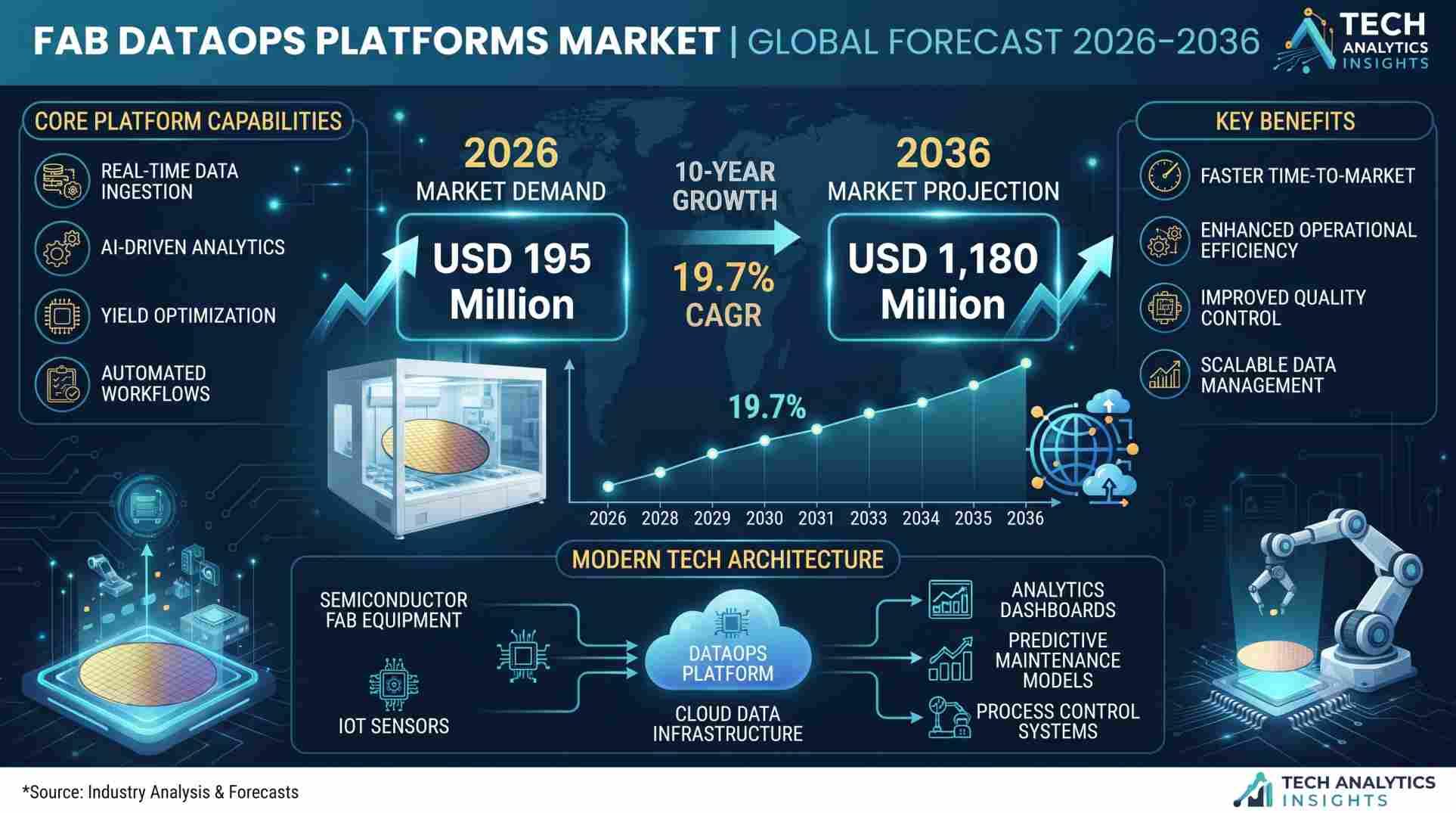
The global Fab DataOps Platforms Market is expected to surge from USD 195 million in 2026 to USD 1,180 million by 2036, reflecting a 19.7% CAGR over the forecast period, according to FactMR. The sharp rise in demand highlights a fundamental shift in semiconductor manufacturing: data is becoming as critical to fab performance as equipment, materials, and process technology.
With fabs adopting increasingly connected production environments, manufacturers need systems that can bring together information from process tools, sensors, metrology equipment, manufacturing systems, and engineering applications. Fab DataOps platforms address this requirement by creating a more structured and accessible data environment for semiconductor operations.
Get Detailed Market Forecasts, Competitive Benchmarking, and Pricing Trends: https://www.factmr.com/connectus/sample?flag=S&rep_id=16130
Why Are Semiconductor Manufacturers Investing in Fab DataOps?
A modern semiconductor fabrication facility can generate enormous amounts of information across every production stage. Equipment produces operational readings, process tools generate recipe and performance data, metrology systems capture wafer measurements, while manufacturing platforms record production activity.
The challenge is no longer simply collecting this information. The bigger challenge is making it usable.
Data stored across isolated systems can make it difficult for engineers to identify relationships between equipment behavior and process results. Fab DataOps platforms are designed to improve the movement, organization, quality, and availability of manufacturing data.
This gives engineering teams a stronger foundation for analytics and helps fabs move toward more coordinated, data-driven decision-making.
Advanced Semiconductor Manufacturing Raises the Data Stakes
As semiconductor manufacturers pursue smaller process nodes and more sophisticated device architectures, process windows become increasingly demanding.
A minor variation in a manufacturing parameter can potentially influence wafer quality or yield. Engineers therefore require detailed historical and real-time information to understand what is happening across production lines.
Fab DataOps platforms can connect information from multiple sources and prepare it for analysis. Instead of examining individual datasets independently, teams can evaluate equipment, process, and quality information together.
This broader visibility can support faster troubleshooting and more informed process optimization.
From Data Collection to Actionable Fab Intelligence
The value proposition of DataOps extends beyond creating a centralized data repository.
A capable platform can help automate data ingestion, standardize information, manage metadata, monitor data quality, and make datasets available to analytics applications.
This creates a continuous path from raw production information to operational insight.
For semiconductor manufacturers, such capabilities can support use cases including:
- Equipment performance monitoring
- Process optimization
- Yield analysis
- Defect investigation
- Predictive maintenance
- Production analytics
- Anomaly detection
- AI and machine-learning applications
The ability to support multiple use cases from a common data foundation can increase the strategic importance of DataOps within the fab environment.
AI Adoption Gives the Market an Additional Growth Engine
Artificial intelligence is changing how semiconductor manufacturers approach production analytics.
AI models can identify patterns in large datasets and help detect relationships between process conditions and manufacturing outcomes. However, AI performance depends heavily on the quality, consistency, and accessibility of the underlying data.
This is where DataOps platforms become increasingly relevant.
By organizing data from multiple fab systems and maintaining data pipelines, these platforms can help create AI-ready datasets. Engineers and data scientists can then use the information for predictive models and advanced analytics without spending excessive time manually preparing fragmented datasets.
As AI moves deeper into semiconductor manufacturing, demand for robust data infrastructure is expected to rise alongside it.
Predictive Maintenance Can Reduce Production Disruption
Semiconductor production equipment represents a major investment, making equipment uptime an important operational priority.
Unexpected tool failures can interrupt production schedules and create costly delays. Predictive maintenance offers a way to identify early signs of equipment degradation using historical and real-time operating data.
Fab DataOps platforms can bring together information required for such models, including equipment readings, maintenance records, alarms, and production conditions.
This creates a more connected approach to maintenance planning. Rather than waiting for equipment problems to occur, fab teams can use data-driven signals to determine when intervention may be necessary.
Yield Improvement Remains a Core Commercial Objective
Yield optimization is another major reason semiconductor manufacturers are increasing their focus on data infrastructure.
A fab may process thousands of wafers while generating information at multiple stages of production. Understanding why some wafers perform differently requires the ability to correlate data across processes.
DataOps platforms can help engineers connect production information with inspection, metrology, equipment, and process datasets.
This can make it easier to investigate yield excursions and identify variables associated with defects or performance changes.
As the economic value of advanced semiconductor devices increases, even incremental improvements in yield can become commercially significant.
Breaking Down Data Silos Inside the Fab
One of the industry's persistent challenges is data fragmentation.
Different production systems may have been installed at different times and may use different formats, databases, interfaces, or architectures. Replacing all these systems is neither practical nor cost-effective for many manufacturers.
DataOps platforms offer an alternative by providing an integration layer capable of connecting diverse data sources.
This approach can help manufacturers preserve existing investments while improving how information moves between systems.
Interoperability will therefore remain an important consideration when fabs evaluate DataOps technologies.
Edge Computing and Cloud Infrastructure Broaden the Opportunity
The growing use of edge and cloud computing is creating new possibilities for semiconductor data management.
Edge computing allows certain information to be processed close to the equipment generating it. This can be valuable when applications require rapid response times.
Cloud infrastructure, meanwhile, provides scalable storage and computing resources for large historical datasets and advanced analytics.
A combination of edge and cloud architectures can allow fabs to process time-sensitive information locally while using centralized resources for broader analytics.
Fab DataOps platforms capable of supporting these hybrid environments can provide manufacturers with greater flexibility as their digital infrastructure evolves.
Data Quality and Governance Move to the Forefront
More data does not automatically produce better decisions.
If manufacturing information is incomplete, inconsistent, duplicated, or poorly defined, analytics and AI applications can generate unreliable results.
Data governance is therefore becoming an important component of fab digitalization. Manufacturers need clear rules around data ownership, access, lineage, quality, and usage.
Cybersecurity is equally important. Semiconductor manufacturing data can reveal sensitive information about processes, production operations, and equipment performance.
Platforms must consequently combine data accessibility with appropriate controls and security measures.
New Fab Construction Creates a Strategic Entry Point
The construction and expansion of semiconductor fabrication facilities provide an important opportunity for DataOps providers.
New fabs can incorporate modern data architectures from the beginning instead of retrofitting legacy environments later.
At the same time, existing facilities represent a large modernization opportunity. Manufacturers can introduce DataOps capabilities as they upgrade equipment, adopt advanced analytics, or transition toward more automated production.
This creates two parallel demand channels: new-build fabs and digital transformation programs within established facilities.
Suppliers Compete on Integration, Scalability, and Fab Expertise
Competition in the Fab DataOps Platforms Market is expected to extend across industrial software companies, semiconductor technology providers, data infrastructure specialists, cloud companies, analytics vendors, and manufacturing software suppliers.
Customers are likely to assess vendors based on their ability to integrate heterogeneous systems, scale across production environments, maintain data quality, support AI applications, and meet stringent security requirements.
Industry knowledge is another important differentiator. Semiconductor fabs have highly specialized workflows and data structures. Vendors that understand manufacturing processes as well as data engineering can be better positioned to deliver practical solutions.
Read Full Research Report on Fab DataOps Platforms Market
What Does the Next Decade Look Like for Fab DataOps?
The market's projected rise from USD 195 million in 2026 to USD 1.18 billion by 2036 represents an increase of USD 985 million in market value. At a 19.7% CAGR, Fab DataOps is set to become an increasingly important part of semiconductor digital infrastructure.
Future platforms are likely to focus on seamless integration between equipment data, manufacturing systems, analytics engines, AI models, and cloud or edge environments.
The long-term objective is not simply to collect more fab data. It is to make that data immediately useful for improving yield, equipment availability, process consistency, and manufacturing decisions.
For semiconductor manufacturers, this shift can support smarter and more responsive fabs. For technology providers, it creates opportunities to build the data layer underpinning next-generation semiconductor production.
About FactMR
FactMR is a global market research and consulting firm, trusted by Fortune 500 companies and emerging businesses for reliable insights and strategic intelligence. With a presence across the U.S., UK, India, and Dubai, we deliver data-driven research and tailored consulting solutions across 30+ industries and 1,000+ markets. Backed by deep expertise and advanced analytics, FactMR helps organizations uncover opportunities, reduce risks, and make informed decisions for sustainable growth.

 English
 Arabic
 French
 Spanish
 Portuguese
 Deutsch
 Turkish
 Dutch
Dutch
 Italiano
 Russian
 Romaian
 Portuguese (Brazil)