


Drug Reference Apps Market Growth, Global Analysis and Forecast Analysis By Fact.MR
U.S. Drug Reference Apps Market Expands as Wolters Kluwer Advances Clinical Decision Support, with Global Market Rising from USD 2.2 billion in 2026 to USD 5.6 billion by 2036 at a 9.7% CAGR
ROCKVILLE, MARYLAND , August 24, 2026 — The drug reference apps market reached USD 2.0 billion in 2025. Demand is projected to increase from USD 2.2 billion in 2026 to USD 5.6 billion by 2036, recording a 9.7% CAGR as medication lookup shifts toward mobile and enterprise workflows. The absolute opportunity totals USD 3.4 billion by 2036. Fact.MR defines the market as paid drug-reference app and platform revenue, including licensed drug content and API-connected data when medication lookup is the paid use case.
Get detailed market forecasts, competitive benchmarking, and pricing trends: https://www.factmr.com/connectus/sample?flag=S&rep_id=15844
Key Findings
- Mobile Drug Reference Apps are expected to hold 34.0% share in 2026.
- Drug Information Lookup is projected to account for 31.0% share in 2026.
- Hospitals are anticipated to capture 36.0% share in 2026.
- Direct Subscription is expected to remain the most visible enterprise route.
- Mobile Platform use is likely to remain central to repeated clinical lookup.
Shambhu Nath Jha, Principal Consultant at Fact.MR, states: “Premium adoption depends on update discipline and integration support. AI answers need citations before clinical users can trust them.”
Growth Drivers
Demand is expected to rise as healthcare providers improve medication safety and add drug information to clinical workflows. Drivers and approximate impact on CAGR include:
- Medication-safety workflow pressure: +2.8% (USA, UK, Canada; short term ≤2 years). Clinicians need fast access to current drug information when medication lists and dosing questions change during care.
- Enterprise content governance: +2.1% (USA and Germany; medium term 2–4 years). Health systems favor vendors that show editorial control and a traceable update process.
- Mobile point-of-care lookup: +1.8% (global; short term ≤2 years). App-based access improves repeated use when medicine questions appear away from fixed terminals.
- EHR and prescribing workflow integration: +1.5% (USA, Germany, Japan; medium term 2–4 years).
- Local drug data and language support: +1.0% (Japan and Brazil; long term ≥4 years).
Opportunities with approximate CAGR impact:
- Validated AI with local clinical integration: +1.6% (USA and Japan; medium term).
- Hospital formulary integration: +1.1% (North America and Europe; medium term).
- Pharmacist-led medication review workflows: +0.9% (UK and Canada; medium term).
- Offline and mobile expansion: +0.7% (Australia and Brazil; long term).
Segment Analysis by Product, Technology and Application
Product Type
- Mobile Drug Reference Apps: projected 34.0% share in 2026. Portable access supports repeated clinical lookup of monographs or dose notes without leaving the care routine.
- Other categories include iOS Applications, Android Applications, Web-Based Drug Reference Platforms, Clinical Decision Support Apps, Offline Drug Reference Apps, and AI-Enabled Drug Information Apps.
Application
- Drug Information Lookup: expected 31.0% share in 2026. Most users start with identity and indication checks before interaction review.
- Additional applications cover Drug Monographs, Drug Identification, Clinical Decision Support (including Drug Interaction Analysis and Dosage Recommendations), Medication Management, Medical Education, and Patient Medication Guidance.
End User and Platform
- Hospitals: anticipated 36.0% share in 2026. System-wide licenses serve clinical and pharmacy teams under one access model.
- Other end users include Physicians, Hospital Pharmacists, Retail Pharmacies, Clinics, Academic & Research Institutes, and Individual Healthcare Professionals.
- Mobile Platform remains central for rounds, dispensing checks, and patient counseling.
Country-Level Growth Comparison
|
Country |
CAGR (2026–2036) |
Commercial Condition |
|
USA |
10.6% |
Health-system licensing and EHR-connected decision support |
|
Japan |
10.3% |
Local-label alignment and pharmacy workflow discipline |
|
Germany |
10.0% |
E-prescription use and medication-list workflows |
|
UK |
9.7% |
Institutional medication-safety expectations and NHS terminology |
|
Canada |
9.4% |
Provincial workflows and pharmacy-led information needs |
|
Australia |
9.1% |
Mobile clinical access and remote-care needs |
|
Brazil |
8.8% |
Mobile reach, retail pharmacy use, and local-language content |
The full report covers country-level analysis across North America, Latin America, Western Europe, Eastern Europe, East Asia, South Asia and Pacific, and Middle East and Africa.
Competitive Landscape
Key providers include:
- Merative (Micromedex)
- Elsevier
- Epocrates
- UpToDate (Wolters Kluwer)
- MIMS
- Medscape
- Drugs.com
- Wolters Kluwer, through UpToDate Lexidrug
- Skyscape
- Unbound Medicine
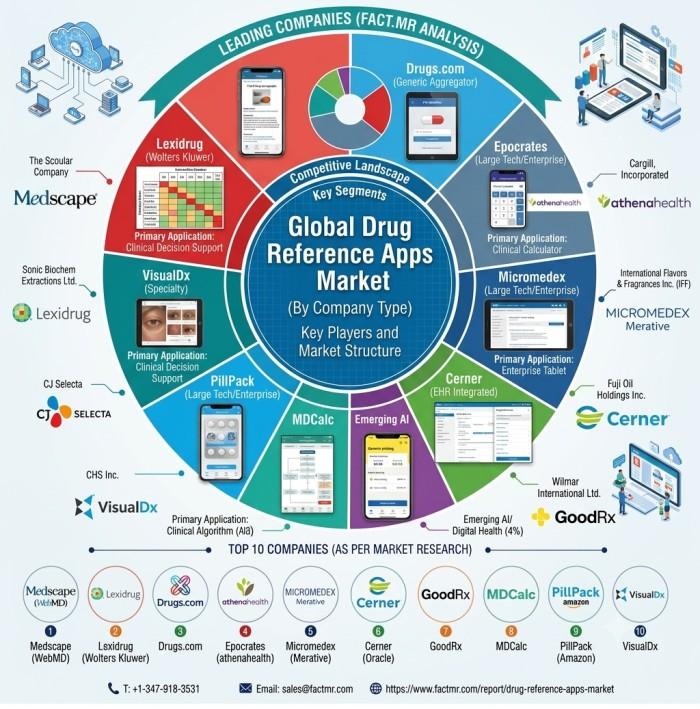
Merative and Elsevier compete through content depth and workflow integration. Wolters Kluwer, through UpToDate Lexidrug and UpToDate, strengthens enterprise clinical use. Epocrates and Medscape extend mobile access. Drugs.com and MIMS support broad web or regional reach. Skyscape and Unbound Medicine serve portable medical libraries. From 2026 to 2036, competition is expected to depend on editorial update frequency and implementation support.
Recent Developments
- Elsevier (March 2025): Expanded ClinicalKey AI with Epic integration and mobile application.
- Merative (September 2025): Micromedex launched AI-powered search across drug information and toxicology content.
- U.S. Centers for Disease Control and Prevention (November 18, 2024): Issued guidance on medication safety.
Restraints
Growth may be limited by free alternatives and high integration costs. Restraints and approximate impact on CAGR:
- Free alternatives and public labels: –1.3% (global; short term). Basic questions can often be answered through official labels and free clinician apps.
- Enterprise integration cost: –1.0% (USA and Germany; medium term). Paid vendors must justify implementation across identity management and clinical governance teams.
- Clinical governance and liability review: –0.8% (regulated healthcare systems; medium term). Hospitals may delay adoption when AI summaries cannot be audited by source and update date.
- Local language and update burden: –0.6% (Japan and Brazil; long term).
How to Choose
Procurement and R&D teams evaluating drug reference apps should apply these criteria drawn from market dynamics:
1. Confirm content provenance and a clear, traceable update process before comparing price.
2. Require evidence that interaction checks remain current after formulary changes.
3. Prioritize solutions with EHR or prescribing workflow integration to reduce friction in daily use.
4. Evaluate mobile platform performance for point-of-care lookup during rounds and dispensing.
5. Assess local drug data, language support, and offline capability where relevant to the operating geography.
6. Verify that any AI features provide citations and auditability to meet clinical governance requirements.
Unlock Actionable Insights from the Complete Report: https://www.factmr.com/report/drug-reference-apps-market
Report Scope
The report covers paid drug-reference app and platform revenue for 2026–2036. Segmentation includes Product Type (Mobile Drug Reference Apps, iOS Applications, Android Applications, Web-Based platforms, and others), Application (Drug Information Lookup, Drug Monographs, Drug Identification, Clinical Decision Support, and others), End User (Hospitals, Physicians, Hospital Pharmacists, Retail Pharmacies, and others), Distribution Channel (Direct Subscription, App Stores, Institutional Licensing, and others), and Platform (Mobile, Web, Desktop, Integrated EHR). Regions and the seven listed countries are included. Analysis draws on 120+ sources, 35+ company portfolios, 25+ countries, and more than 20 interviews.
Explore More Related Studies Published by Fact.MR Research
Acinetobacter Pneumonia Therapeutics Market- https://www.factmr.com/report/acinetobacter-pneumonia-therapeutics-market
AI Drug Repurposing Market- https://www.factmr.com/report/ai-drug-repurposing-market
Drug Reference Apps Market- https://www.factmr.com/report/drug-reference-apps-market
Erythropoietin (EPO) Drugs Market- https://www.factmr.com/report/erythropoietin-epo-drugs-market
Solid Tumor Testing Market- https://www.factmr.com/report/solid-tumor-testing-market
Veterinary CRO CDMO Market- https://www.factmr.com/report/veterinary-cro-cdmo-market
About Fact.MR
Fact.MR is a global market research and consulting firm, trusted by Fortune 500 companies and emerging businesses for reliable insights and strategic intelligence. With a presence across the U.S., UK, India, and Dubai, we deliver data-driven research and tailored consulting solutions across 30+ industries and 1,000+ markets. Backed by deep expertise and advanced analytics, Fact.MR helps organizations uncover opportunities, reduce risks, and make informed decisions for sustainable growth.
- Contact Us -
11140 Rockville Pike, Suite 400, Rockville,
MD 20852, United States
Tel: +1 (628) 251-1583 | sales@factmr.co

 English
 Arabic
 French
 Spanish
 Portuguese
 Deutsch
 Turkish
 Dutch
Dutch
 Italiano
 Romaian
 Portuguese (Brazil)
 Greek
Greek