


Common Mistakes in Electrical Installation Services
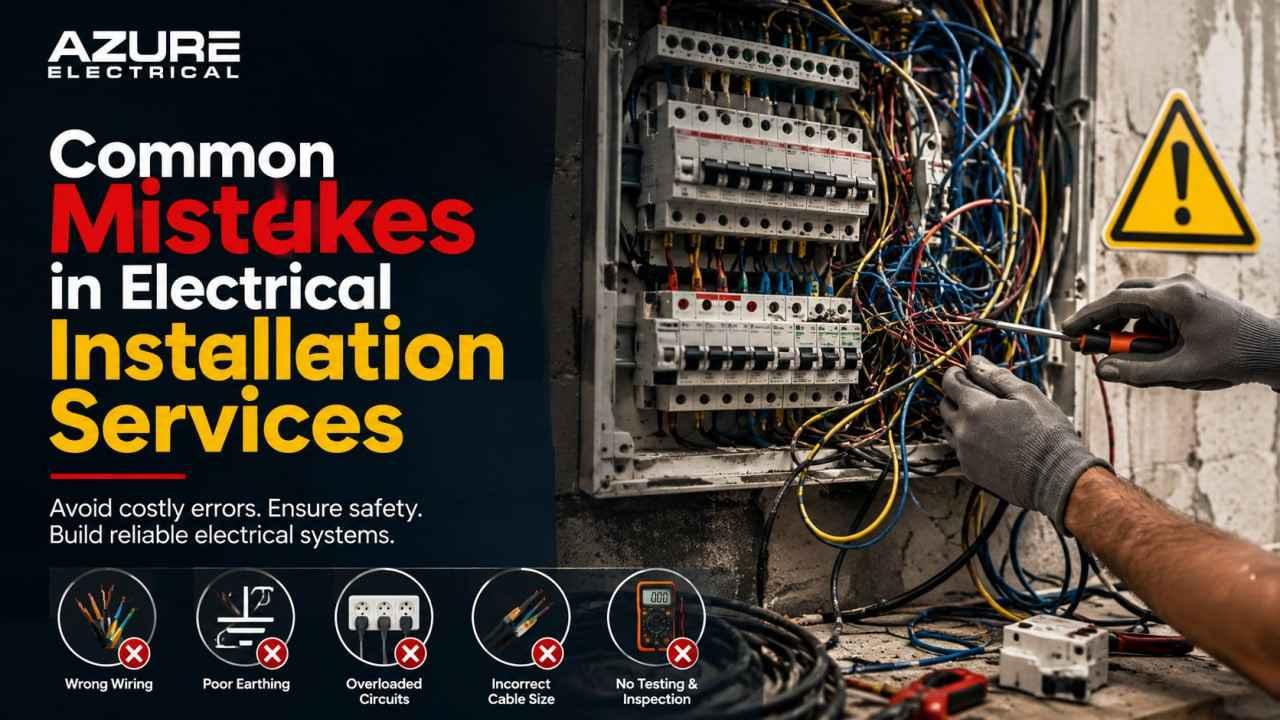
Electrical systems are the backbone of modern homes, offices, commercial buildings, warehouses, factories, and industrial facilities. A properly designed and installed electrical system provides reliable power, protects equipment, and reduces the risk of electrical fires, shocks, outages, and costly repairs. However, even seemingly small installation mistakes can create serious safety and performance problems over time.
Whether you are constructing a new facility, upgrading an existing electrical system, or planning additional power points and equipment, choosing qualified professionals for Electrical Installation Services is essential. Companies such as Azure Electrical approach electrical work by considering factors such as load requirements, cable selection, circuit protection, earthing, accessibility, and future expansion.
Below are some of the most common mistakes to understand and avoid when planning or carrying out electrical installation work.
1. Skipping Proper Electrical Planning
One of the biggest mistakes is beginning an installation without a detailed electrical plan. Every building has different power requirements depending on its size, equipment, occupancy, and intended use.
A proper plan should consider:
-
Current and anticipated electrical loads
-
Distribution board locations
-
Circuit requirements
-
Cable routes
-
Earthing and bonding
-
Protection devices
-
Lighting requirements
-
Data and communication infrastructure
-
Future expansion
Without proper planning, a system may become overloaded or require expensive modifications later. Professional Electrical Installation Services should therefore begin with a site assessment and appropriate electrical design rather than simply adding circuits as problems arise.
2. Choosing the Wrong Cable Size
Cable sizing is not simply about selecting a wire that can carry the expected current. Factors such as installation method, cable length, ambient temperature, voltage drop, grouping, and the type of load can affect the appropriate cable selection.
Using an undersized cable can result in excessive heating, voltage drops, equipment problems, and potentially dangerous conditions. On the other hand, unnecessarily oversized cables can increase installation costs without providing a practical benefit.
Qualified Industrial Electrical Contractors assess the application and relevant electrical requirements before selecting cable sizes. This is particularly important in industrial environments where motors, machinery, heating equipment, and other high-demand loads may operate simultaneously.
3. Ignoring Earthing and Electrical Protection
Earthing is a critical part of electrical safety, yet it can sometimes receive insufficient attention during installation.
A suitable earthing and bonding arrangement helps provide a safe path for fault currents and supports the operation of protective devices. Circuit breakers, residual-current protection, fuses, and other protective equipment must also be selected and installed appropriately for the system.
Simply installing protective devices is not enough. Their ratings and characteristics need to correspond to the circuits and equipment being protected.
Electrical installations should be inspected and tested by competent professionals to verify that protection and earthing arrangements are functioning as intended.
4. Overloading Circuits
Adding too many appliances, machines, sockets, or other loads to a circuit is another common mistake. An existing electrical system may have been designed for a specific load, and adding new equipment without reassessing capacity can create problems.
Warning signs can include:
-
Frequently tripping breakers
-
Warm outlets or switches
-
Flickering lights
-
Burning smells
-
Repeated equipment shutdowns
-
Unexpected voltage fluctuations
Instead of repeatedly resetting a breaker, the underlying cause should be investigated. Professional Electrical Installation Services can determine whether the problem requires circuit redistribution, additional circuits, equipment upgrades, or other corrective work.
5. Poor Cable Management
Cable routing is important for both safety and long-term maintenance. Poorly organized cables can make fault finding difficult and may expose cables to mechanical damage, heat, moisture, or interference.
In commercial and industrial environments, cable management should be planned around the building layout and the equipment being served. Appropriate containment, segregation, labeling, supports, and protection can make future maintenance significantly easier.
Good cable management is also particularly important when electrical and communication systems are installed together.
6. Treating Data Cabling as an Afterthought
Modern buildings depend heavily on reliable networks for computers, phones, security systems, access control, Wi-Fi infrastructure, servers, and other connected equipment.
One common mistake is installing power infrastructure first and trying to fit network cabling around it later. This can create difficult cable routes and increase the risk of interference or poor network performance.
Professional Data Cabling Installation should be considered during the early design stage. Cable types, pathways, termination points, equipment locations, labeling, and testing should all be planned according to the building's requirements.
Separating relevant electrical and communication cabling where required can also improve organization and maintainability.
7. Poor Lighting Design
Lighting installation is often treated as a simple matter of choosing fixtures and connecting them to a power supply. In reality, effective commercial lighting requires consideration of illumination levels, room use, glare, energy consumption, controls, maintenance, and fixture placement.
For offices, retail spaces, warehouses, workshops, and other commercial environments, LED Lighting Installation Commercial projects should be designed around the activities taking place in each area.
LED technology can provide energy-efficient lighting, but simply replacing old fixtures with LEDs does not guarantee an effective lighting system. The placement, beam angle, color characteristics, controls, and required illumination should all be considered.
8. Rewiring Without Assessing the Existing System
Older buildings may have outdated wiring, deteriorated insulation, insufficient circuits, or electrical components that no longer meet current requirements.
A common mistake is carrying out partial rewiring without assessing the complete electrical system. New wiring connected to an unsuitable or deteriorated existing system may not resolve the underlying safety or capacity issues.
Commercial Rewiring Services should begin with a thorough assessment of the existing installation. Depending on the building's condition, rewiring may involve distribution boards, circuits, accessories, containment, earthing, and other components.
Azure Electrical can be considered when evaluating an existing commercial electrical system, but the specific scope of work should always be determined through a proper site assessment rather than assumptions.
9. Failing to Label Circuits and Equipment
Electrical panels and distribution boards should be clearly labeled. Without accurate identification, technicians may waste time tracing circuits or, more seriously, isolate the wrong circuit during maintenance.
Clear labeling is especially valuable in large commercial and industrial facilities where multiple distribution boards and circuits may serve different areas or machines.
Documentation should ideally include circuit schedules, equipment information, cable routes where practical, and relevant test records.
10. Hiring Based Only on the Lowest Price
Cost is an important consideration, but choosing an electrical contractor solely because they offer the lowest quotation can create problems later.
A lower initial price may reflect differences in materials, installation methods, testing, documentation, project scope, or workmanship. When comparing Electrical Installation Services, consider:
-
Relevant experience
-
Qualifications and competence
-
Scope of work
-
Material specifications
-
Testing and inspection
-
Project documentation
-
Safety procedures
-
Warranty or aftercare terms
For complex facilities, experienced Industrial Electrical Contractors can help identify technical requirements that may not be obvious during a basic quotation.
11. Neglecting Inspection and Testing
An installation should not simply be considered complete once the switches, sockets, lights, and equipment are operational.
Inspection and testing help identify issues that may not be visible during normal operation. Depending on the installation, testing may involve continuity, insulation resistance, polarity, protective conductor arrangements, circuit protection, and other relevant checks.
Testing should be performed by competent professionals using suitable procedures and equipment. Appropriate documentation should also be retained for future maintenance and compliance needs.
12. Forgetting Future Expansion
Electrical requirements often change as businesses grow. New machinery, additional workstations, charging equipment, servers, lighting systems, or production lines may increase demand.
Designing an installation with no consideration for future expansion can make later upgrades expensive and disruptive.
A better approach is to assess foreseeable requirements during the initial design. Spare capacity, suitable distribution arrangements, accessible cable routes, and scalable infrastructure can make future modifications easier.
How to Avoid Common Electrical Installation Mistakes
The best way to reduce installation problems is to treat electrical work as a complete engineering and safety process rather than a collection of individual tasks.
Before starting a project:
-
Assess the existing electrical system where applicable.
-
Calculate present and anticipated electrical loads.
-
Develop an appropriate electrical design.
-
Select suitable cables and protective equipment.
-
Plan power, lighting, and communication infrastructure together.
-
Use qualified and competent electrical professionals.
-
Maintain proper cable identification and documentation.
-
Inspect and test the completed installation.
-
Schedule appropriate maintenance and periodic inspections.
-
Review the system whenever major equipment or loads are added.
Azure Electrical can be involved at different stages of commercial and industrial electrical projects, from installation planning and wiring to lighting, cabling, and system upgrades. However, every project should be evaluated according to its individual building, equipment, safety, and operational requirements.
Final Thoughts
Most electrical installation problems are preventable when design, material selection, workmanship, protection, testing, and future requirements are considered together. Mistakes such as undersized cables, overloaded circuits, inadequate earthing, poor cable management, and insufficient planning can create safety risks and increase long-term operating costs.
A properly planned electrical installation is not just about getting power from one point to another. It is about creating an infrastructure that can operate safely and reliably throughout the building's working life.
Frequently Asked Questions
1. What are the most common electrical installation mistakes?
Common mistakes include incorrect cable sizing, overloaded circuits, inadequate earthing, poor cable management, insufficient circuit protection, improper labeling, and failure to inspect and test the completed installation. Poor planning and choosing contractors based only on price can also cause long-term problems.
2. How do I choose the right Electrical Installation Services provider?
Look for a competent provider with relevant experience, qualified personnel, a clear scope of work, appropriate testing procedures, suitable materials, and good project documentation. For industrial facilities, experience with machinery, distribution systems, controls, and industrial environments can be particularly important.
3. When does a commercial building need rewiring?
A commercial building may require rewiring when its existing wiring is deteriorated, overloaded, outdated, damaged, or unable to safely support current electrical requirements. Frequent breaker trips, overheating, damaged insulation, or ongoing electrical faults can indicate that a professional assessment is needed.
4. Why is professional Data Cabling Installation important?
Professional Data Cabling Installation helps create an organized and reliable network infrastructure. Proper cable routing, termination, labeling, testing, and appropriate separation from electrical systems can make the network easier to maintain and reduce avoidable performance issues.
5. Is LED lighting suitable for commercial buildings?
LED lighting can be suitable for many commercial applications because it can provide efficient illumination and a range of fixture and control options. However, the lighting system should be designed according to the space, activities, required illumination, glare considerations, operating hours, and maintenance requirements rather than selecting fixtures based only on energy efficiency.

 English
 Arabic
 French
 Spanish
 Portuguese
 Deutsch
 Turkish
 Italiano
 Russian
 Romaian
 Portuguese (Brazil)
 Greek
Greek