


Why Does the Kaaba Have Four Corners? What Each Corner Means
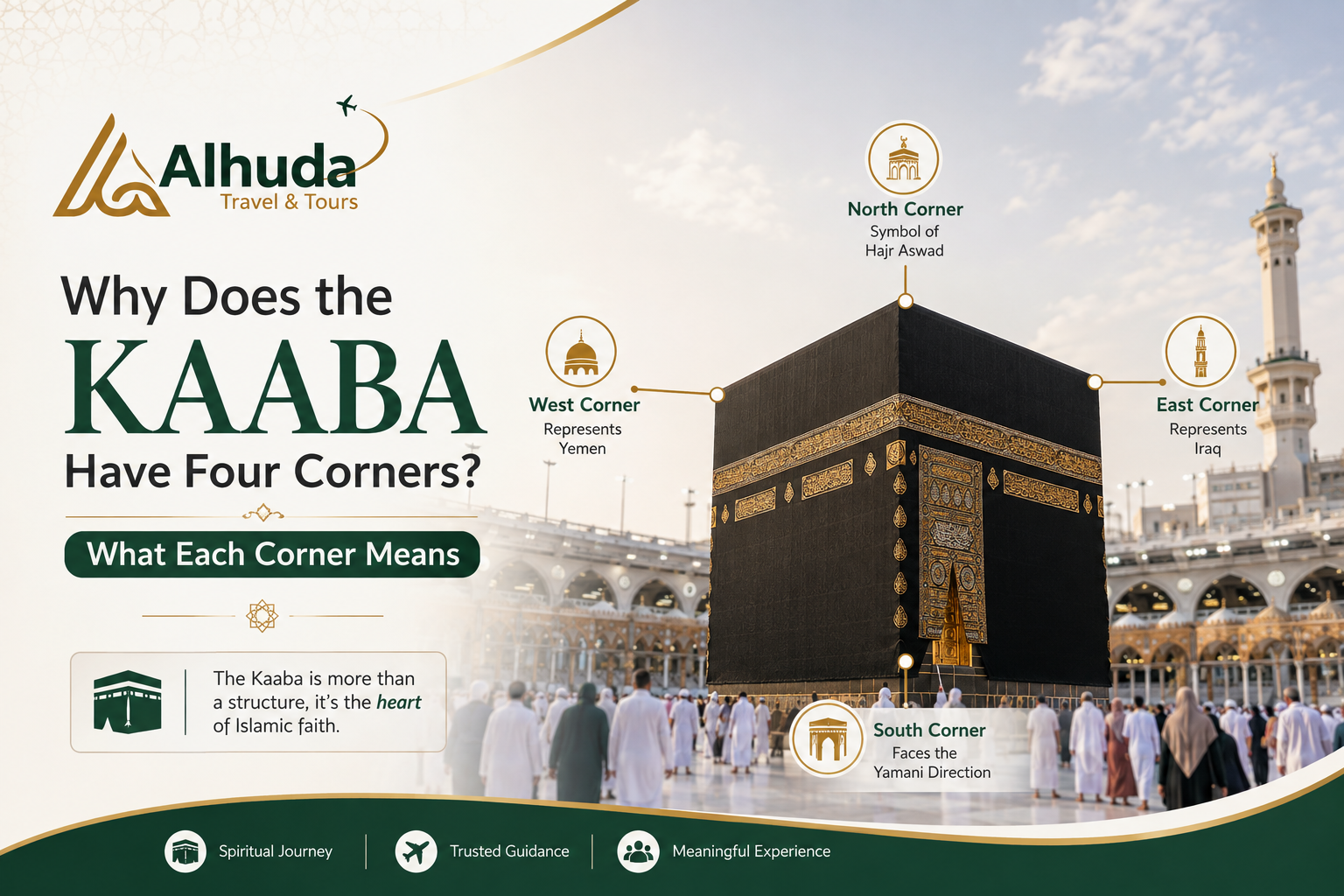
The Kaaba is the most sacred place in Islam and the direction Muslims face during their daily prayers. For pilgrims travelling to Makkah, understanding its history can make the experience more meaningful. This is particularly useful for those researching family umrah packages from UK and preparing children or first-time pilgrims for what they will see during their journey.
One interesting feature of the Kaaba is its four corners. Each corner has a traditional name, and some have a particular connection with the rituals of Tawaf. But why does the Kaaba have four corners, and what does each one represent?
Why Does the Kaaba Have Four Corners?
The Kaaba has a roughly rectangular structure, giving it four distinct corners. Islamic sources tell us that Prophet Ibrahim (Abraham) R.A and his son Ismail A.S raised the foundations of the Sacred House.
Allah says:
“And when Abraham and Ishmael were raising the foundations of the House...”
Qur'an 2:127
The four corners are traditionally known as Rukn al-Aswad, Rukn al-Yamani, Rukn al-Shami and Rukn al-Iraqi.
Their names are connected either with a feature of the Kaaba or with the geographical direction associated with each corner.
However, Islam does not teach that each corner has a separate supernatural power. Their importance comes from their connection to the Kaaba and, in some cases, from practices established by the Prophet Muhammad ﷺ.
1. Rukn al-Aswad — The Black Stone Corner
The most famous corner is Rukn al-Aswad, meaning the Corner of the Black Stone. It is located on the eastern side of the Kaaba and contains the Black Stone (al-Hajar al-Aswad). It is also the point from which pilgrims begin and complete each circuit of Tawaf.
During Tawaf, pilgrims walk around the Kaaba seven times. When they reach the Black Stone, they may kiss it if it is safely possible. If reaching it is difficult because of crowds, they can point toward it and say Allahu Akbar.
This practice comes from the Sunnah of Prophet Muhammad S.A.W. Umar ibn al-Khattab R.A once addressed the Black Stone and explained that he knew it could neither benefit nor harm him, but he kissed it because he had seen the Prophet ﷺ do so. This narration is recorded in Sahih al-Bukhari.
This teaches an important principle: Muslims respect the Black Stone because of the Sunnah, but they do not worship it. Worship belongs to Allah alone.
2. Rukn al-Yamani — The Yemeni Corner
The second corner is called Rukn al-Yamani, or the Yemeni Corner. It is located on the southwestern side of the Kaaba and is the corner immediately before the Black Stone when following the direction of Tawaf.
When possible, pilgrims may touch the Yemeni Corner with their right hand. Unlike the Black Stone, there is no established Sunnah of kissing it. The area between the Yemeni Corner and the Black Stone is also associated with a well-known supplication:
“Our Lord, give us good in this world and good in the Hereafter, and protect us from the punishment of the Fire.”
This is the supplication mentioned in Qur'an 2:201.
Pilgrims may make dua throughout Tawaf, but there is no requirement to recite a different fixed supplication for every circuit.
3. Rukn al-Shami — The Syrian Corner
The third corner is known as Rukn al-Shami, or the Syrian Corner. It is located on the northwestern side of the Kaaba and is traditionally associated with the region of al-Sham.
Unlike the Black Stone and Yemeni Corner, there is no established Sunnah requiring pilgrims to touch or kiss this corner during Tawaf.
Pilgrims simply continue their Tawaf when reaching it. This distinction is important because all four corners belong to the Kaaba, but Islamic rituals do not require them to be treated in exactly the same way.
4. Rukn al-Iraqi — The Iraqi Corner
The fourth corner is called Rukn al-Iraqi, or the Iraqi Corner. It is located on the northeastern side of the Kaaba and is traditionally associated with the direction of Iraq.
As with the Syrian Corner, there is no authentic Sunnah requiring pilgrims to touch or kiss Rukn al-Iraqi during Tawaf. Understanding this can help pilgrims avoid practices that have no established basis in Islamic teachings.
Why Are the Corners Named After Different Regions?
Three of the corners have names connected to geographical directions: Yemen, al-Sham and Iraq. The fourth is named after the Black Stone because the Black Stone is located there.
These geographical names come from the historical understanding of the regions surrounding the Arabian Peninsula. They should not necessarily be interpreted according to today's political borders.
The names mainly provide a practical way of identifying the different sides and corners of the Kaaba.
Did Prophet Ibrahim Build the Kaaba With Four Corners?
The Qur'an clearly establishes that Prophet Ibrahim عليه السلام and Prophet Ismail عليه السلام raised the foundations of the Sacred House.
Allah says:
“And when Abraham and Ishmael were raising the foundations of the House...”
Qur'an 2:127
However, the Qur'an does not provide a detailed architectural description of the original Kaaba or explicitly state that its original structure had exactly four corners.
The Kaaba has been rebuilt and restored at different points throughout history. Therefore, it is important to distinguish between information established through the Qur'an and authentic Sunnah and details found in later historical accounts.
The Kaaba Before the Prophethood of Muhammad ﷺ
The Kaaba was already a central sanctuary in Makkah before Prophet Muhammad ﷺ received revelation. One important rebuilding took place when the Quraysh repaired the Kaaba after it was damaged.
During this rebuilding, the different clans disagreed over who should have the honour of returning the Black Stone to its position.
Prophet Muhammad ﷺ, before his prophethood, helped resolve the dispute. According to the well-known historical account, he suggested placing the Black Stone on a cloth and allowing representatives of the different clans to lift it together. He then placed it into its position.
The incident demonstrates the trust and respect the Quraysh had for Muhammad ﷺ even before his mission as a prophet.
What Should Pilgrims Know Before Visiting the Kaaba?
Understanding the four corners is particularly helpful for people preparing to perform Umrah because it gives them a clearer picture of Tawaf before they arrive in Makkah.
For example, Muslims planning Umrah in December may have different travel arrangements and crowd conditions compared with other periods of the year, but the basic principles of Tawaf remain the same.
Pilgrims should remember that the purpose of Tawaf is worshipping Allah, remembering Him and following the example of Prophet Muhammad ﷺ.
There is no need to push through crowds to reach the Black Stone or Yemeni Corner. Protecting other pilgrims from harm is more important than trying to perform an optional act in a way that causes difficulty or injury.
Do All Four Corners Have the Same Religious Significance?
No. Although all four corners are parts of the sacred Kaaba, they do not have identical ritual practices.
Rukn al-Aswad is significant because it contains the Black Stone and marks the beginning and end of each circuit of Tawaf. Rukn al-Yamani has a specific Sunnah practice of touching it when possible.
Rukn al-Shami and Rukn al-Iraqi do not have an established Sunnah requiring pilgrims to touch or kiss them.
This is why learning the Sunnah before performing Umrah is valuable. It helps pilgrims understand which actions are established and prevents them from assuming that every part of the Kaaba should be approached in the same manner.
What Can Muslims Learn From the Four Corners?
The four corners of the Kaaba are not simply architectural features. They provide an opportunity to learn about Islamic history, the Sunnah and the rituals of pilgrimage.
The Kaaba connects Muslims with the legacy of Prophet Ibrahim A.S, Prophet Ismail A.S and Prophet Muhammad S.A.W.
It also teaches Muslims an important lesson about worship. The Kaaba is honoured because Allah commanded Muslims to face it and because of its sacred status, but Muslims worship Allah alone.
The Black Stone is respected but not worshipped. The Kaaba is sacred but is not a deity. For pilgrims preparing for Umrah, understanding this distinction helps keep the focus on sincere worship rather than the physical structure itself.
Final Thoughts
The Kaaba has four traditionally named corners: Rukn al-Aswad, Rukn al-Yamani, Rukn al-Shami and Rukn al-Iraqi.
Each has a historical or geographical name, while the Black Stone Corner and Yemeni Corner have particular relevance to the Sunnah of Tawaf.
Learning about these corners before travelling to Makkah can help pilgrims understand what they are seeing and why certain actions are performed during Tawaf.
For Muslims preparing for Umrah, studying the history and authentic practices surrounding the Kaaba is one of the best ways to make the pilgrimage more meaningful and spiritually focused.

 English
 Arabic
 Spanish
 Portuguese
 Deutsch
 Turkish
 Dutch
Dutch
 Italiano
 Russian
 Romaian
 Portuguese (Brazil)
 Greek
Greek